Spermidine Supplements: What Safety Research Shows
Small, short human studies offer an early safety signal, not proof that spermidine supplements are safe for long-term use or for every woman.
A few small human studies have not found major short-term safety problems, but they don’t establish long-term safety. One included only 12 men and women for 56 days; another studied 37 men for up to 28 days. Pregnancy, breastfeeding, and menopause-specific safety in people remain unanswered, and the studies don’t provide a reliable medication-interaction guide. 12
Spermidine is a naturally occurring compound, and its role in cell processes such as autophagy has prompted interest in healthy aging. But a biological rationale, or a benefit seen in animals, doesn’t show that taking a supplement will help people live longer or age more healthfully. For a woman weighing a supplement, the more useful question is what human research says about the product, the people studied, and the length of follow-up.
What the human safety studies actually tested
One 56-day pilot study randomly assigned 12 healthy men and women, with an average age of about 55, to rice germ extract providing 1.5 mg or 3.3 mg of spermidine daily. The researchers reported a good safety profile for the 3.3 mg group. With so few participants and less than two months of follow-up, though, the study can’t establish uncommon side effects or safety with longer use. The abstract also doesn’t report how many participants were women or separate their results by sex. 1
A separate randomized, placebo-controlled study tested a different product: high-purity spermidine trihydrochloride at 40 mg daily in 37 healthy men aged 50 to 70. Over periods of up to 28 days, researchers reported no product-related adverse events and no significant changes in the clinical measures they compared with placebo. That’s useful early evidence for this particular product and group of men, but it doesn’t tell us whether women would have the same experience or what happens with longer use. 2
These products and amounts aren’t interchangeable. The first study used rice germ extract; the second used high-purity spermidine trihydrochloride. Neither brief study can stand in for the full range of supplements on sale, their formulations, or years of use.
What women-specific safety questions remain
The mixed-sex pilot is the only described healthy-aging study here that included women, and it doesn’t report a women-only safety result. The other healthy-volunteer trial included men only. Neither provides safety evidence for pregnancy or breastfeeding, or a human answer about use during perimenopause or after menopause. 12
Animal research involving estrogen-deprived female rats is not a substitute for testing a supplement in postmenopausal women. Those experiments can help researchers study possible biological effects, but they don’t establish human benefit or safety. 45
There is also a small randomized human trial in a very different setting: people receiving radiotherapy for head and neck cancer. It reported no serious adverse events, but a treatment-specific trial doesn’t establish that a supplement is safe for routine healthy-aging use. 3
Pregnancy, breastfeeding, and regular medicines
If you’re pregnant or breastfeeding, don’t assume a concentrated supplement is safe because spermidine also occurs naturally. The human studies described here don’t establish safety for either situation. That uncertainty is a good reason to discuss a specific product with your obstetric clinician, pediatric clinician, or pharmacist before using it.
For regular medicines, the studies don’t provide a dependable list of interactions. That means there isn’t enough information here to confirm a particular interaction, or to treat the lack of a reported interaction as proof that none exists. Bring the product label, including the ingredient form and amount, when asking a pharmacist or prescriber to check it against your medicines. 12
A practical way to weigh the decision
The strongest conclusion is limited: a small number of short studies offer an early, product-specific safety signal in selected adults. They don’t show that spermidine extends human lifespan, and they don’t answer whether long-term use is safe for women, whether it is suitable during pregnancy or breastfeeding, or how it may interact with medicines.
If you’re considering a product, check whether its ingredient form matches one studied in people and whether its amount is comparable. A label that uses the word “spermidine” alone doesn’t tell you that the product is equivalent to either research product. If your situation involves pregnancy, breastfeeding, or regular medicines, the unresolved safety questions matter more than animal findings or broad longevity claims.
From biological idea to human safety evidence
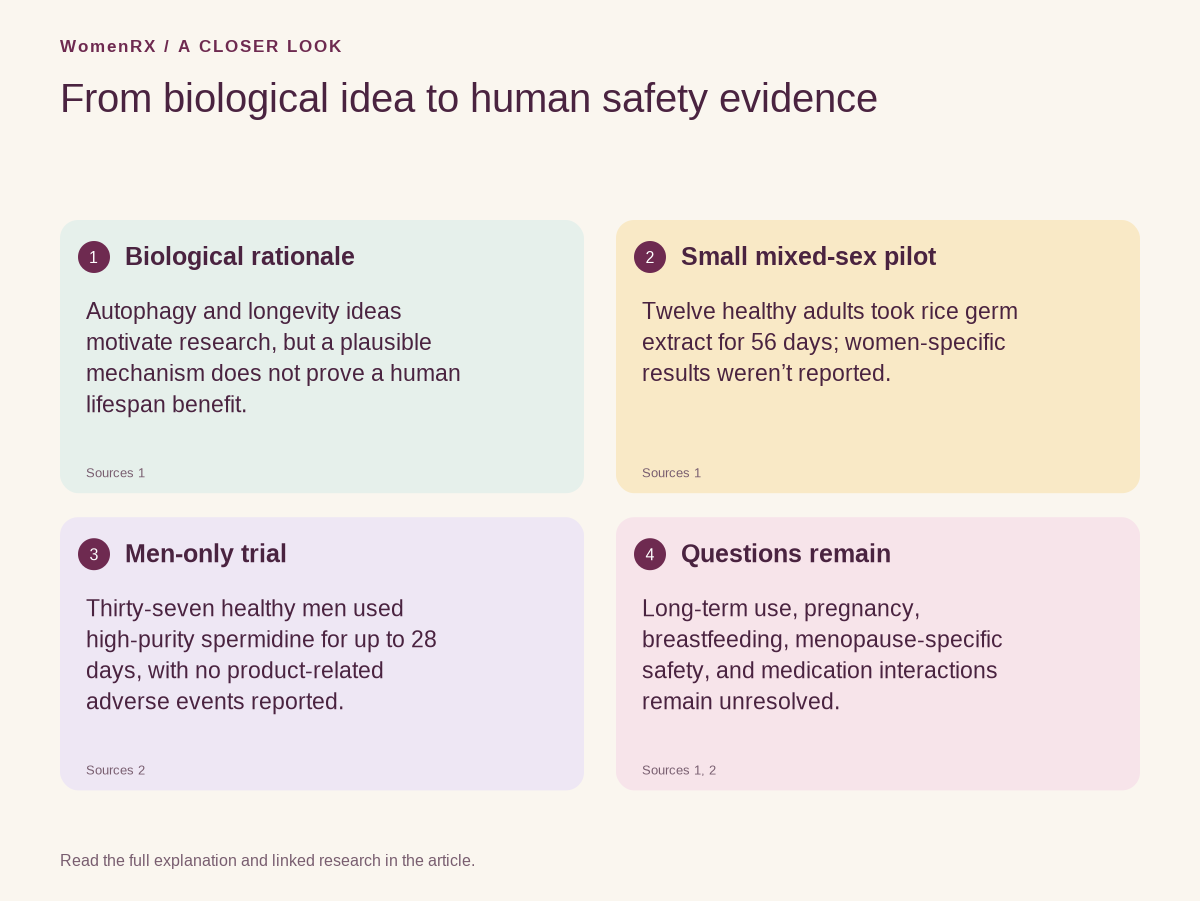
Biological rationale: Autophagy and longevity ideas motivate research, but a plausible mechanism does not prove a human lifespan benefit.1
Small mixed-sex pilot: Twelve healthy adults took rice germ extract for 56 days; women-specific results weren’t reported.1
Men-only trial: Thirty-seven healthy men used high-purity spermidine for up to 28 days, with no product-related adverse events reported.2
Questions remain: Long-term use, pregnancy, breastfeeding, menopause-specific safety, and medication interactions remain unresolved.12
Read the figure as text
The evidence moves from a proposed cell mechanism to brief studies in selected people, leaving important questions for women unanswered.- Biological rationale: Autophagy and longevity ideas motivate research, but a plausible mechanism does not prove a human lifespan benefit.1
- Small mixed-sex pilot: Twelve healthy adults took rice germ extract for 56 days; women-specific results weren’t reported.1
- Men-only trial: Thirty-seven healthy men used high-purity spermidine for up to 28 days, with no product-related adverse events reported.2
- Questions remain: Long-term use, pregnancy, breastfeeding, menopause-specific safety, and medication interactions remain unresolved.12
More questions, answered
Does research show that spermidine supplements extend lifespan in people?
The human studies described here measured short-term safety or biological and health markers, not whether people lived longer. Lifespan benefits aren’t established by these trials. 12
Is spermidine safety established after menopause?
No human menopause-specific safety result is reported in the described supplement studies. Research in estrogen-deprived female rats is preclinical and can’t answer whether a supplement is safe or beneficial for postmenopausal women. 45
Sources you can check
- Effects of Spermidine-Rich Rice Germ Extract Supplement on Biomarkers of Healthy Aging and Autophagy-Proof-of-Concept Pilot Study.Bruno G, La Monica M, Ziegenfuss TN. · Alternative therapies in health and medicine · 2025Return to first citation
- Supplementation of spermidine at 40 mg/day has minimal effects on circulating polyamines: An exploratory double-blind randomized controlled trial in older men.Keohane P, Everett JR, Pereira R, Cook CM, Blonquist TM, Mah E. · Nutrition research (New York, N.Y.) · 2024Return to first citation
- Oral Spermidine Supplementation Preserves Submandibular Gland Function After Radiotherapy: Mechanistic Insights and Use in a Phase II Randomized Clinical Trial.Min Y, Gao K, Liu Y, Dai L, Peng X. · MedComm · 2026Return to first citation
- Spermidine preserves cardiac systolic function in estrogen-deprived rats with accelerated aging via metabolic and mitochondrial reprogramming.Kaorop W, Maneechote C, Pratchayasakul W, Kumfu S, Arunsak B, Kongkaew A, Chattipakorn SC, Chattipakorn N. · Scientific reports · 2026Return to first citation
- Spermidine exerts cardiometabolic protection in estrogen-deprived rats via mitigating cardiac mitochondrial dysfunction and apoptosis.Kaorop W, Maneechote C, Pratchayasakul W, Kumfu S, Arunsak B, Kongkaew A, Chattipakorn SC, Chattipakorn N. · Toxicology and applied pharmacology · 2025Return to first citation