Spermidine Supplements: What We Know About Benefits and Timing
Human studies haven’t established an ideal time to take spermidine, and results for memory so far are mixed.
There’s no human evidence here showing that spermidine works better in the morning, evening, or with a meal. A 12-month trial of a wheat-germ spermidine supplement did not improve its primary memory outcome, while a smaller earlier trial suggested a possible benefit. Short safety studies offer limited reassurance, not proof of long-term benefit or safety. 2 4 5
Timing advice is ahead of the evidence
No cited human trial compared morning with evening use, or taking spermidine with food versus on an empty stomach. So there’s no clinically established “best time” to take it. One trial tested a multi-ingredient supplement before the first meal of the day, but because spermidine was combined with other ingredients, that study can’t show that this timing works for spermidine on its own. 6
That distinction matters when timing recommendations sound precise. A mechanism proposed in laboratory or animal research does not tell you what time a person should take a capsule, and it doesn’t establish a benefit you’d notice in everyday life.
What the human supplement trials found
The clearest longer-term test for memory was the 12-month SmartAge trial. It enrolled 100 adults aged 60 to 90 with subjective cognitive decline; 49 were women. Participants received either a wheat-germ extract providing 0.9 mg of spermidine daily or a placebo. The groups did not differ significantly on the primary memory measure or the reported secondary outcomes. Exploratory findings on verbal memory and inflammation were not established benefits. 2
A smaller, three-month pilot trial enrolled 30 older adults with subjective cognitive decline and tested a spermidine-rich plant extract. Its results suggested a possible memory benefit, but the study was small, and its authors called for a larger follow-up. The later 12-month trial did not confirm a benefit on its primary memory outcome. 4 2
Other trials answer narrower questions. In 12 healthy volunteers, five days of 15 mg daily did not increase blood spermidine levels compared with placebo, though spermine, a related compound, increased. That short study measured blood and saliva chemistry, not longevity, memory, or other lasting health outcomes. 3 A separate 28-day trial in 37 healthy men aged 50 to 70 found no significant changes in the reported clinical laboratory measures and no product-related adverse events. It was too short and too small to establish long-term effects. 1
Food research and supplements aren’t interchangeable
A trial of wheat-germ extract is still a trial of a supplement. It doesn’t tell you whether a particular eating pattern, or eating foods that contain spermidine, produces the same result. The products also differed across studies: some used plant extracts, while one tested highly purified spermidine. Findings from one preparation or dose shouldn’t automatically be applied to another. 1 2 5
Spermidine is studied partly because researchers propose it may affect processes such as autophagy, the cell’s way of breaking down and recycling components. That biological idea helps explain the interest in the compound; it isn’t proof that a supplement slows aging or prevents disease in people. The longer-term memory trial did not show improvement on its primary outcome. 2 3
What this means if you’re considering it
If your goal is better memory or longer life, current human evidence doesn’t establish that a spermidine supplement delivers that outcome. A small pilot signal and proposed mechanisms are reasons to keep studying it, not a reliable basis for expecting a benefit. Likewise, short-term tolerability in selected study participants can’t settle the question of long-term use. 1 2 4 5
The memory trial included nearly equal numbers of women and men, but the reported results don’t establish a women-specific effect. The other studies described here focused on older men, small groups of older adults, or healthy volunteers. Pregnancy and breastfeeding weren’t studied in these trials, so they don’t establish safety during those periods. 1 2 3 4 5
For now, taking spermidine at a particular hour is a preference, not an evidence-based way to improve results. And a supplement label’s timing suggestion should not be mistaken for proof that the timing has been tested.
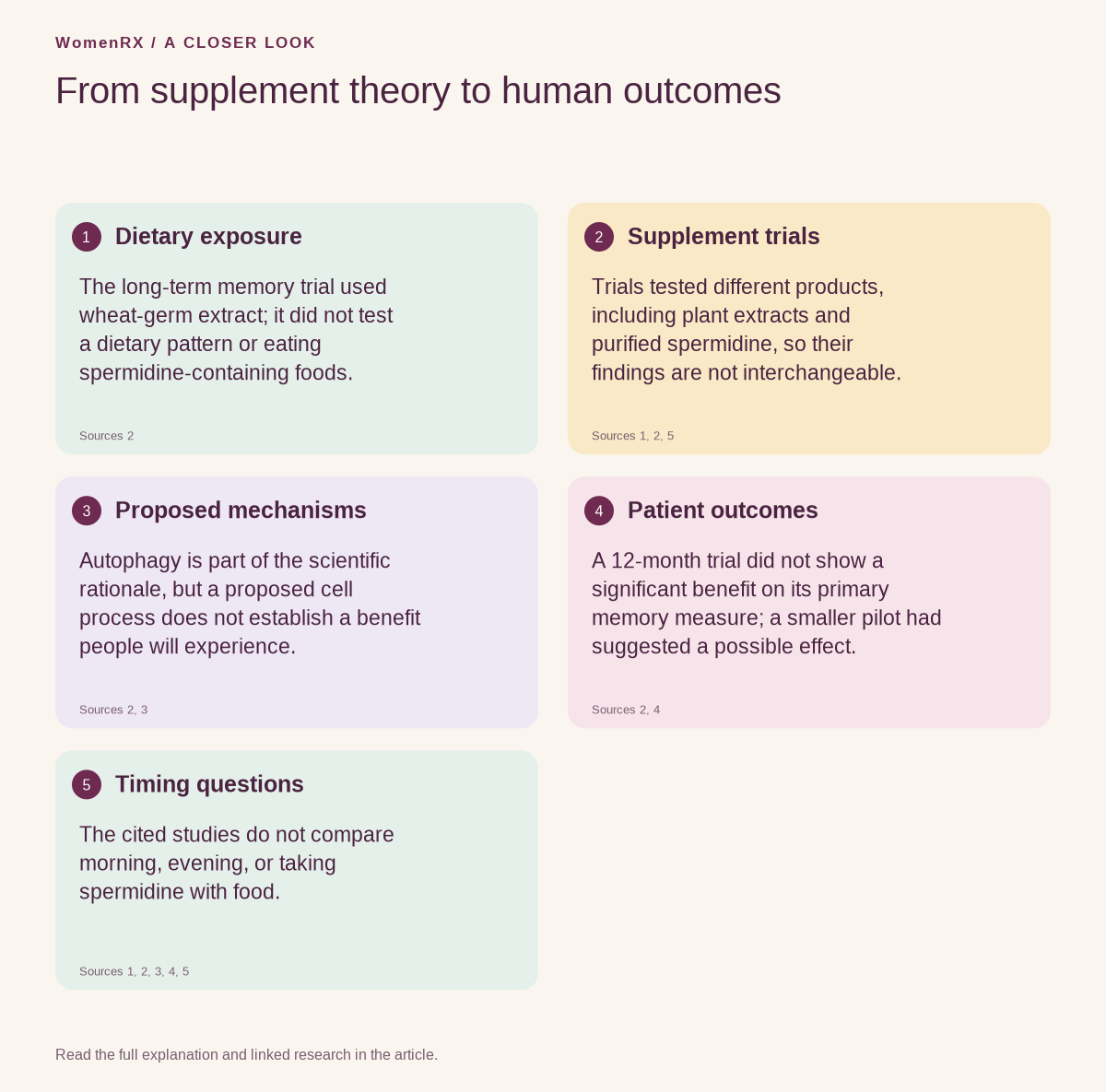
From supplement theory to human outcomes
Dietary exposure: The long-term memory trial used wheat-germ extract; it did not test a dietary pattern or eating spermidine-containing foods.2
Supplement trials: Trials tested different products, including plant extracts and purified spermidine, so their findings are not interchangeable.125
Proposed mechanisms: Autophagy is part of the scientific rationale, but a proposed cell process does not establish a benefit people will experience.23
Patient outcomes: A 12-month trial did not show a significant benefit on its primary memory measure; a smaller pilot had suggested a possible effect.24
Timing questions: The cited studies do not compare morning, evening, or taking spermidine with food.12345
Read the figure as text
These evidence categories answer different questions: a proposed mechanism or blood-marker change is not the same as a demonstrated health benefit.- Dietary exposure: The long-term memory trial used wheat-germ extract; it did not test a dietary pattern or eating spermidine-containing foods.2
- Supplement trials: Trials tested different products, including plant extracts and purified spermidine, so their findings are not interchangeable.125
- Proposed mechanisms: Autophagy is part of the scientific rationale, but a proposed cell process does not establish a benefit people will experience.23
- Patient outcomes: A 12-month trial did not show a significant benefit on its primary memory measure; a smaller pilot had suggested a possible effect.24
- Timing questions: The cited studies do not compare morning, evening, or taking spermidine with food.12345
More questions, answered
Does spermidine need to be taken with food?
The human studies summarized here don’t compare taking spermidine with food against taking it without food, so they don’t establish a preferred approach.
Does spermidine supplementation improve memory?
A small pilot trial suggested a possible benefit, but a larger 12-month trial did not find a significant benefit on its primary memory outcome. The evidence does not establish spermidine as a memory treatment. 2 4
Sources you can check
- Supplementation of spermidine at 40 mg/day has minimal effects on circulating polyamines: An exploratory double-blind randomized controlled trial in older men.Keohane P, Everett JR, Pereira R, Cook CM, Blonquist TM, Mah E. · Nutrition research (New York, N.Y.) · 2024Return to first citation
- Effects of Spermidine Supplementation on Cognition and Biomarkers in Older Adults With Subjective Cognitive Decline: A Randomized Clinical Trial.Schwarz C, Benson GS, Horn N, Wurdack K, Grittner U, Schilling R, Märschenz S, Köbe T, Hofer SJ, Magnes C, Stekovic S, Eisenberg T, Sigrist SJ, Schmitz D, Wirth M, Madeo F, Flöel A... · JAMA network open · 2022Return to first citation
- High-Dose Spermidine Supplementation Does Not Increase Spermidine Levels in Blood Plasma and Saliva of Healthy Adults: A Randomized Placebo-Controlled Pharmacokinetic and Metabolomic Study.Senekowitsch S, Wietkamp E, Grimm M, Schmelter F, Schick P, Kordowski A, Sina C, Otzen H, Weitschies W, Smollich M. · Nutrients · 2023Return to first citation
- The effect of spermidine on memory performance in older adults at risk for dementia: A randomized controlled trial.Wirth M, Benson G, Schwarz C, Köbe T, Grittner U, Schmitz D, Sigrist SJ, Bohlken J, Stekovic S, Madeo F, Flöel A. · Cortex; a journal devoted to the study of the nervous system and behavior · 2018Return to first citation
- Safety and tolerability of spermidine supplementation in mice and older adults with subjective cognitive decline.Schwarz C, Stekovic S, Wirth M, Benson G, Royer P, Sigrist SJ, Pieber T, Dammbrueck C, Magnes C, Eisenberg T, Pendl T, Bohlken J, Köbe T, Madeo F, Flöel A. · Aging · 2018Return to first citation
- A novel fasting mimetic (Mimio) creates fasting-like benefits to hunger control, oxidative stress, and cardiometabolic health in humans.Grant AD, Erfe MCB, Kazaryan A, Oliver PL, Moos J, Luna V, Craft N, Rhodes CH. · Scientific reports · 2026Return to first citation