What Human Studies Actually Show About Spermidine
Spermidine has intriguing biology, but the human studies discussed here do not establish that supplements extend lifespan or reliably improve memory.
So far, the clearest human test for cognition found no significant memory benefit after 12 months in older adults with subjective cognitive decline. A small pilot reported changes in selected blood biomarkers, not proven improvements in health or longevity. A separate trial tested spermidine as one ingredient in a multi-ingredient product, so its results can’t show what spermidine alone does. 1 3 4
Spermidine is a naturally occurring compound found in the body and in foods. Researchers are interested in how it may affect processes such as autophagy, the way cells break down and recycle components. That makes it biologically interesting. It doesn’t establish that taking a supplement will help you live longer, think more clearly, or prevent disease.
For a product marketed for longevity or cognition, the most useful question is whether people taking a comparable product did better on an outcome that matters to them. The human evidence so far gives a limited answer: one year of a wheat germ extract did not significantly improve the main memory measure tested in older adults with subjective cognitive decline. 1
A yearlong memory trial found no significant benefit
In the SmartAge trial, 100 adults aged 60 to 90 with subjective cognitive decline were randomly assigned to a spermidine-rich wheat germ extract or placebo for 12 months. The extract provided about 0.9 mg of spermidine per day. The primary outcome was performance on a test of mnemonic discrimination, a specific aspect of memory. At 12 months, the difference between the groups was not statistically significant. The trial also found no significant differences in its secondary outcomes. 1
That is more informative than a change in a lab marker because the study directly measured memory. It still answers a narrow question: this particular extract and amount, in this study population, did not significantly change the primary memory test over one year. It does not settle every possible formulation or outcome. Exploratory findings for verbal memory and inflammation were described as possible signals needing validation, not established benefits. 1
Women made up 49% of the trial, but the reported findings here don’t establish a separate benefit for women. The study was of older adults with subjective cognitive decline, not a general test of supplements in younger women or people without memory concerns. 1
Small biomarker studies aren’t proof of longer life
A 2025 pilot study randomly assigned 12 healthy men and women to one of two daily amounts of spermidine from rice germ extract for 56 days. At the higher amount, the researchers reported increases from baseline in Beclin-1, ULK-1, and BDNF, along with changes in some cardiometabolic markers. But the study was very small, and its abstract reports comparisons with participants’ own baseline, not a placebo-group benefit. These are biomarker findings, not evidence that participants lived longer, had better memory, or avoided disease. The abstract does not give the participants’ sex breakdown or report sex-specific effects. 4
The distinction matters because proposed effects on cellular processes and findings in animals are not the same as a demonstrated human outcome. A change in a marker associated with autophagy doesn’t by itself show that a supplement meaningfully improves health. Human studies would need to show that people experience a relevant benefit, not just that a marker changes. 2 4
There is also a human trial of a product containing spermidine alongside nicotinamide, PEA, and OEA. It studied 42 overweight older adults with elevated HbA1c for eight weeks. Some hunger, satiety, and blood-marker results favored the combination, but cognitive failures did not differ significantly from placebo. Because the product had several active ingredients, the results cannot be attributed to spermidine alone. Women made up 47.6% of participants, but the reported results do not give sex-specific effects. 3
The product formulation changes what you can conclude
The trials didn’t test one interchangeable ingredient in one standard form. The cognition study used a wheat germ extract providing about 0.9 mg of spermidine daily; the small biomarker pilot used rice germ extract and tested two amounts. The multi-ingredient study used a different combination product. A result from one of these preparations doesn’t automatically apply to a product with a different source, amount, or set of ingredients. 1 3 4
Spermidine is also present in foods, but food-source and supplement evidence aren’t interchangeable. The human studies discussed here don’t establish that eating spermidine-containing foods or taking a supplement extends lifespan, and they don’t establish that a supplement reproduces the effects of a particular diet. 3
A practical way to judge a longevity claim
When you look at a product, check what the study actually tested: the form of spermidine, the amount stated as spermidine rather than just total extract, the people enrolled, and the outcome measured. Then ask whether the study showed a meaningful difference from placebo or only a change from baseline in a biomarker. If spermidine was part of a blend, don’t treat the blend’s result as proof for spermidine by itself.
The human studies discussed here do not establish that spermidine supplements extend lifespan. The best directly relevant cognition trial did not find a significant benefit on its main memory outcome, while smaller studies offer early biomarker findings that need confirmation. That’s a reason to be cautious about confident longevity or cognition promises, not a reason to assume every future study will be negative. 1 4
From proposed mechanism to human outcome
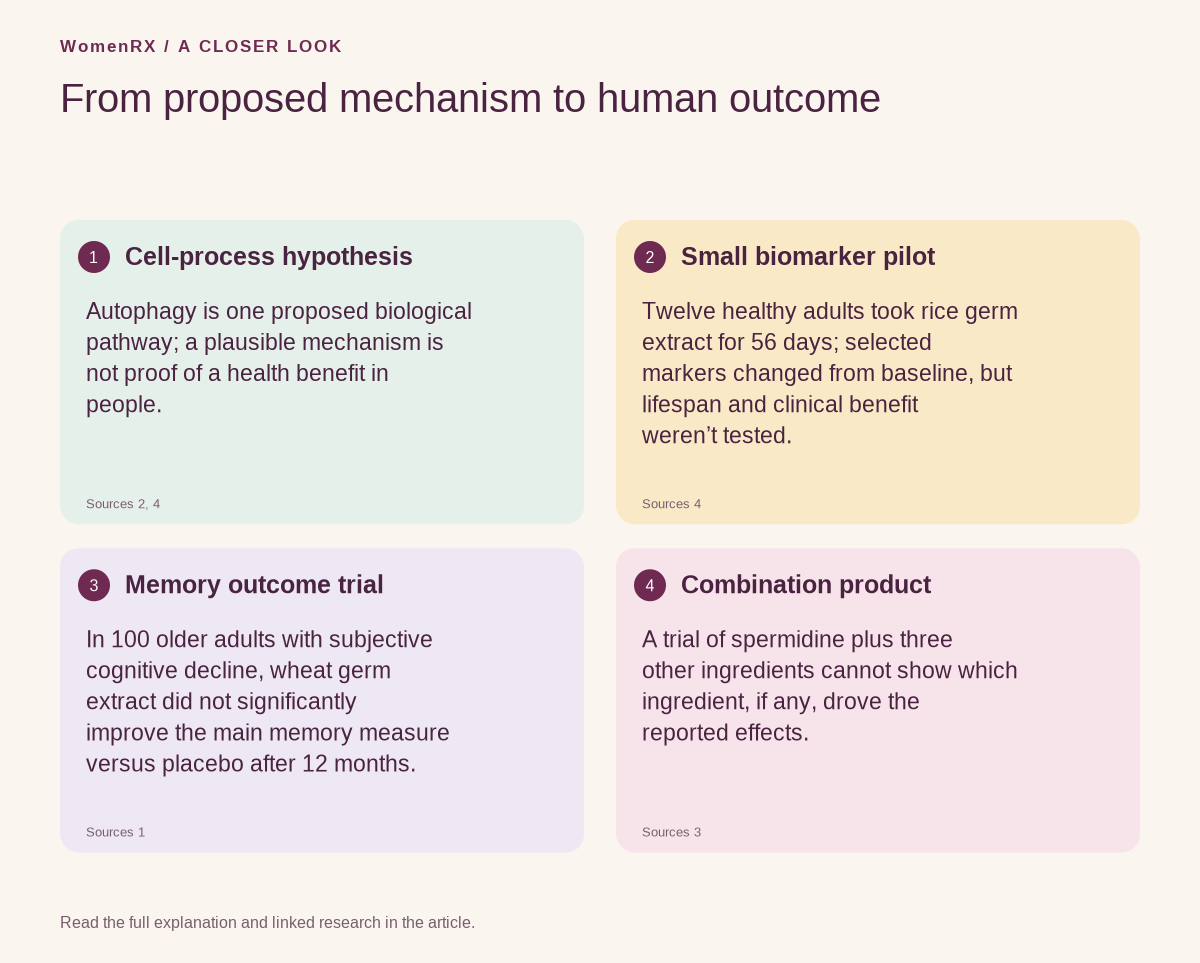
Cell-process hypothesis: Autophagy is one proposed biological pathway; a plausible mechanism is not proof of a health benefit in people.24
Small biomarker pilot: Twelve healthy adults took rice germ extract for 56 days; selected markers changed from baseline, but lifespan and clinical benefit weren’t tested.4
Memory outcome trial: In 100 older adults with subjective cognitive decline, wheat germ extract did not significantly improve the main memory measure versus placebo after 12 months.1
Combination product: A trial of spermidine plus three other ingredients cannot show which ingredient, if any, drove the reported effects.3
Read the figure as text
These studies sit at different points on the evidence path: a biological hypothesis, small biomarker findings, and a longer trial measuring memory directly.- Cell-process hypothesis: Autophagy is one proposed biological pathway; a plausible mechanism is not proof of a health benefit in people.24
- Small biomarker pilot: Twelve healthy adults took rice germ extract for 56 days; selected markers changed from baseline, but lifespan and clinical benefit weren’t tested.4
- Memory outcome trial: In 100 older adults with subjective cognitive decline, wheat germ extract did not significantly improve the main memory measure versus placebo after 12 months.1
- Combination product: A trial of spermidine plus three other ingredients cannot show which ingredient, if any, drove the reported effects.3
More questions, answered
Does spermidine from food have the same evidence as a supplement?
No. Spermidine occurs in foods, but these studies tested specific extracts or a multi-ingredient supplement. They don’t establish that food sources and supplements produce the same effects, or that either extends human lifespan. 1 3 4
Did the cognition trial show a separate benefit for women?
Women were 49% of the 100 participants, but the reported results don’t establish a separate effect for women. The trial’s overall primary memory result was not significantly different between supplement and placebo. 1
Sources you can check
- Effects of Spermidine Supplementation on Cognition and Biomarkers in Older Adults With Subjective Cognitive Decline: A Randomized Clinical Trial.Schwarz C, Benson GS, Horn N, Wurdack K, Grittner U, Schilling R, Märschenz S, Köbe T, Hofer SJ, Magnes C, Stekovic S, Eisenberg T, Sigrist SJ, Schmitz D, Wirth M, Madeo F, Flöel A... · JAMA network open · 2022Return to first citation
- Safety and tolerability of spermidine supplementation in mice and older adults with subjective cognitive decline.Schwarz C, Stekovic S, Wirth M, Benson G, Royer P, Sigrist SJ, Pieber T, Dammbrueck C, Magnes C, Eisenberg T, Pendl T, Bohlken J, Köbe T, Madeo F, Flöel A. · Aging · 2018Return to first citation
- A novel fasting mimetic (Mimio) creates fasting-like benefits to hunger control, oxidative stress, and cardiometabolic health in humans.Grant AD, Erfe MCB, Kazaryan A, Oliver PL, Moos J, Luna V, Craft N, Rhodes CH. · Scientific reports · 2026Return to first citation
- Effects of Spermidine-Rich Rice Germ Extract Supplement on Biomarkers of Healthy Aging and Autophagy-Proof-of-Concept Pilot Study.Bruno G, La Monica M, Ziegenfuss TN. · Alternative therapies in health and medicine · 2025Return to first citation