L-Theanine Benefits: What Human Studies Actually Show
Human studies have tested stress ratings, sleep measures, and performance on attention tasks, but the results don’t establish a broad or women-specific benefit.
L-theanine has been studied in people for perceived stress, sleep, and performance on cognitive tests. The findings are mixed: one small adult trial reported improved sleep quality but also mixed sleep-monitor results, and its stress-rating changes were similar to placebo. Cognitive changes were tied to specific tasks. Results that include women don’t establish a women-specific effect. 2 3
L-theanine is promoted for feeling calmer, sleeping better, and focusing. Human studies have examined all three, but a change on a questionnaire or a timed computer task doesn’t necessarily mean a lasting improvement in everyday life. So far, the evidence is narrow and mixed, not proof of a general-purpose benefit. 2 3
Stress: a small trial, with a close placebo comparison
In a randomized, placebo-controlled trial, 30 healthy adults with moderate stress took L-theanine or placebo for 28 days, with 15 people in each group. Researchers measured stress using questionnaires and salivary cortisol. 2
Perceived Stress Scale scores fell in both groups. At day 28, the reported decrease was 17.98% with L-theanine and 17.88% with placebo. The report gives significance tests for changes within each group, but those very similar decreases don’t show a clear advantage over placebo. Salivary cortisol also didn’t differ significantly between groups. 2
This is a useful distinction when you see a claim that L-theanine lowers stress: a score improving among people who took a supplement is not, by itself, evidence that the supplement caused the improvement. The placebo comparison is what helps separate a supplement effect from changes that may happen over time or during a study.
Sleep: reported quality and monitor readings differed
The same trial assessed sleep with a questionnaire and an actigraphy device. The researchers reported improved sleep quality, but the monitor findings weren’t uniformly favorable: time asleep decreased in the L-theanine group after 28 days, while light sleep was reduced compared with placebo. Because these measures point in different directions, the results don’t establish a simple or consistent sleep benefit. 2
A separate systematic review of treatments for sleep problems in children with ADHD included one L-theanine randomized trial. The review said improvements in sleep-onset time and total sleep duration had been reported, but judged the overall evidence for the medicines reviewed to be generally poor. That pediatric finding can’t establish a benefit for adult women, or for people without ADHD. 1
Focus: test results aren’t the same as everyday function
A randomized, placebo-controlled study enrolled Japanese men and women aged 50 to 69. After a single dose, participants performed better on selected attention and working-memory measures, including parts of computerized tasks. After 12 weeks of regular intake, the study did not find an effect on the attention processes it assessed. 3
In the 28-day adult stress trial, a Stroop attention measure also improved in the L-theanine group at two measurement points, while the placebo group improved at the later point. That is a signal worth studying, not proof that L-theanine reliably improves focus in daily life. The trial was small, and a computer test measures a particular kind of performance under test conditions. 2
What the findings mean for women
One cognition study explicitly enrolled both men and women, but its reported results don’t establish whether the effects differed by sex. The adult stress-trial findings also don’t establish a women-specific effect. It’s more accurate to describe these as limited findings in adult study groups, rather than evidence that L-theanine has a proven benefit for women in particular. 2 3
The practical takeaway: treat claims about calm, sleep, or focus as questions researchers have tested, not outcomes that are settled. The stress results don’t show a clear placebo advantage, sleep findings are mixed, and cognitive findings concern selected tests rather than lasting everyday changes. 1 2 3
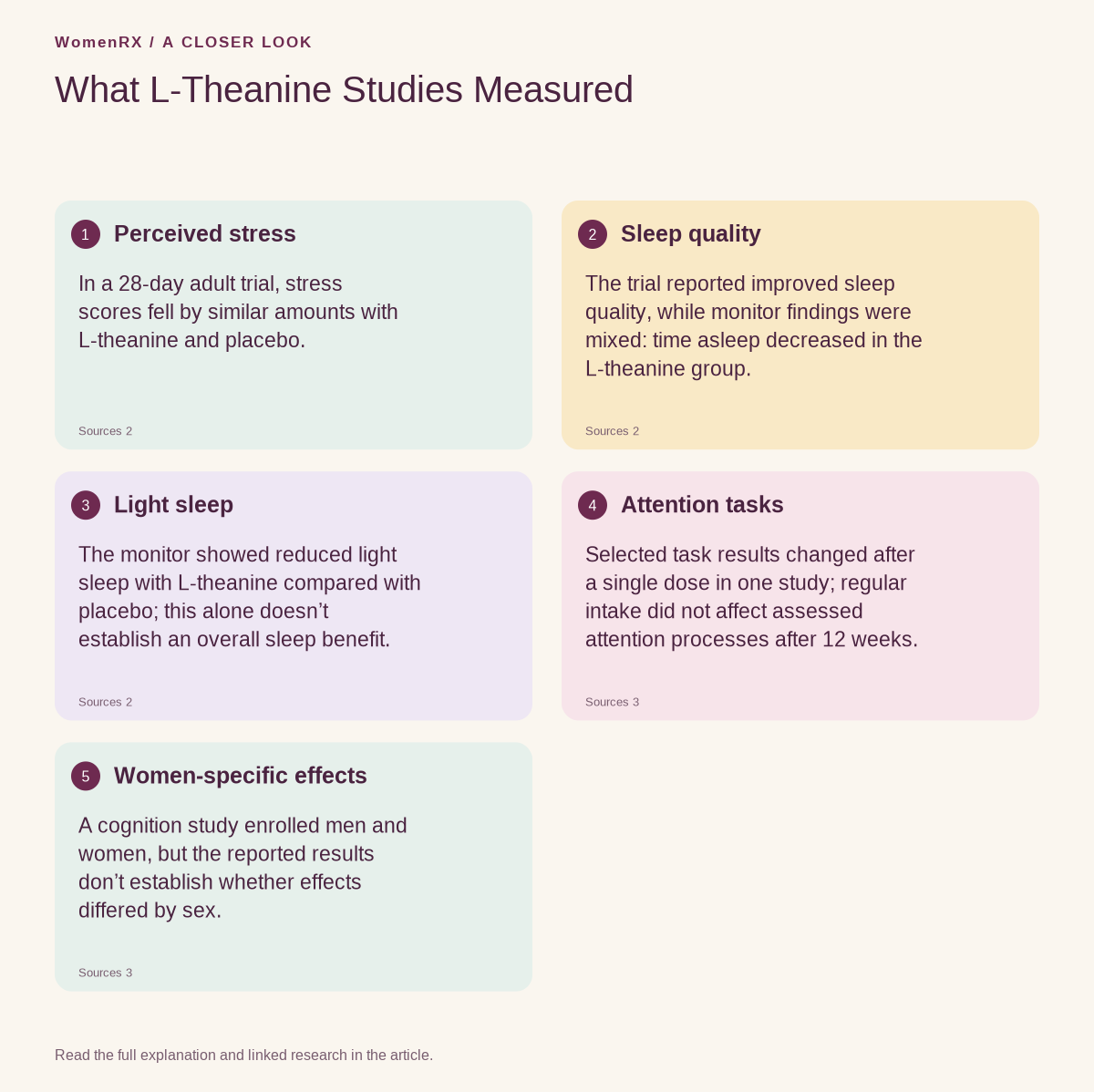
What L-Theanine Studies Measured
Perceived stress: In a 28-day adult trial, stress scores fell by similar amounts with L-theanine and placebo.2
Sleep quality: The trial reported improved sleep quality, while monitor findings were mixed: time asleep decreased in the L-theanine group.2
Light sleep: The monitor showed reduced light sleep with L-theanine compared with placebo; this alone doesn’t establish an overall sleep benefit.2
Attention tasks: Selected task results changed after a single dose in one study; regular intake did not affect assessed attention processes after 12 weeks.3
Women-specific effects: A cognition study enrolled men and women, but the reported results don’t establish whether effects differed by sex.3
Read the figure as text
The tested outcomes differ: a stress rating, sleep-quality reports, sleep-monitor readings, and performance on specific cognitive tasks do not answer the same question.- Perceived stress: In a 28-day adult trial, stress scores fell by similar amounts with L-theanine and placebo.2
- Sleep quality: The trial reported improved sleep quality, while monitor findings were mixed: time asleep decreased in the L-theanine group.2
- Light sleep: The monitor showed reduced light sleep with L-theanine compared with placebo; this alone doesn’t establish an overall sleep benefit.2
- Attention tasks: Selected task results changed after a single dose in one study; regular intake did not affect assessed attention processes after 12 weeks.3
- Women-specific effects: A cognition study enrolled men and women, but the reported results don’t establish whether effects differed by sex.3
More questions, answered
Can a study in children with ADHD show that L-theanine helps adult women sleep?
No. A review found that sleep improvements had been reported in one L-theanine trial involving children with ADHD, while judging the overall evidence it reviewed to be generally poor. Those results don’t establish an effect in adult women or other groups. 1
Sources you can check
- Safety, Tolerability and Efficacy of Drugs for Treating Behavioural Insomnia in Children with Attention-Deficit/Hyperactivity Disorder: A Systematic Review with Methodological Quality Assessment.Anand S, Tong H, Besag FMC, Chan EW, Cortese S, Wong ICK. · Paediatric drugs · 2017Return to first citation
- Safety and Efficacy of AlphaWave® L-Theanine Supplementation for 28 Days in Healthy Adults with Moderate Stress: A Randomized, Double-Blind, Placebo-Controlled Trial.Moulin M, Crowley DC, Xiong L, Guthrie N, Lewis ED. · Neurology and therapy · 2024Return to first citation
- Effects of l-Theanine on Cognitive Function in Middle-Aged and Older Subjects: A Randomized Placebo-Controlled Study.Baba Y, Inagaki S, Nakagawa S, Kaneko T, Kobayashi M, Takihara T. · Journal of medicinal food · 2021Return to first citation