L-Theanine for Stress and Sleep: What Human Trials Show
Small trials offer some encouraging signals, but they don’t yet show that L-theanine reliably improves stress or sleep beyond placebo.
Human trials of L-theanine alone have reported improvements in some self-rated stress and sleep measures, but the studies are small and their results aren’t consistent. In a 28-day trial, perceived stress fell by almost the same amount with L-theanine and placebo, and some sleep measurements moved in an unfavorable direction. Results from combination products can’t tell you what L-theanine itself did. 1 2 3
The clearest answer: possible effects, not a proven fix
L-theanine has been tested on its own in a few small studies of adults, with some improvements in self-reported stress or sleep. That’s a reason for interest, not strong evidence that it treats anxiety or insomnia. The trials differ in participants, product, and what they measured, and they don’t point to a dependable benefit for everyone.
A 2019 placebo-controlled crossover trial studied 30 healthy adults, including 21 women. After four weeks of L-theanine, participants’ scores on several stress-related measures and the overall Pittsburgh Sleep Quality Index (PSQI) fell. However, the report describes the overall score changes after L-theanine, while the clearest stated comparisons with placebo were for specific sleep subscales. The study was small and did not report whether women responded differently from men. 1
A later placebo-controlled trial assigned 30 adults with moderate stress to L-theanine or placebo for 28 days. Perceived stress scores fell 17.98% in the L-theanine group and 17.88% in the placebo group. The near-identical changes make it hard to credit L-theanine for a distinct stress benefit in this trial. Salivary cortisol also did not differ significantly between groups. 2
Sleep results don’t all point the same way
In the 2019 study, some PSQI subscales, including sleep latency and sleep disturbance, improved compared with placebo. These are questionnaire measures, not proof that L-theanine treats insomnia. 1
In the 28-day trial, L-theanine was associated with less light sleep than placebo, but participants also spent less time asleep after 28 days. Those findings don’t add up to a straightforward improvement in sleep. A favorable change in one sleep measure shouldn’t be treated as evidence that sleep as a whole improved. 2
The practical distinction is that “relaxation,” perceived stress, sleep quality, and time asleep are different outcomes. Feeling calmer, scoring differently on a questionnaire, and sleeping longer aren’t interchangeable claims. These studies don’t establish a reliable effect on all of them.
Check whether a product is standalone or a blend
A combination study can’t show that L-theanine caused the result. For example, one trial tested a product containing magnesium, B vitamins, Rhodiola, and green tea extract that included L-theanine. The study reported a change in stress scores, but the ingredients were given together. It can’t separate the contribution of L-theanine from the other ingredients or their combination. 3
That matters when reading a label or a product claim: evidence about a multi-ingredient blend is not evidence that L-theanine alone produces the same outcome. The trials described here also don’t compare standalone L-theanine directly with combination products.
What the studies can’t answer for women
The 2019 trial included more women than men, but it did not report a separate result for women. The 2024 trial also studied adults but excluded people who were pregnant or breastfeeding. These studies therefore don’t establish whether effects differ by sex, or whether L-theanine is safe or effective during pregnancy or breastfeeding. They also don’t provide menopause-specific evidence. 1 2
Short studies in small groups can’t settle long-term safety or how L-theanine might interact with a person’s medicines. The 2024 trial monitored adverse events for 28 days in 30 adults; that’s useful short-term information, but not a broad safety assessment. If you’re considering a supplement while pregnant, breastfeeding, taking medication, or managing a health condition, the available trial results don’t answer the safety question for your situation. 2
A useful way to judge the claim
Before treating an L-theanine claim as meaningful, ask three questions: Was L-theanine the only active ingredient? Did the study compare it with placebo, and were the changes actually different between groups? And did researchers measure the outcome you care about, such as perceived stress or time asleep? For now, human evidence offers limited signals on selected measures, not a dependable treatment for anxiety or insomnia.
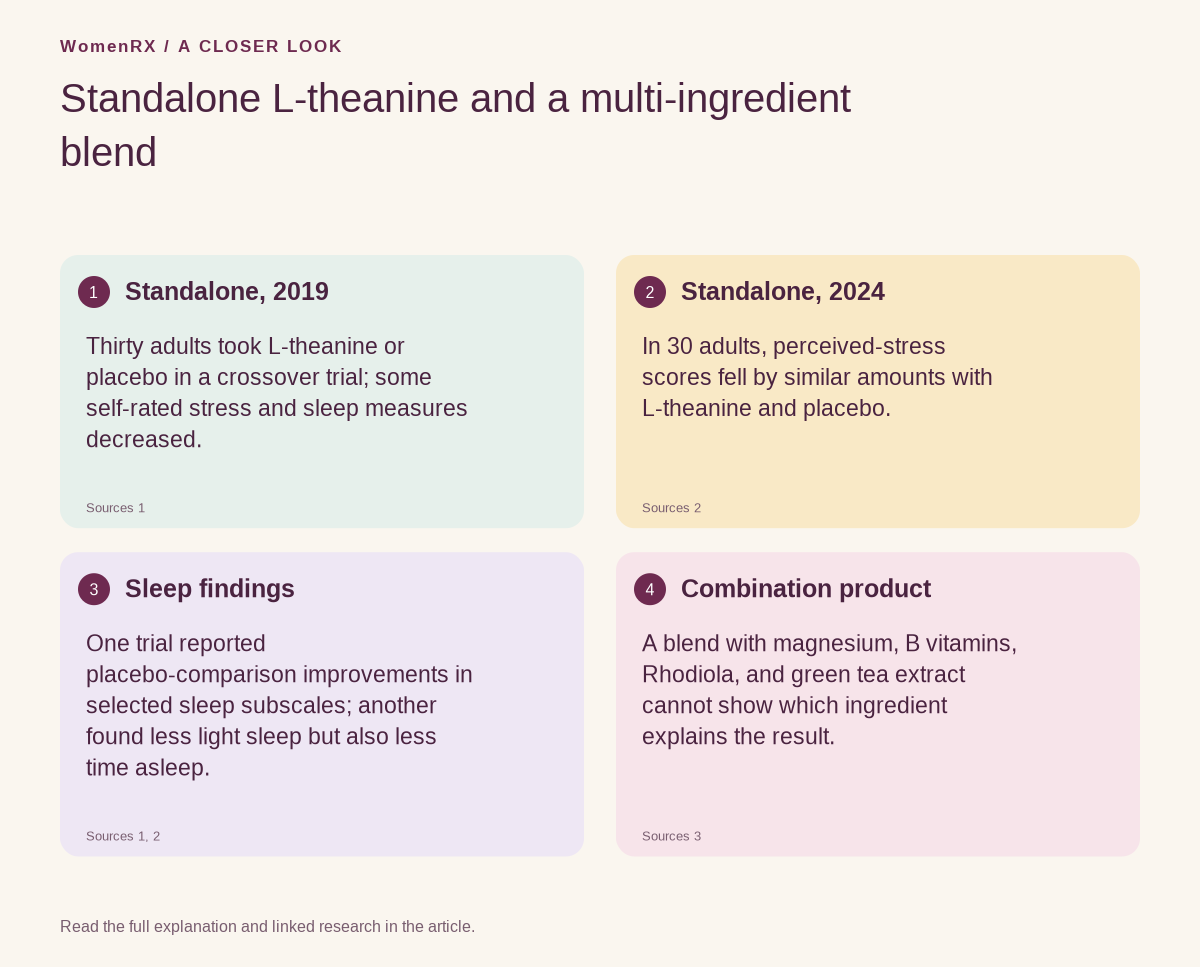
Standalone L-theanine and a multi-ingredient blend
Standalone, 2019: Thirty adults took L-theanine or placebo in a crossover trial; some self-rated stress and sleep measures decreased.1
Standalone, 2024: In 30 adults, perceived-stress scores fell by similar amounts with L-theanine and placebo.2
Sleep findings: One trial reported placebo-comparison improvements in selected sleep subscales; another found less light sleep but also less time asleep.12
Combination product: A blend with magnesium, B vitamins, Rhodiola, and green tea extract cannot show which ingredient explains the result.3
Read the figure as text
These studies differ in whether L-theanine was tested alone and in which stress or sleep measures changed.- Standalone, 2019: Thirty adults took L-theanine or placebo in a crossover trial; some self-rated stress and sleep measures decreased.1
- Standalone, 2024: In 30 adults, perceived-stress scores fell by similar amounts with L-theanine and placebo.2
- Sleep findings: One trial reported placebo-comparison improvements in selected sleep subscales; another found less light sleep but also less time asleep.12
- Combination product: A blend with magnesium, B vitamins, Rhodiola, and green tea extract cannot show which ingredient explains the result.3
More questions, answered
Does L-theanine have evidence for treating anxiety or insomnia?
The trials discussed here studied healthy adults or adults with moderate stress, not treatment of diagnosed anxiety disorders or insomnia. Their findings don’t establish L-theanine as a treatment for either condition. 1 2
Do these studies establish safety during pregnancy or breastfeeding?
No. Pregnant participants were excluded from the 2019 trial, and the 2024 trial excluded people who were pregnant or breastfeeding. Those studies can’t answer safety in either situation. 1 2
Sources you can check
- Effects of L-Theanine Administration on Stress-Related Symptoms and Cognitive Functions in Healthy Adults: A Randomized Controlled Trial.Hidese S, Ogawa S, Ota M, Ishida I, Yasukawa Z, Ozeki M, Kunugi H. · Nutrients · 2019Return to first citation
- Safety and Efficacy of AlphaWave® L-Theanine Supplementation for 28 Days in Healthy Adults with Moderate Stress: A Randomized, Double-Blind, Placebo-Controlled Trial.Moulin M, Crowley DC, Xiong L, Guthrie N, Lewis ED. · Neurology and therapy · 2024Return to first citation
- Assessing brain function in stressed healthy individuals following the use of a combination of green tea, Rhodiola, magnesium, and B vitamins: an fMRI study.Pickering G, Noah L, Pereira B, Goubayon J, Leray V, Touron A, Macian N, Bernard L, Dualé C, Roux V, Chassain C. · Frontiers in nutrition · 2023Return to first citation