When to Take L-Theanine for Focus or Sleep
A study’s schedule tells you what researchers tested, not when L-theanine works best for you.
There isn’t a proven best time of day to take L-theanine for focus or sleep. One small study assessed attention after a single dose, while other trials looked at daily use over weeks. A sleep trial used a Lactium-and-L-theanine combination before bed, so it can’t show whether L-theanine alone helps sleep or whether bedtime is the best timing. 1 2 3 4
Let your goal guide how you read the studies
If you’re weighing L-theanine for focus, relaxation, or sleep, the clock is only one part of the question. Studies have tested different ingredients, schedules, and outcomes. A result measured after one dose doesn’t answer what happens with regular use, and a bedtime routine tested in a combination product can’t establish the best timing for L-theanine by itself.
For focus, one-dose results are specific to the tests
A randomized, placebo-controlled study included Japanese men and women ages 50 to 69. Researchers assessed cognition after a single dose and again after 12 weeks of regular intake. The abstract reports faster reaction time on one attention task and changes on a working-memory task after the single dose. Those test results don’t establish that L-theanine reliably improves everyday concentration, or how long before work or studying to take it. 3
A separate randomized trial followed 30 healthy adults with moderate stress for 28 days. It included cognition measures and reported a change in Stroop reaction time in the L-theanine group. That small study doesn’t establish a predictable focus benefit or test a particular time of day. 4
For sleep, bedtime has been studied, but not established as best
In an eight-week randomized trial, 40 adults with sleep discomfort received either a product containing Lactium and L-theanine or a placebo. The combination was taken one hour before bedtime. The groups did not differ significantly on the main sleep-quality and insomnia-scale measures, although some sleep-diary measures differed. Because both ingredients were in the active product, the results can’t identify L-theanine’s separate effect. The bedtime schedule is what the trial tested, not proof of an optimal bedtime window. 2
Another trial tested L-theanine alongside stable antidepressant treatment in 46 people with generalized anxiety disorder. Over the eight-week placebo-controlled period, L-theanine did not outperform placebo on overall anxiety reduction or insomnia severity. A self-reported sleep-satisfaction item favored L-theanine, but that narrower result doesn’t establish a general sleep benefit or a particular time to take it. 1
Acute and repeated use answer different questions
A study that measures an outcome after one dose asks whether a short-term effect appears on that measure. A trial that assesses people after regular use for weeks asks about a longer-term pattern. Neither schedule automatically tells you what to expect from the other. In particular, a single-dose attention result doesn’t predict sleep that night, and a weeks-long study doesn’t establish an immediate effect before a task. 1 3 4
When you see a timing claim, check three things: whether the study tested L-theanine alone or alongside another ingredient; whether it measured an outcome after one dose or after repeated use; and what it actually measured, such as a specific attention test, sleep diary, or insomnia scale. These details help distinguish a study’s limited finding from a broader promise about focus or sleep.
What’s known about women
The focus study included men and women, but its abstract doesn’t report separate results for women. The 28-day stress trial’s abstract also doesn’t provide sex-specific results. Neither study description establishes what to expect during pregnancy or breastfeeding. So these findings shouldn’t be treated as evidence of a women-specific effect or as evidence for those life stages. 3 4
The practical takeaway: no tested schedule establishes the best time of day for L-theanine. The single-dose focus findings, longer-term trials, and bedtime combination study answer different questions, so match any claim you encounter to the exact outcome and product studied.
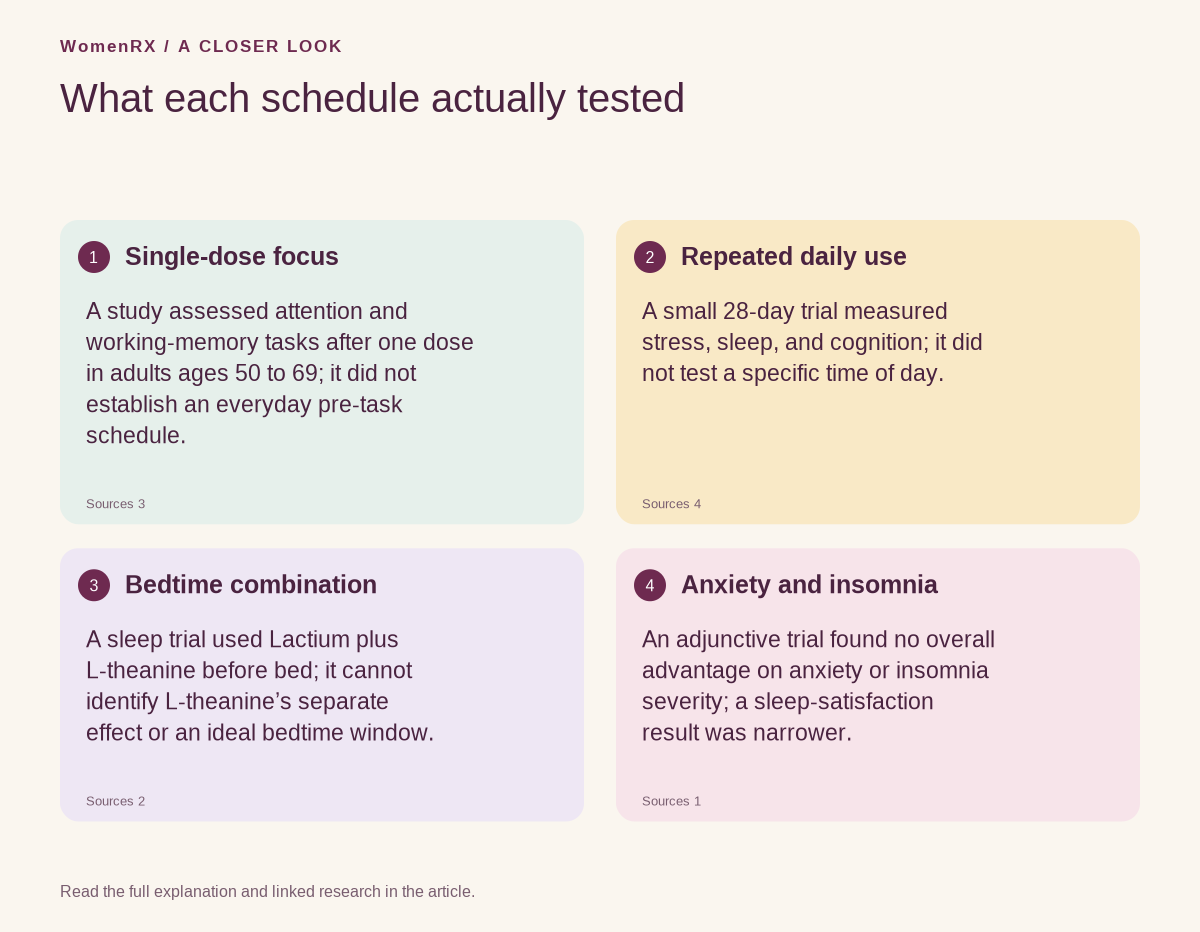
What each schedule actually tested
Single-dose focus: A study assessed attention and working-memory tasks after one dose in adults ages 50 to 69; it did not establish an everyday pre-task schedule.3
Repeated daily use: A small 28-day trial measured stress, sleep, and cognition; it did not test a specific time of day.4
Bedtime combination: A sleep trial used Lactium plus L-theanine before bed; it cannot identify L-theanine’s separate effect or an ideal bedtime window.2
Anxiety and insomnia: An adjunctive trial found no overall advantage on anxiety or insomnia severity; a sleep-satisfaction result was narrower.1
Read the figure as text
Compare the ingredient, schedule, and measured outcome before applying a study result to your own goal.- Single-dose focus: A study assessed attention and working-memory tasks after one dose in adults ages 50 to 69; it did not establish an everyday pre-task schedule.3
- Repeated daily use: A small 28-day trial measured stress, sleep, and cognition; it did not test a specific time of day.4
- Bedtime combination: A sleep trial used Lactium plus L-theanine before bed; it cannot identify L-theanine’s separate effect or an ideal bedtime window.2
- Anxiety and insomnia: An adjunctive trial found no overall advantage on anxiety or insomnia severity; a sleep-satisfaction result was narrower.1
More questions, answered
Does taking it before bed have evidence behind it?
A small trial tested a Lactium-and-L-theanine combination one hour before bed, but the main sleep-quality and insomnia measures didn’t differ significantly between groups. Since the product combined ingredients, it also can’t show that L-theanine alone was responsible for any diary-measure changes. 2
Sources you can check
- L-theanine in the adjunctive treatment of generalized anxiety disorder: A double-blind, randomised, placebo-controlled trial.Sarris J, Byrne GJ, Cribb L, Oliver G, Murphy J, Macdonald P, Nazareth S, Karamacoska D, Galea S, Short A, Ee C, Birling Y, Menon R, Ng CH. · Journal of psychiatric research · 2019Return to first citation
- Dietary supplementation with Lactium and L-theanine alleviates sleep disturbance in adults: a double-blind, randomized, placebo-controlled clinical study.Lim SE, Kim HS, Lee S, Kang EY, Lim JH, Kim BY, Shin SM, Baek Y. · Frontiers in nutrition · 2024Return to first citation
- Effects of l-Theanine on Cognitive Function in Middle-Aged and Older Subjects: A Randomized Placebo-Controlled Study.Baba Y, Inagaki S, Nakagawa S, Kaneko T, Kobayashi M, Takihara T. · Journal of medicinal food · 2021Return to first citation
- Safety and Efficacy of AlphaWave® L-Theanine Supplementation for 28 Days in Healthy Adults with Moderate Stress: A Randomized, Double-Blind, Placebo-Controlled Trial.Moulin M, Crowley DC, Xiong L, Guthrie N, Lewis ED. · Neurology and therapy · 2024Return to first citation