How to Compare L-Theanine Supplements for Sleep and Stress
A useful comparison starts with the exact formula, who was studied, and what the researchers measured.
L-theanine has been tested for stress and sleep, but the findings don’t show a guaranteed benefit. One small adult trial included women but didn’t report their results separately; another reported mixed sleep findings. Several sleep trials tested L-theanine with other ingredients, so their results apply to the blend, not L-theanine alone. Compare each label with the study population, formula, and outcome. 2 3 1 4 5
Start with the outcome you care about
“Relaxation” and “better sleep” can mean different things. A study might measure perceived stress on a questionnaire, overall sleep quality, time to fall asleep, or how long someone sleeps. Those outcomes aren’t interchangeable. When a product makes a specific claim, look for research measuring that same outcome rather than assuming that a change in stress scores proves a sleep benefit, or vice versa.
For stress and sleep-related measures, one four-week crossover trial tested L-theanine alone in 30 healthy adults: 21 women and nine men. Participants took 200 mg daily or placebo during the study periods. The researchers reported decreases in stress-related questionnaire scores and in the Pittsburgh Sleep Quality Index (PSQI) after L-theanine use. The trial did not report whether women responded differently from men, and its small sample limits how confidently the result can be applied to women generally. 2
A second trial assigned 30 adults with moderate stress to L-theanine alone or placebo for 28 days. Its results are not a simple “slept better” story: the L-theanine group had less light sleep than the placebo group, but also less time asleep after 28 days. There was no significant between-group difference in salivary cortisol, and the reported perceived-stress changes were similar in the two groups by day 28. The abstract doesn’t provide a sex breakdown. 3
Check whether the product is a blend
A trial’s result belongs to the formula it tested. In a four-week crossover trial of working adults with poor sleep quality, the supplement combined L-theanine with alpha-S1-casein tryptic hydrolysate. It reported changes in several self-reported sleep measures, but the design can’t show which ingredient, if either one on its own, accounted for the result. 1
Another eight-week trial tested L-theanine combined with Lactium in 40 adults experiencing sleep discomfort. The groups did not differ significantly on the main sleep-quality and insomnia scales, although some diary measures differed. Again, the result is about the combination, not a standalone test of L-theanine. 4
A three-week trial in perimenopausal and postmenopausal women with sleep disturbance and minimal hot flashes tested a five-ingredient blend that included L-theanine. It reported improvements in sleep measures compared with placebo. That finding is relevant to the tested blend and group of women, but it cannot tell you whether L-theanine alone helped or whether the result applies to women in other life stages. 5
A practical label-to-study comparison
Before weighing a product’s marketing language, check its Supplement Facts panel and ingredient list. Note the amount of L-theanine per serving and whether the product includes other active ingredients. If it’s a blend, see whether the individual ingredients and amounts are listed. Then compare the product with the study that most closely matches your reason for considering it:
- For stress: Look for a stress measure, and note whether the study compared L-theanine with placebo or only reported changes over time.
- For sleep: Check whether researchers measured sleep quality, sleep onset, total sleep time, or another specific outcome. A result on one measure doesn’t establish improvement on all of them.
- For a blend: Treat the findings as evidence about the whole formula. They don’t identify the contribution of each ingredient.
- For women’s relevance: Check whether women were included and whether results were reported separately. A study that includes women without reporting their outcomes separately doesn’t show a women-specific effect.
- For life stage: A study in peri- and postmenopausal women doesn’t answer questions about pregnancy, breastfeeding, or other stages of life.
This comparison won’t tell you that a product will work for you. It can help you spot when a claim is based on a different population, a different outcome, or a multi-ingredient formula rather than the product in front of you.
What short safety trials can tell you
A 28-day trial in 30 adults reported that adverse events had resolved by the end of the study or follow-up. That describes what happened in this small, short study; it doesn’t establish longer-term safety or answer questions about every product formulation. 3
The human trials described above did not evaluate L-theanine safety during pregnancy or breastfeeding. They therefore can’t establish safety in either situation. If you’re comparing products for use during pregnancy or while breastfeeding, these findings don’t provide an answer about whether a particular formula is suitable.
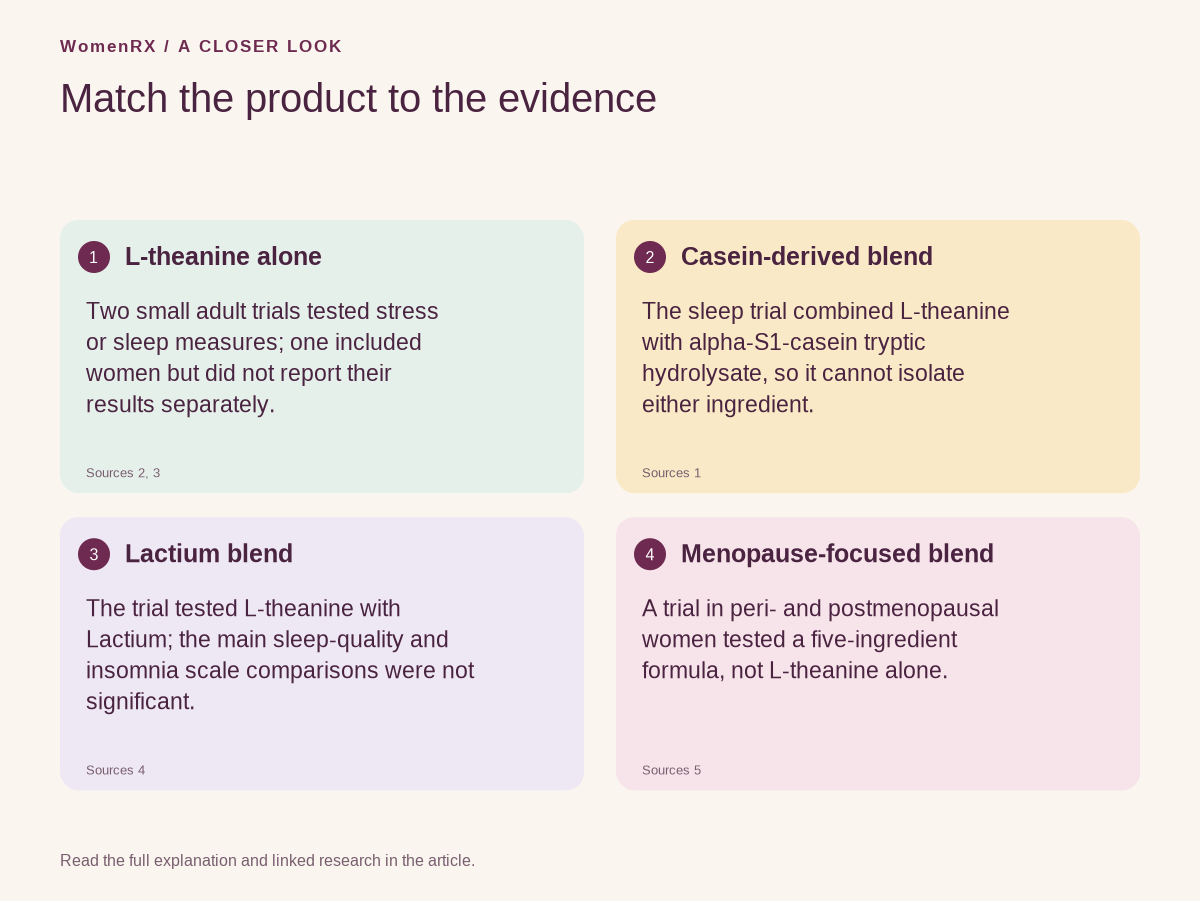
Match the product to the evidence
L-theanine alone: Two small adult trials tested stress or sleep measures; one included women but did not report their results separately.23
Casein-derived blend: The sleep trial combined L-theanine with alpha-S1-casein tryptic hydrolysate, so it cannot isolate either ingredient.1
Lactium blend: The trial tested L-theanine with Lactium; the main sleep-quality and insomnia scale comparisons were not significant.4
Menopause-focused blend: A trial in peri- and postmenopausal women tested a five-ingredient formula, not L-theanine alone.5
Read the figure as text
Compare the ingredient formula, population, and measured outcome before deciding whether a study fits a product’s claim.- L-theanine alone: Two small adult trials tested stress or sleep measures; one included women but did not report their results separately.23
- Casein-derived blend: The sleep trial combined L-theanine with alpha-S1-casein tryptic hydrolysate, so it cannot isolate either ingredient.1
- Lactium blend: The trial tested L-theanine with Lactium; the main sleep-quality and insomnia scale comparisons were not significant.4
- Menopause-focused blend: A trial in peri- and postmenopausal women tested a five-ingredient formula, not L-theanine alone.5
More questions, answered
Does research establish L-theanine safety during pregnancy or breastfeeding?
The human trials described here did not evaluate safety during pregnancy or breastfeeding, so they don’t establish whether L-theanine or a combination product is safe in those situations.
Sources you can check
- Effect of Alpha-S1-Casein Tryptic Hydrolysate and L-Theanine on Poor Sleep Quality: A Double Blind, Randomized Placebo-Controlled Crossover Trial.Thiagarajah K, Chee HP, Sit NW. · Nutrients · 2022Return to first citation
- Effects of L-Theanine Administration on Stress-Related Symptoms and Cognitive Functions in Healthy Adults: A Randomized Controlled Trial.Hidese S, Ogawa S, Ota M, Ishida I, Yasukawa Z, Ozeki M, Kunugi H. · Nutrients · 2019Return to first citation
- Safety and Efficacy of AlphaWave® L-Theanine Supplementation for 28 Days in Healthy Adults with Moderate Stress: A Randomized, Double-Blind, Placebo-Controlled Trial.Moulin M, Crowley DC, Xiong L, Guthrie N, Lewis ED. · Neurology and therapy · 2024Return to first citation
- Dietary supplementation with Lactium and L-theanine alleviates sleep disturbance in adults: a double-blind, randomized, placebo-controlled clinical study.Lim SE, Kim HS, Lee S, Kang EY, Lim JH, Kim BY, Shin SM, Baek Y. · Frontiers in nutrition · 2024Return to first citation
- Nonsedating neurotransmitter-modulating supplement for nonvasomotor sleep disturbance in menopause.Carbonneau S, Mysliwiec V, Doyle AL, Stratton M, Dweck A, Tartar J, Alesi M, Mason L, Komorowski J, VanDusseldorp TA. · Menopause (New York, N.Y.) · 2026Return to first citation