L-Theanine Doses Studied for Sleep and Stress
Human studies have tested L-theanine alone at 200 or 400 mg a day, but the results don’t establish a best dose for women or a reliable treatment for sleep problems.
The clearest adult studies here tested isolated L-theanine at 200 mg daily for four weeks and 400 mg daily for 28 days. One small trial of 30 adults, including 21 women, reported improvements in some stress and sleep questionnaire scores at 200 mg; a 30-person trial at 400 mg found mixed results. Neither establishes a dose for women, insomnia, or pregnancy and breastfeeding. 3 6
If you’re comparing L-theanine supplements, the first useful question is what’s actually in the product. Evidence from a capsule containing L-theanine alone is different from evidence for tea or a blend of several ingredients. Even the isolated-supplement studies are small, and their findings don’t establish a standard dose for sleep or stress.
What isolated L-theanine studies tested
In a four-week, double-blind crossover trial, 30 healthy adults took 200 mg of L-theanine daily or placebo. The group included nine men and 21 women, but results weren’t reported separately for women. After L-theanine, participants had lower scores on several measures, including a sleep-quality questionnaire and a trait-anxiety questionnaire. Some sleep measures improved compared with placebo, though the researchers noted that the placebo comparison limited the interpretation of some sleep findings. This is a signal worth understanding, not proof of a treatment effect or a dose recommendation. 3
A second small trial assigned 30 adults with moderate stress to 400 mg daily or placebo for 28 days. Stress questionnaire scores fell in both groups, with similar percentage decreases by day 28. The L-theanine group also had some sleep and attention findings, but cortisol did not differ significantly between groups, and time asleep decreased in the L-theanine group after 28 days. The study doesn’t show that taking more produces better sleep or reliably reduces stress. 6
Taken together, 200 mg and 400 mg are amounts that have been studied in small adult trials, not established daily doses for women. A study in boys with ADHD also tested 400 mg daily, but its population and sleep context are quite different from adult women’s, so it shouldn’t be used to set an adult dose. 2
A blend doesn’t tell you what L-theanine did
Some sleep studies tested products that combined L-theanine with other ingredients. In a four-week crossover trial of 39 working adults with poor sleep, a product containing L-theanine and alpha-s1-casein hydrolysate improved several sleep questionnaire measures in one analysis. Because the ingredients were combined, the study can’t show whether L-theanine contributed to the changes or what amount of it was responsible. 1
A separate eight-week study of a Lactium-and-L-theanine product found no significant between-group difference on its sleep-quality and insomnia scales. Some sleep-diary measures changed, but the results don’t isolate L-theanine. 7 A short trial of a blend containing L-theanine, tryptophan, glycine, magnesium, and tart cherry also reported sleep changes, but it tested only the combined formula in 16 people, including nine men and seven women. 5
When you read a label, check whether it lists L-theanine by itself or includes other active ingredients, and whether it gives the amount of each ingredient. If it’s a blend or doesn’t clearly state the L-theanine amount, you can’t compare it directly with a study of isolated L-theanine.
Tea is another distinct comparison. L-theanine is present in green tea, but the 200 mg trial described its tablet dose as relatively high compared with the median amount per cup reported in the study. Tea and a supplement tablet aren’t interchangeable study formulations, and tea also contains other components. 3 4
What the studies mean for women’s safety
The 200 mg adult trial included women, but it didn’t report a women-specific result or identify results by pregnancy, postpartum, perimenopause, or postmenopause. The 400 mg trial’s abstract doesn’t provide a sex breakdown. These studies therefore can’t show whether effects differ across women’s life stages or establish safety during pregnancy or breastfeeding. 3 6
Short trials involving a few dozen people can’t establish long-term safety or answer which medicines and calming products are safe to combine with L-theanine. The studies summarized here don’t provide a verified interaction list. If you take medication or another product that makes you sleepy or calm, check the full ingredient label and ask a pharmacist to review the specific combination before adding a supplement. That’s a practical check, not evidence that a particular interaction has been demonstrated.
The clearest takeaway is a comparison, not a prescription: 200 mg and 400 mg have been tested in small, short adult trials, with mixed and limited results. For your own decision, distinguish isolated L-theanine from a blend, and don’t treat a studied amount as proof that it will help your sleep or stress.
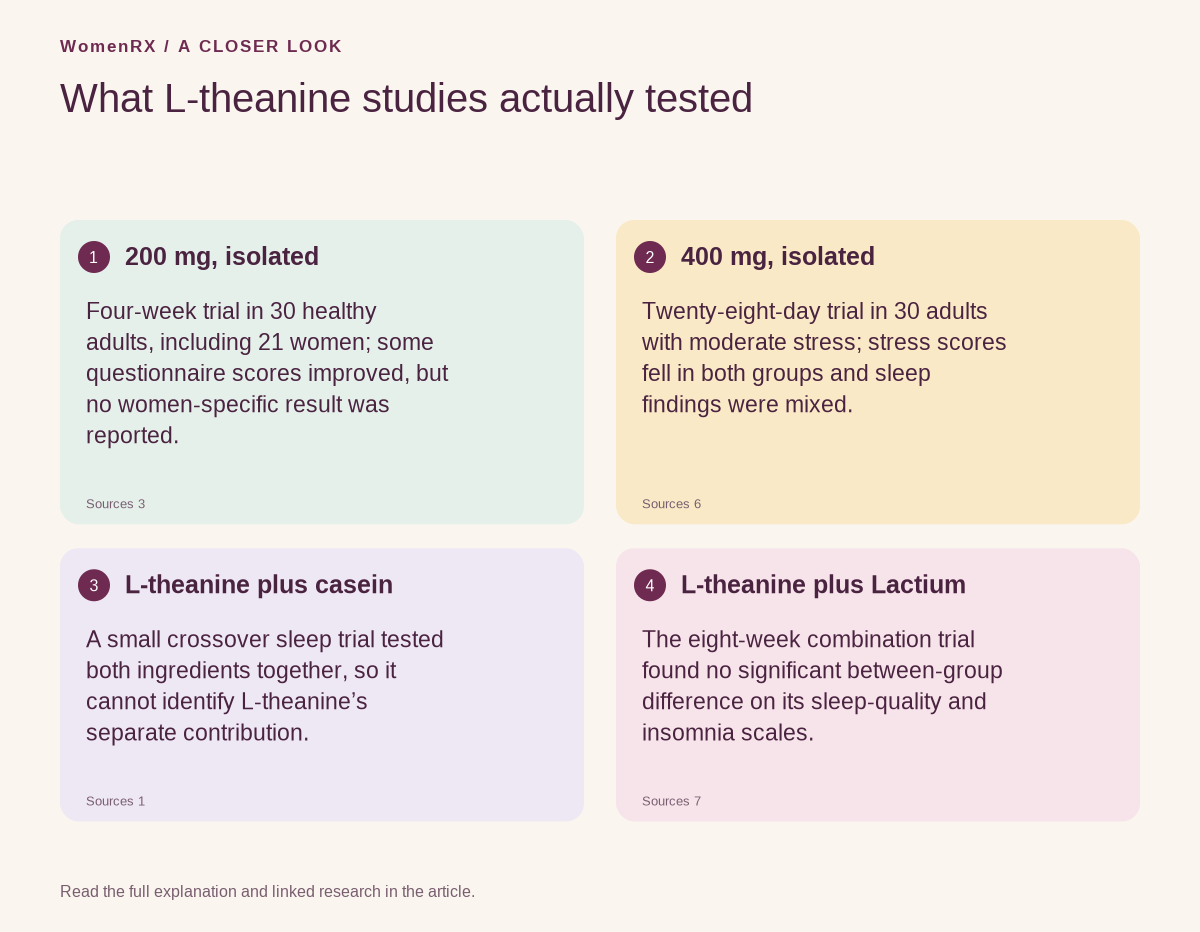
What L-theanine studies actually tested
200 mg, isolated: Four-week trial in 30 healthy adults, including 21 women; some questionnaire scores improved, but no women-specific result was reported.3
400 mg, isolated: Twenty-eight-day trial in 30 adults with moderate stress; stress scores fell in both groups and sleep findings were mixed.6
L-theanine plus casein: A small crossover sleep trial tested both ingredients together, so it cannot identify L-theanine’s separate contribution.1
L-theanine plus Lactium: The eight-week combination trial found no significant between-group difference on its sleep-quality and insomnia scales.7
Read the figure as text
Compare isolated L-theanine trials with combination products, and note what each design can and cannot show.- 200 mg, isolated: Four-week trial in 30 healthy adults, including 21 women; some questionnaire scores improved, but no women-specific result was reported.3
- 400 mg, isolated: Twenty-eight-day trial in 30 adults with moderate stress; stress scores fell in both groups and sleep findings were mixed.6
- L-theanine plus casein: A small crossover sleep trial tested both ingredients together, so it cannot identify L-theanine’s separate contribution.1
- L-theanine plus Lactium: The eight-week combination trial found no significant between-group difference on its sleep-quality and insomnia scales.7
More questions, answered
Is L-theanine from tea the same as a supplement?
L-theanine occurs in green tea, but the adult trial tested a tablet, and the researchers described its 200 mg daily amount as relatively high compared with the median amount per cup they cited. Tea and an isolated supplement are different formulations, so the trial result can’t be directly applied to a cup of tea. 3
Do these studies establish that L-theanine is safe during pregnancy or breastfeeding?
No. The adult trials don’t report findings for pregnancy or breastfeeding, so they can’t establish safety for either situation. 3 6
Sources you can check
- Effect of Alpha-S1-Casein Tryptic Hydrolysate and L-Theanine on Poor Sleep Quality: A Double Blind, Randomized Placebo-Controlled Crossover Trial.Thiagarajah K, Chee HP, Sit NW. · Nutrients · 2022Return to first citation
- The effects of L-theanine (Suntheanine®) on objective sleep quality in boys with attention deficit hyperactivity disorder (ADHD): a randomized, double-blind, placebo-controlled clinical trial.Lyon MR, Kapoor MP, Juneja LR. · Alternative medicine review : a journal of clinical therapeutic · 2011Return to first citation
- Effects of L-Theanine Administration on Stress-Related Symptoms and Cognitive Functions in Healthy Adults: A Randomized Controlled Trial.Hidese S, Ogawa S, Ota M, Ishida I, Yasukawa Z, Ozeki M, Kunugi H. · Nutrients · 2019Return to first citation
- Effects of l-Theanine on Cognitive Function in Middle-Aged and Older Subjects: A Randomized Placebo-Controlled Study.Baba Y, Inagaki S, Nakagawa S, Kaneko T, Kobayashi M, Takihara T. · Journal of medicinal food · 2021Return to first citation
- Nutritional Modulation of Sleep Latency, Duration, and Efficiency: A Randomized, Repeated-Measures, Double-Blind Deception Study.Langan-Evans C, Hearris MA, Gallagher C, Long S, Thomas C, Moss AD, Cheung W, Howatson G, Morton JP. · Medicine and science in sports and exercise · 2023Return to first citation
- Safety and Efficacy of AlphaWave® L-Theanine Supplementation for 28 Days in Healthy Adults with Moderate Stress: A Randomized, Double-Blind, Placebo-Controlled Trial.Moulin M, Crowley DC, Xiong L, Guthrie N, Lewis ED. · Neurology and therapy · 2024Return to first citation
- Dietary supplementation with Lactium and L-theanine alleviates sleep disturbance in adults: a double-blind, randomized, placebo-controlled clinical study.Lim SE, Kim HS, Lee S, Kang EY, Lim JH, Kim BY, Shin SM, Baek Y. · Frontiers in nutrition · 2024Return to first citation