Does L-Theanine Help With Stress or Sleep?
L-theanine has some short-term human evidence for perceived stress and sleep quality, but the findings depend on the outcome and the product studied.
L-theanine may modestly help with perceived stress during stressful situations and some aspects of sleep quality, but evidence is short-term and doesn’t show that it reliably reduces ongoing stress or increases total sleep time. A review reports different studied ranges for stress, sleep, and cognition; these are research ranges, not recommended doses. One small trial also found mixed sleep results. 2 3
Stress relief and sleep support aren’t the same claim
The most useful distinction is what researchers measured. A review of human trials suggests L-theanine may reduce perceived stress and anxiety in people exposed to stressful situations. But the studies were mostly acute, and the review found insufficient evidence to conclude that it reduces stress in people with chronic conditions. 2
Sleep quality is also different from sleeping longer. The review describes possible improvements in sleep quality, with little effect on total sleep duration. If your main goal is more hours of sleep, the evidence is less encouraging. 2
The studied ranges vary by goal
Across the trials summarized in the review, researchers studied 200-400 mg per day for stress, 200-450 mg per day for sleep quality, and 100-400 mg for cognition. These are ranges used in studies, not established recommendations. The review draws on different trials and products, so the ranges shouldn’t be read as a single, directly comparable dose-finding test. 2
One specific example is a 28-day placebo-controlled trial of a branded L-theanine product at 400 mg per day in 30 adults with moderate stress. At day 28, perceived-stress scores had fallen by 17.98% in the L-theanine group and 17.88% in the placebo group. The similar changes don’t show a clear advantage over placebo for that outcome. 3
Sleep findings include a tradeoff
In that same trial, the L-theanine group had less light sleep than the placebo group, but also spent less time asleep at day 28. Those findings don’t add up to an unambiguous sleep benefit. The trial was small and tested one specific product for four weeks, so it can’t establish what other formulations will do. 3
A separate eight-week human trial reported better sleep measures with walnut peptide plus theanine. Because participants took the ingredients together, the result can’t establish whether theanine alone was responsible. 1
Attention is another outcome, not proof of better sleep
L-theanine has also been studied for cognition. The review reports small improvements in some cognitive tasks, particularly visual attention and in studies where theanine was combined with caffeine. A change on an attention test doesn’t demonstrate that a supplement will improve everyday focus, relieve stress, or help you sleep. 2
What to check before choosing a product
Tea, a single-ingredient supplement, and a blend with other ingredients aren’t interchangeable. The review’s findings come from multiple trials, while the 28-day study tested one specific L-theanine product and the eight-week sleep study tested a combination. Match the product to the evidence rather than assuming every label makes the same claim credible. 1 2 3
Short-term safety findings are limited. In the 30-person trial, adverse events resolved by the end of the study or follow-up, but that doesn’t establish long-term safety or safety for every product. The review also says that potential interactions with other bioactive ingredients need further study. It doesn’t provide a dependable list of interactions with prescription medicines. If you take medicines, have a pharmacist or prescriber review the exact label, including any added ingredients. 2 3
The findings discussed don’t establish whether L-theanine’s effects differ by sex or reproductive stage, such as pregnancy, postpartum, perimenopause, or postmenopause. There isn’t a supported basis here for claiming a distinct benefit for women. 2 3
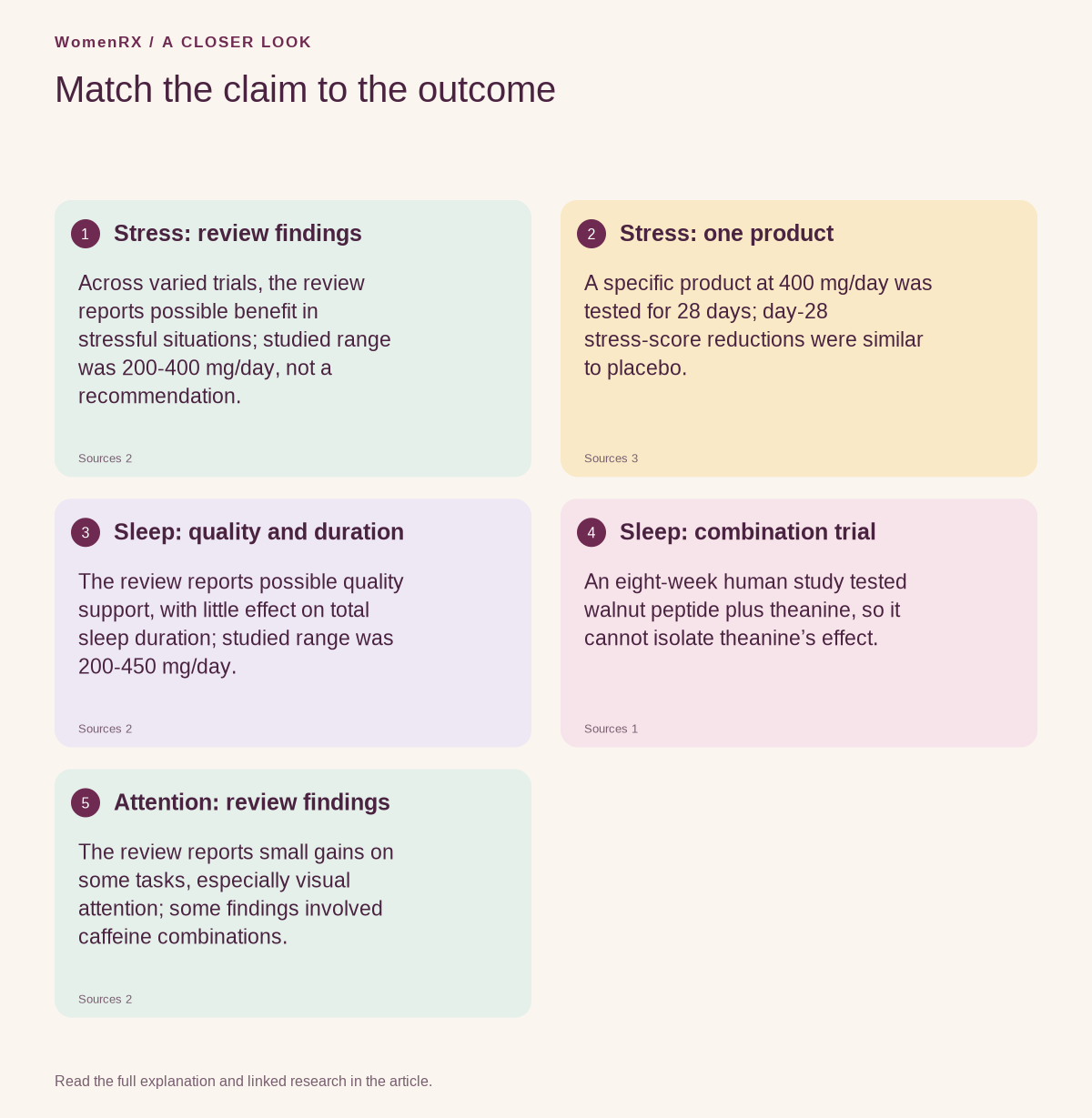
Match the claim to the outcome
Stress: review findings: Across varied trials, the review reports possible benefit in stressful situations; studied range was 200-400 mg/day, not a recommendation.2
Stress: one product: A specific product at 400 mg/day was tested for 28 days; day-28 stress-score reductions were similar to placebo.3
Sleep: quality and duration: The review reports possible quality support, with little effect on total sleep duration; studied range was 200-450 mg/day.2
Sleep: combination trial: An eight-week human study tested walnut peptide plus theanine, so it cannot isolate theanine’s effect.1
Attention: review findings: The review reports small gains on some tasks, especially visual attention; some findings involved caffeine combinations.2
Read the figure as text
Stress, sleep, and attention are separate outcomes. These examples show the measured result and whether researchers tested L-theanine alone, a specific product, or a combination.- Stress: review findings: Across varied trials, the review reports possible benefit in stressful situations; studied range was 200-400 mg/day, not a recommendation.2
- Stress: one product: A specific product at 400 mg/day was tested for 28 days; day-28 stress-score reductions were similar to placebo.3
- Sleep: quality and duration: The review reports possible quality support, with little effect on total sleep duration; studied range was 200-450 mg/day.2
- Sleep: combination trial: An eight-week human study tested walnut peptide plus theanine, so it cannot isolate theanine’s effect.1
- Attention: review findings: The review reports small gains on some tasks, especially visual attention; some findings involved caffeine combinations.2
Sources you can check
- Walnut peptide and theanine combination ameliorates sleep disorders: a multi-species study including a human trial.Gong J, Jia X, Wang L, Lu Y, Guo R, Gong R, Hao J, Zhao Z, Duan S, Liu X, He J, Li H, Liu Z. · Food & function · 2026Return to first citation
- Effects of L-theanine on cognition, mood and sleep: evidence from human trials.Cotter J, Kilpatrick HE. · Frontiers in nutrition · 2026Return to first citation
- Safety and Efficacy of AlphaWave® L-Theanine Supplementation for 28 Days in Healthy Adults with Moderate Stress: A Randomized, Double-Blind, Placebo-Controlled Trial.Moulin M, Crowley DC, Xiong L, Guthrie N, Lewis ED. · Neurology and therapy · 2024Return to first citation