Ashwagandha for Stress and Sleep: What the Evidence Shows
Small, short-term studies suggest possible benefits for stress ratings and sleep quality, but results don’t tell you that every product will work the same way.
Ashwagandha has been studied separately for perceived stress and sleep quality, and reviews find promising signals for both. The evidence is limited by small, short trials and differences in extracts, so it doesn’t establish a reliable effect for every product or long-term use. Women’s separate results and safety across pregnancy and breastfeeding aren’t established. 14
Stress ratings and sleep are different outcomes
The research doesn’t test one general feeling of “calm.” Stress studies assess how people report or score their stress, while sleep studies look at outcomes such as sleep quality and duration. A change in a stress rating doesn’t automatically mean someone will fall asleep faster, sleep longer, or feel rested the next morning.
The National Institutes of Health Office of Dietary Supplements summarizes randomized, placebo-controlled trials as showing that some ashwagandha extracts may reduce perceived stress and anxiety and improve sleep quality or duration. A systematic review of controlled human studies also found enough evidence to analyze ashwagandha against placebo for perceived stress and sleep quality. These are encouraging findings, not a guarantee of a noticeable benefit for an individual. 14
The bottle matters to the evidence
“Ashwagandha” doesn’t identify one interchangeable preparation. Most supplements contain root extract, while some use root and leaf. Studies also differ in extraction and standardization, which can change the preparation being tested. That makes it hard to know whether a result from one trial applies to a different product on a store shelf. 1
When comparing products, check the plant part and the extract information on the label. If those details aren’t clear, it’s difficult to tell how closely the product matches the preparations studied. Even a clearly labeled extract isn’t proven equivalent to one used in a trial unless the preparation matches; the research doesn’t support treating all products as the same. 1
Short trials can’t settle long-term questions
Most studies have been small and brief. The NIH review says ashwagandha appears to be tolerated for up to three months, but its long-term safety and effectiveness over months or years aren’t known. A broader review of randomized trials reported intervention periods from 3 to 16 weeks across studies of both ashwagandha and rhodiola, with small samples and methodological differences among the limitations. 12
So the evidence is most relevant to short-term outcomes measured during a study. It doesn’t show that benefits continue with extended use, or that taking it for longer is better. 1
What this evidence says about women
The reviews and summaries here don’t provide results for women separately or establish whether effects differ by sex. They also don’t answer whether results vary across cycling years, perimenopause, or postmenopause. A finding in adults overall shouldn’t be presented as a women-specific result without that information. 124
Pregnancy and breastfeeding call for particular caution: the NIH review says ashwagandha might not be safe during either. A separate review describes reproductive-harm evidence as inconclusive and calls for better research on fertility and developmental outcomes. That uncertainty isn’t proof of safety, and the available evidence doesn’t settle use during pregnancy or breastfeeding. 13
The NIH review also flags potential liver and thyroid adverse effects. If you have a liver or thyroid condition, or are considering ashwagandha while taking a treatment related to either, check the specific product with a clinician or pharmacist before using it. This is a safety check prompted by those concerns, not evidence that every product interacts with every medicine. 1
A practical way to read a claim
If a product promises better sleep and less stress, look for evidence that matches the outcome you care about and the actual preparation in the bottle. Ask whether the result came from a human trial, how long the study lasted, and whether it assessed stress, sleep, or both. A promising result on one measure doesn’t confirm the others, and a short trial can’t answer long-term safety questions. 14
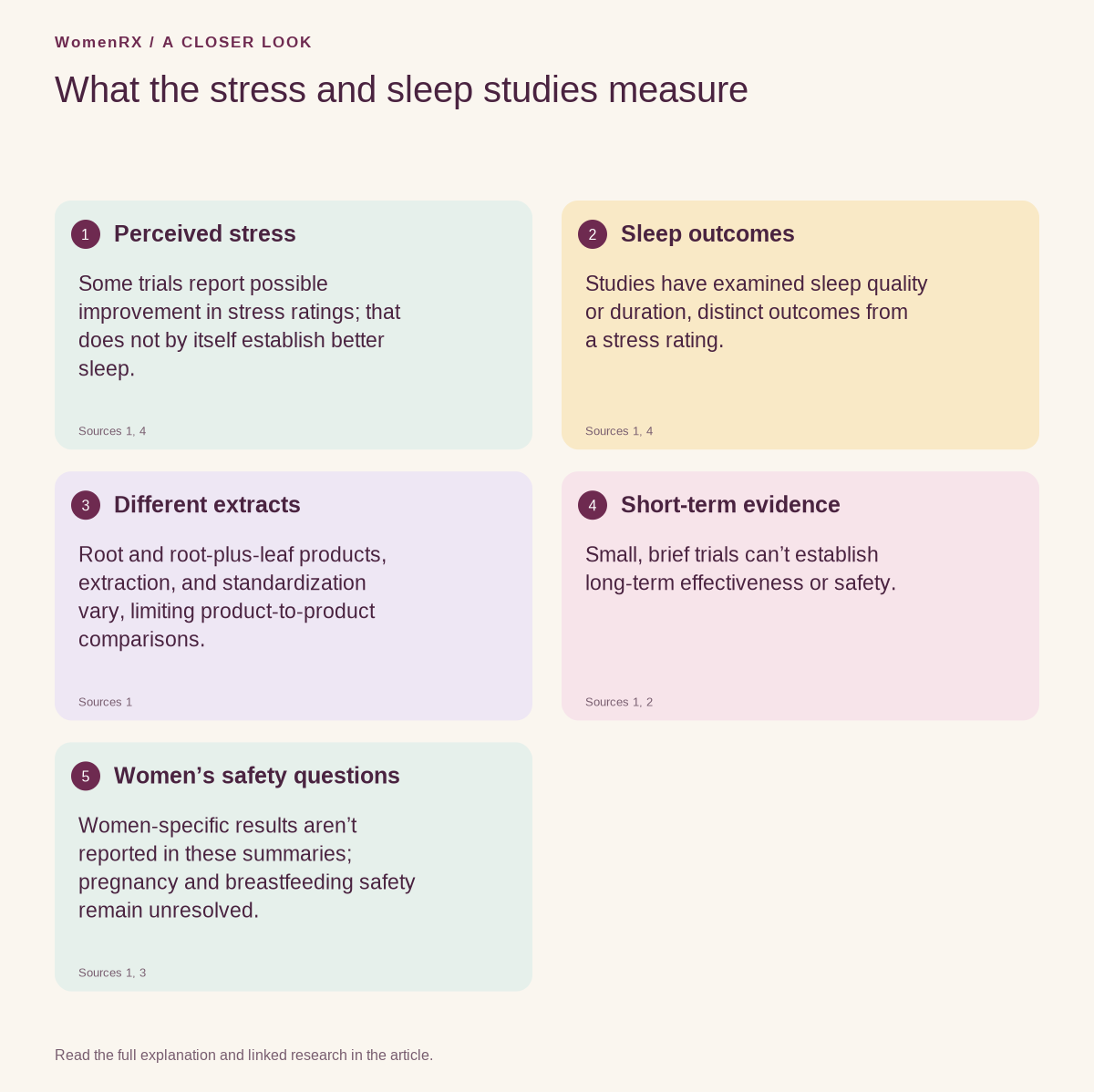
What the stress and sleep studies measure
Perceived stress: Some trials report possible improvement in stress ratings; that does not by itself establish better sleep.14
Sleep outcomes: Studies have examined sleep quality or duration, distinct outcomes from a stress rating.14
Different extracts: Root and root-plus-leaf products, extraction, and standardization vary, limiting product-to-product comparisons.1
Short-term evidence: Small, brief trials can’t establish long-term effectiveness or safety.12
Women’s safety questions: Women-specific results aren’t reported in these summaries; pregnancy and breastfeeding safety remain unresolved.13
Read the figure as text
These comparisons show why a promising result for one outcome or extract shouldn’t be assumed to apply to every product or safety question.- Perceived stress: Some trials report possible improvement in stress ratings; that does not by itself establish better sleep.14
- Sleep outcomes: Studies have examined sleep quality or duration, distinct outcomes from a stress rating.14
- Different extracts: Root and root-plus-leaf products, extraction, and standardization vary, limiting product-to-product comparisons.1
- Short-term evidence: Small, brief trials can’t establish long-term effectiveness or safety.12
- Women’s safety questions: Women-specific results aren’t reported in these summaries; pregnancy and breastfeeding safety remain unresolved.13
More questions, answered
Does a stress study show that ashwagandha helps insomnia?
No. Stress ratings and sleep outcomes are separate measures. Some studies have examined both, but a result for perceived stress alone doesn’t establish a benefit for insomnia or sleep quality. 14
Can I assume one ashwagandha product matches another?
No. Products and trials can differ in plant part, extraction, and standardization. The evidence doesn’t establish that a result from one preparation applies to a different bottle. 1
Sources you can check
- Ashwagandha: Is it helpful for stress, anxiety, or sleep? - Health Professional Fact SheetAccessed 2026-09-25Return to first citation
- Clinical evidence for the adaptogenic effects of Withania somnifera and Rhodiola rosea - A systematic review with molecular interpretation of psychometric outcomes.Łuszczak J, Kocki J. · Annals of agricultural and environmental medicine : AAEM · 2026Return to first citation
- A Systematic and Ethnobotanical Review of Ashwagandha's ( Withania Somnifera ) Teratogenic and Abortifacient Potentials.Tallon MJ, Koturbash I, Blum JL. · Phytotherapy research : PTR · 2026Return to first citation
- Ayurvedic Dravya-Based Herbal Products for Cognition, Stress, Sleep, and Psychiatric Symptoms: A Node-Resolved Systematic Review and Meta-Analysis.Baune BT, Patel MM, Patel MV, Gupta SN. · Journal of integrative and complementary medicine · 2026Return to first citation