Rhodiola Supplements: What Human Studies Actually Show
Rhodiola has been studied for depression and stress-related symptoms, but a result for one extract doesn’t tell you how another product will work.
Human trials have examined Rhodiola rosea for mild to moderate depression and for stress-related symptoms. One depression trial reported improvement with a specific extract, while a later, small trial found no statistically significant differences between rhodiola, sertraline, and placebo. Stress findings are harder to interpret because the studies lacked a placebo group or any comparison group. Before buying, check what extract the product contains and whether the research measured your actual concern. 1245
Match the claim to the outcome studied
Rhodiola has a history of traditional use for stamina and stress. That history explains why people are interested in it, but it doesn’t establish that a supplement treats fatigue or another health concern. Human researchers have tested particular rhodiola extracts for depression, mild anxiety and stress symptoms. Each is a different question: a change in a depression score doesn’t demonstrate more energy, and a change in self-reported stress doesn’t show that an anxiety disorder was treated. 31245
Depression: two trials, different results
In a six-week randomized, double-blind trial, 89 adults with mild to moderate depression, including men and women, received placebo or one of two amounts of a standardized extract called SHR-5. Both rhodiola groups showed improvement in depression scores, while the placebo group did not show the same improvement. The reported results were for participants overall, not separately for women. 2
A later, 12-week phase II trial randomized 57 people with mild to moderate major depression to standardized rhodiola extract, sertraline or placebo. Scores declined in all three groups, but differences between groups were not statistically significant. Taken together, these trials don’t establish that rhodiola can replace depression treatment. 12
The 12-week trial also offers a limited look at tolerability. Adverse events were reported by 30.0% of participants in the rhodiola group, 63.2% in the sertraline group and 16.7% in the placebo group. Those figures describe this small trial over 12 weeks, not the safety of every rhodiola product or longer-term use. The six-week SHR-5 trial reported no serious side effects in any group; that isn’t a guarantee of safety outside the trial. 12
Stress: promising reports, weaker comparisons
In a 14-day randomized study of 80 mildly anxious participants, people assigned to an extract called Vitano reported improvements in several anxiety, stress and mood measures compared with people assigned to no treatment. The study did not use a placebo, making it difficult to separate the extract’s effect from expectations or other differences between groups. It found no relevant difference in cognitive performance. 4
Another study followed 101 people with life-stress symptoms for four weeks while they took an extract called WS 1375. Participants reported improvement, but everyone received the extract: there was no placebo or other comparison group. Their symptoms may have changed for reasons the study could not separate from taking rhodiola. 5
That distinction matters if you’re considering rhodiola for a stressful stretch at work, for example. Self-reported stress was measured, but these studies don’t give a dependable prediction of whether a product you buy will help you feel better.
Check the preparation, then consider what remains unknown
The trials used different named extracts, including SHR-5, Vitano and WS 1375. A label that says only “rhodiola” doesn’t show that the product matches any of them. Check whether it identifies the plant as Rhodiola rosea and describes the extract. Even then, a finding for one preparation doesn’t establish the same effect for another. 245
The women-specific questions are narrower still. The six-week depression trial included women but did not report their results separately. These trials do not establish a benefit for menstrual symptoms, perimenopause or menopause, and they do not establish safety during pregnancy or breastfeeding. They also don’t establish whether rhodiola can be combined safely with a particular medicine. If you take medication, a pharmacist can help you assess the exact product and your medicine list before you use it. 1245
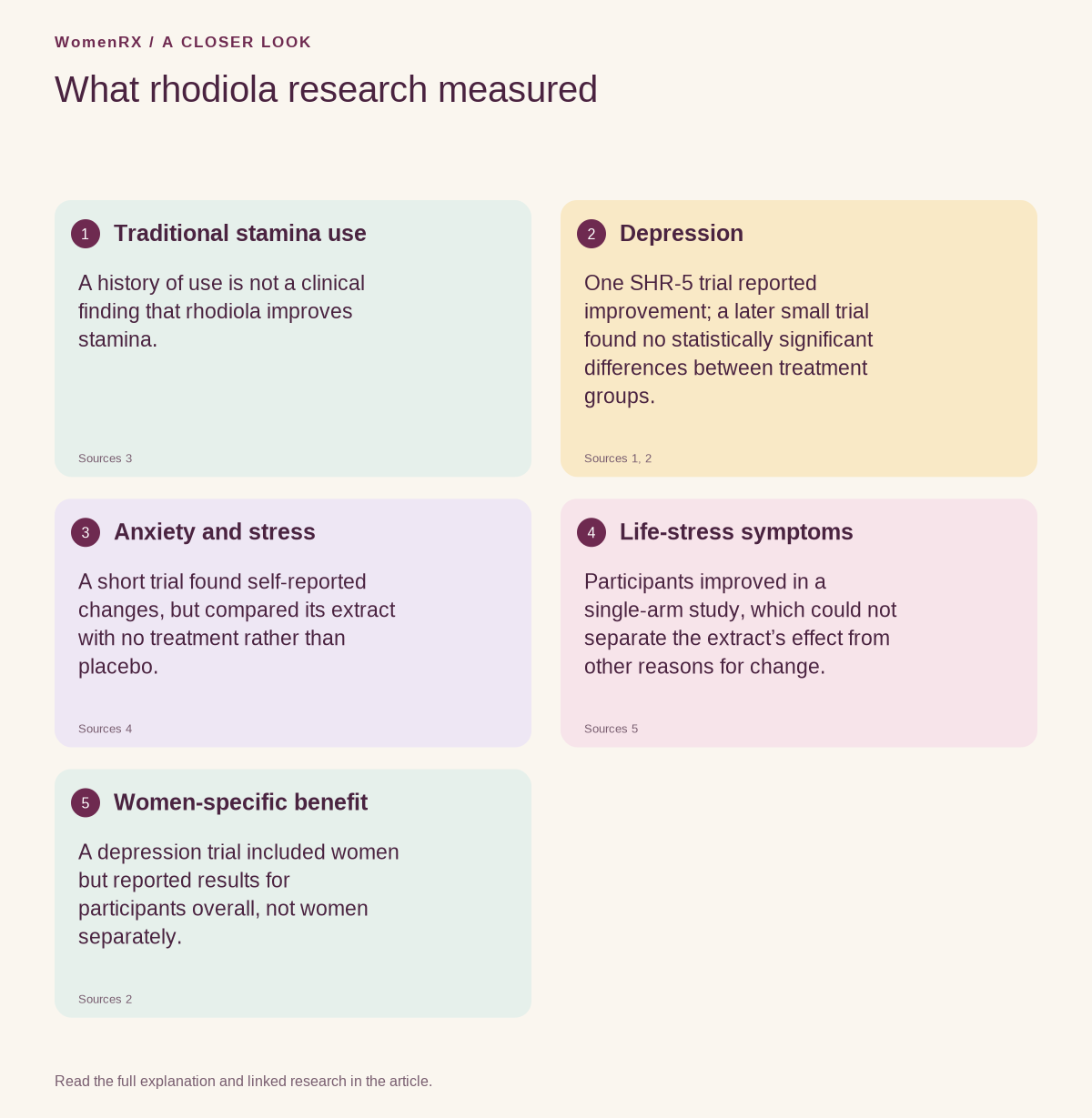
What rhodiola research measured
Traditional stamina use: A history of use is not a clinical finding that rhodiola improves stamina.3
Depression: One SHR-5 trial reported improvement; a later small trial found no statistically significant differences between treatment groups.12
Anxiety and stress: A short trial found self-reported changes, but compared its extract with no treatment rather than placebo.4
Life-stress symptoms: Participants improved in a single-arm study, which could not separate the extract’s effect from other reasons for change.5
Women-specific benefit: A depression trial included women but reported results for participants overall, not women separately.2
Read the figure as text
Compare the proposed use with the people studied, the outcome measured and the strength of the comparison.- Traditional stamina use: A history of use is not a clinical finding that rhodiola improves stamina.3
- Depression: One SHR-5 trial reported improvement; a later small trial found no statistically significant differences between treatment groups.12
- Anxiety and stress: A short trial found self-reported changes, but compared its extract with no treatment rather than placebo.4
- Life-stress symptoms: Participants improved in a single-arm study, which could not separate the extract’s effect from other reasons for change.5
- Women-specific benefit: A depression trial included women but reported results for participants overall, not women separately.2
More questions, answered
Does rhodiola improve concentration?
The 14-day study in mildly anxious participants included cognitive tests and found no relevant difference in performance between the rhodiola and no-treatment groups. Its self-reported mood findings shouldn’t be read as evidence of better concentration. 4
Sources you can check
- Rhodiola rosea versus sertraline for major depressive disorder: A randomized placebo-controlled trial.Mao JJ, Xie SX, Zee J, Soeller I, Li QS, Rockwell K, Amsterdam JD. · Phytomedicine : international journal of phytotherapy and phytopharmacology · 2015Return to first citation
- Clinical trial of Rhodiola rosea L. extract SHR-5 in the treatment of mild to moderate depression.Darbinyan V, Aslanyan G, Amroyan E, Gabrielyan E, Malmström C, Panossian A. · Nordic journal of psychiatry · 2007Return to first citation
- Rhodiola rosea therapy for major depressive disorder: a study protocol for a randomized, double-blind, placebo- controlled trial.Mao JJ, Li QS, Soeller I, Xie SX, Amsterdam JD. · Journal of clinical trials · 2014Return to first citation
- The Effects of Rhodiola rosea L. Extract on Anxiety, Stress, Cognition and Other Mood Symptoms.Cropley M, Banks AP, Boyle J. · Phytotherapy research : PTR · 2015Return to first citation
- Therapeutic effects and safety of Rhodiola rosea extract WS® 1375 in subjects with life-stress symptoms--results of an open-label study.Edwards D, Heufelder A, Zimmermann A. · Phytotherapy research : PTR · 2012Return to first citation