Does Rhodiola Help With Fatigue or Stress?
Rhodiola has shown mixed results for fatigue, and the more encouraging stress findings come from small studies of specific extracts.
Rhodiola isn’t a proven fix for fatigue, stress, or poor concentration. One small placebo-controlled trial found better results with placebo for fatigue in shift-working nursing students, while another small trial found improvements in selected fatigue and attention measures with a specific extract. Other positive fatigue and stress findings came from studies without a placebo group, so they can’t show that rhodiola caused the improvement. 3 5 4 8
The answer depends on what you want it to help
“Fatigue” can mean feeling worn out after poor sleep, struggling through shift work, or having persistent exhaustion that doesn’t improve with rest. Those aren’t interchangeable problems, and the rhodiola studies don’t give one reliable answer for all of them.
For fatigue during shift work, a randomized, double-blind trial followed 48 nursing students for 42 days. Participants taking rhodiola had worse average results than those taking placebo on two fatigue measures at the end of the study. The small sample means the finding deserves caution, but it doesn’t support assuming rhodiola will help you feel more energetic. 3
A separate placebo-controlled study included 60 men and women with stress-related fatigue. After 28 days, both groups improved on several measures. Compared with placebo, the group taking the specific SHR-5 extract improved on a burnout scale and on selected attention-test measures. That’s a potentially useful signal, not proof that rhodiola treats burnout or reliably improves concentration in everyday life. The reported combined results don’t show whether women responded differently. 5
Other reports look more positive at first glance but are harder to interpret. In an eight-week study of 100 people with prolonged or chronic fatigue, symptoms improved while participants took rhodiola, but there was no comparison group. A four-week study of 101 people with life-stress symptoms also had no placebo group. Without that comparison, changes could reflect time, expectations, or other influences as well as the supplement. 4 8
Concentration claims are narrower than they sound
A single-dose trial in 161 young cadets tested one standardized extract during mental work under fatigue and stress. It reported a difference on a study-specific antifatigue index, but that setting and measure don’t establish a benefit for everyday focus, brain fog, or concentration problems in other groups. The trial of stress-related fatigue also found differences in selected attention-test measures, not a general improvement in concentration for women. 6 5
So if concentration is your main concern, ask what kind of evidence would match your situation: a short test during demanding mental work is different from sustained improvement in day-to-day focus.
The extract matters, but products aren’t proven interchangeable
The trials didn’t all test the same preparation. For example, the stress-related fatigue trial studied SHR-5, while the open-label fatigue and life-stress studies studied WS 1375. Rhodiola contains many compounds, and studies have used different doses and reported different standardizations of compounds such as salidroside and rosavin. A result for one named extract does not establish the same result for every rhodiola supplement on a store shelf. 5 4 8 7
This is a reason to be cautious about broad claims on a label or in an advertisement. It is not evidence that a particular extract works, or that standardized products have been shown to be equivalent.
What the studies tell women, and what they don’t
The 2009 stress-related fatigue trial included men and women, but its reported combined results don’t show whether women responded differently. The nursing-student trial’s eligibility criteria excluded pregnant and breastfeeding women; it also required female participants who could become pregnant to use birth control during the trial. That study therefore doesn’t establish rhodiola’s effectiveness or safety during pregnancy or breastfeeding. 5 3
These findings don’t establish that rhodiola treats depression, burnout as a clinical condition, or unexplained fatigue. If you’ve been tired for weeks, fatigue can have many causes, including sleep disorders, anemia, thyroid disease, pregnancy, and depression. Finding the cause may be more useful than trying a supplement on your own. 1
For stress, practical options with general guidance behind them include regular physical activity, relaxation practices such as breathing or meditation, and support from people you trust. If stress is seriously disrupting sleep or your usual activities for two weeks or more, MedlinePlus advises seeking help. 2
A practical way to weigh a product claim
Before considering rhodiola, match the claim to the actual evidence: Was the study about your symptom? Did it compare the extract with a placebo? Did it measure a meaningful outcome, and was the extract the same one in the product you’re considering? For persistent fatigue, start with the possibility of an underlying cause rather than treating rhodiola as an answer. 1 3 5
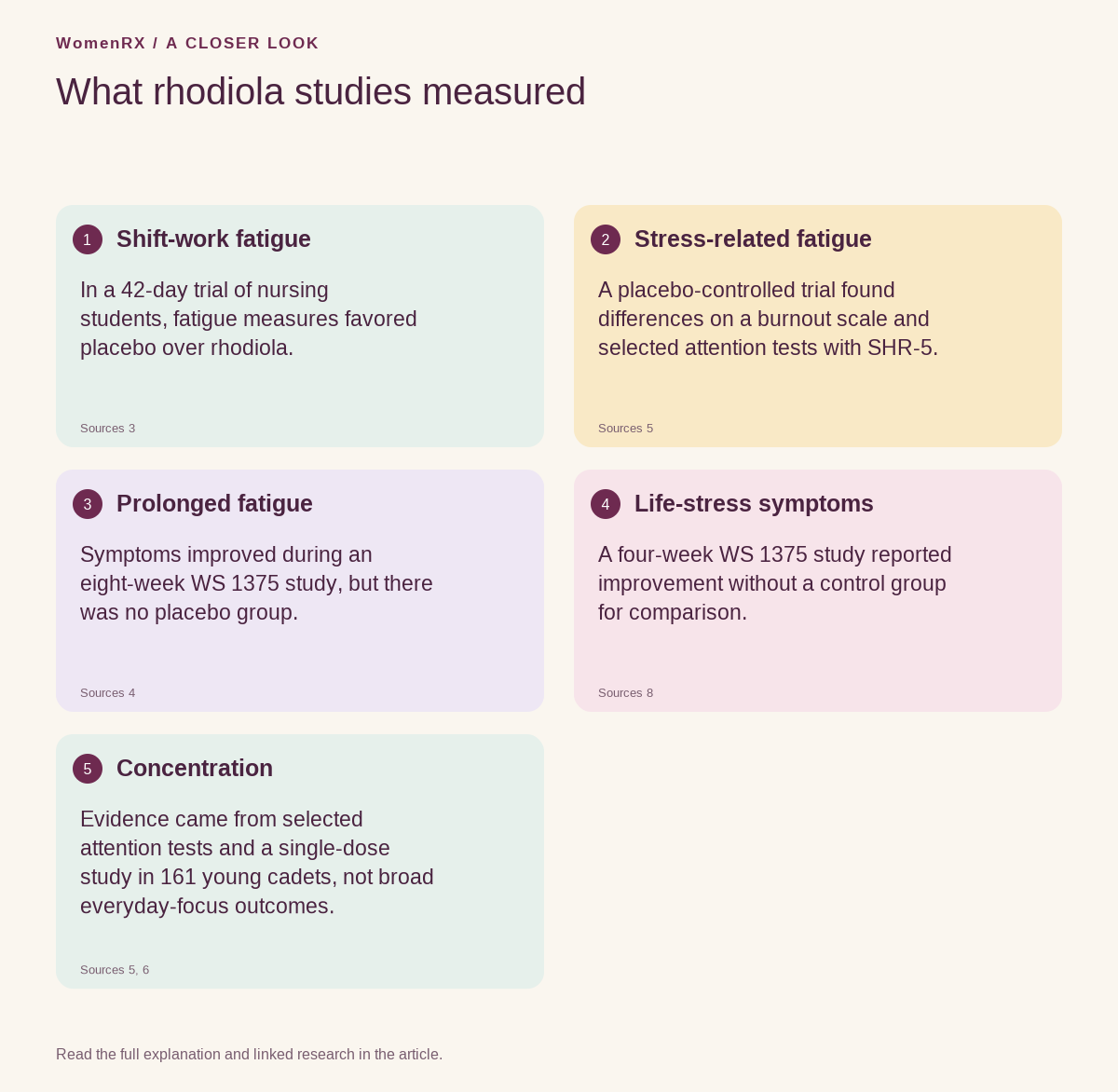
What rhodiola studies measured
Shift-work fatigue: In a 42-day trial of nursing students, fatigue measures favored placebo over rhodiola.3
Stress-related fatigue: A placebo-controlled trial found differences on a burnout scale and selected attention tests with SHR-5.5
Prolonged fatigue: Symptoms improved during an eight-week WS 1375 study, but there was no placebo group.4
Life-stress symptoms: A four-week WS 1375 study reported improvement without a control group for comparison.8
Concentration: Evidence came from selected attention tests and a single-dose study in 161 young cadets, not broad everyday-focus outcomes.56
Read the figure as text
The findings look different depending on the symptom, comparison group, and extract studied.- Shift-work fatigue: In a 42-day trial of nursing students, fatigue measures favored placebo over rhodiola.3
- Stress-related fatigue: A placebo-controlled trial found differences on a burnout scale and selected attention tests with SHR-5.5
- Prolonged fatigue: Symptoms improved during an eight-week WS 1375 study, but there was no placebo group.4
- Life-stress symptoms: A four-week WS 1375 study reported improvement without a control group for comparison.8
- Concentration: Evidence came from selected attention tests and a single-dose study in 161 young cadets, not broad everyday-focus outcomes.56
More questions, answered
Has rhodiola been shown to improve concentration in women?
Not clearly. One trial included men and women and reported improvements on selected attention-test measures, but its reported combined results don’t show whether women benefited differently. A study in 161 young cadets tested mental work during fatigue and stress, which doesn’t establish an everyday concentration benefit for women. 5 6
Is rhodiola known to be safe during pregnancy or breastfeeding?
The nursing-student fatigue trial excluded people who were pregnant or breastfeeding, so it can’t answer that safety question. That study does not establish safety or effectiveness during pregnancy or breastfeeding. 3
Sources you can check
- Fatigue: MedlinePlusAccessed 2026-09-25Return to first citation
- Stress: MedlinePlusAccessed 2026-09-25Return to first citation
- Rhodiola rosea for mental and physical fatigue in nursing students: a randomized controlled trial.Punja S, Shamseer L, Olson K, Vohra S. · PloS one · 2014Return to first citation
- Rhodiola rosea in Subjects with Prolonged or Chronic Fatigue Symptoms: Results of an Open-Label Clinical Trial.Lekomtseva Y, Zhukova I, Wacker A. · Complementary medicine research · 2017Return to first citation
- A randomised, double-blind, placebo-controlled, parallel-group study of the standardised extract shr-5 of the roots of Rhodiola rosea in the treatment of subjects with stress-related fatigue.Olsson EM, von Schéele B, Panossian AG. · Planta medica · 2009Return to first citation
- A randomized trial of two different doses of a SHR-5 Rhodiola rosea extract versus placebo and control of capacity for mental work.Shevtsov VA, Zholus BI, Shervarly VI, Vol'skij VB, Korovin YP, Khristich MP, Roslyakova NA, Wikman G. · Phytomedicine : international journal of phytotherapy and phytopharmacology · 2003Return to first citation
- Rhodiola rosea as an adaptogen to enhance exercise performance: a review of the literature.Tinsley GM, Jagim AR, Potter GDM, Garner D, Galpin AJ. · The British journal of nutrition · 2024Return to first citation
- Therapeutic effects and safety of Rhodiola rosea extract WS® 1375 in subjects with life-stress symptoms--results of an open-label study.Edwards D, Heufelder A, Zimmermann A. · Phytotherapy research : PTR · 2012Return to first citation