Ashwagandha vs. Rhodiola for Stress: What the Evidence Shows
Ashwagandha has more detailed stress-trial findings, but current research doesn’t establish that it works better than Rhodiola.
Ashwagandha has been tested in several placebo-controlled studies of perceived stress and related outcomes, though preparations and results vary. A systematic review counted more ashwagandha trials than Rhodiola trials overall, but those counts cover varied outcomes and don’t tell us how many comparable stress trials each herb has. A trial of a Rhodiola-containing blend can’t isolate Rhodiola’s effect. 134
The trial counts don’t settle the comparison
Ashwagandha has specific human stress research to examine. A review summarized seven randomized studies involving 491 adults in India who had self-reported high stress or anxiety, or a diagnosed anxiety disorder. The studies lasted six to eight weeks and used different preparations, including root extracts, root-and-leaf extracts, and whole-root granules. Overall, the studies reported improvements in stress or anxiety ratings compared with placebo, but that variety makes it hard to know whether results apply to a particular product. 1
A separate systematic review counted 19 trials of Withania somnifera (ashwagandha) and five of Rhodiola rosea. Those are counts of trials across varied populations and outcomes, not counts of comparable stress trials. Its abstract doesn’t provide enough study-level detail to compare how often each herb was tested for stress, or how well the studies match one another. 4
So, the larger ashwagandha count shouldn’t be read as proof that it’s more effective for stress. It does mean the available summaries give more specific details about ashwagandha’s stress research.
What the stress measures actually tell you
Ashwagandha studies have measured different outcomes: people’s ratings of stress or anxiety, sleep, fatigue, and cortisol. These measures can relate to one another, but they aren’t interchangeable. For instance, one 12-week trial in adults experiencing low energy and fatigue found less fatigue with ashwagandha than with placebo, but no reduction in perceived stress. 1
Cortisol is also not a direct measure of how manageable your day feels. A systematic review of randomized human trials examining hormones involved in the stress response found that effects across the plants studied were unclear overall. Its most consistent finding was lower morning cortisol with ashwagandha. That finding doesn’t show that a person will feel less stressed, or establish an advantage over Rhodiola. 5
The closest comparison still doesn’t test Rhodiola alone
One 60-day randomized trial enrolled 186 adults with high stress. It compared a full-spectrum ashwagandha-root product, a Rhodiola-containing blend, and placebo. The blend also contained ashwagandha, holy basil, milky oats, and schisandra. Both active products had lower perceived-stress scores than placebo at the end of the trial. Because the blend contained several herbs, including ashwagandha, the result can’t tell us what Rhodiola alone contributed. It also doesn’t establish that either single herb is better. 3
A product label isn’t a match to a trial
Ashwagandha studies have used different plant parts and preparations, and the NIH fact sheet says this variation makes it difficult to identify a specific extract or amount that the evidence supports. The systematic review also describes varied Rhodiola interventions. A product marketed as an “adaptogen” isn’t necessarily the same preparation used in a study. 14
If you’re comparing products, look for the named botanical and a clear description of the extract or plant material. Then ask whether the study behind the claim tested that preparation and the outcome you care about. Evidence about sleep or fatigue, for example, doesn’t automatically show an effect on your perceived stress.
Safety may matter more than a small evidence edge
Ashwagandha was generally tolerated in studies lasting up to about three months. Reported side effects include stomach upset, loose stools, nausea, and drowsiness. Longer-term safety is not known, and there are reports of liver injury and possible effects on thyroid function. It may interact with thyroid hormone medication, sedatives, and some medicines for diabetes, blood pressure, or immune suppression. 1
Clinical references advise against ashwagandha during pregnancy; a French health agency has also advised against its use while breastfeeding. If either applies to you, don’t treat a lack of pregnancy data for Rhodiola as evidence that it’s safe. The review summary does not provide comparable detail on Rhodiola’s interactions or long-term safety, so it can’t support a confident safety ranking between the two. 14
The studies summarized here include adults of mixed or unspecified sex, but don’t establish different effects in women. They also don’t give a basis for choosing one herb because you’re a woman. Pregnancy and breastfeeding are separate safety considerations, not evidence that either supplement works differently by sex. 134
Compare the outcome, extract and safety questions
If you’re considering either supplement, use these questions to sort the evidence from the marketing:
- What outcome matters most? Separate perceived stress from anxiety, sleep, fatigue, and cortisol. 135
- Does the study match the product? Check the botanical, preparation, and whether the product is a single herb or a blend. 134
- Does safety change the choice? Ashwagandha’s thyroid, liver, medication, pregnancy, and breastfeeding cautions may make it a poor fit for some people. 1
- Is a supplement the right next step? MedlinePlus suggests exercise, relaxation practices, adequate sleep, limiting excess caffeine, and support from family or friends for managing long-term stress. If severe symptoms such as trouble sleeping, difficulty focusing, loss of interest, or trouble doing usual activities last two weeks or more, seek help. Get help right away if stress brings thoughts of suicide. 2
The evidence doesn’t point to a dependable winner for women, or show that the two herbs are interchangeable. If the studies don’t match your concern, product, or safety needs, neither may be a well-supported choice.
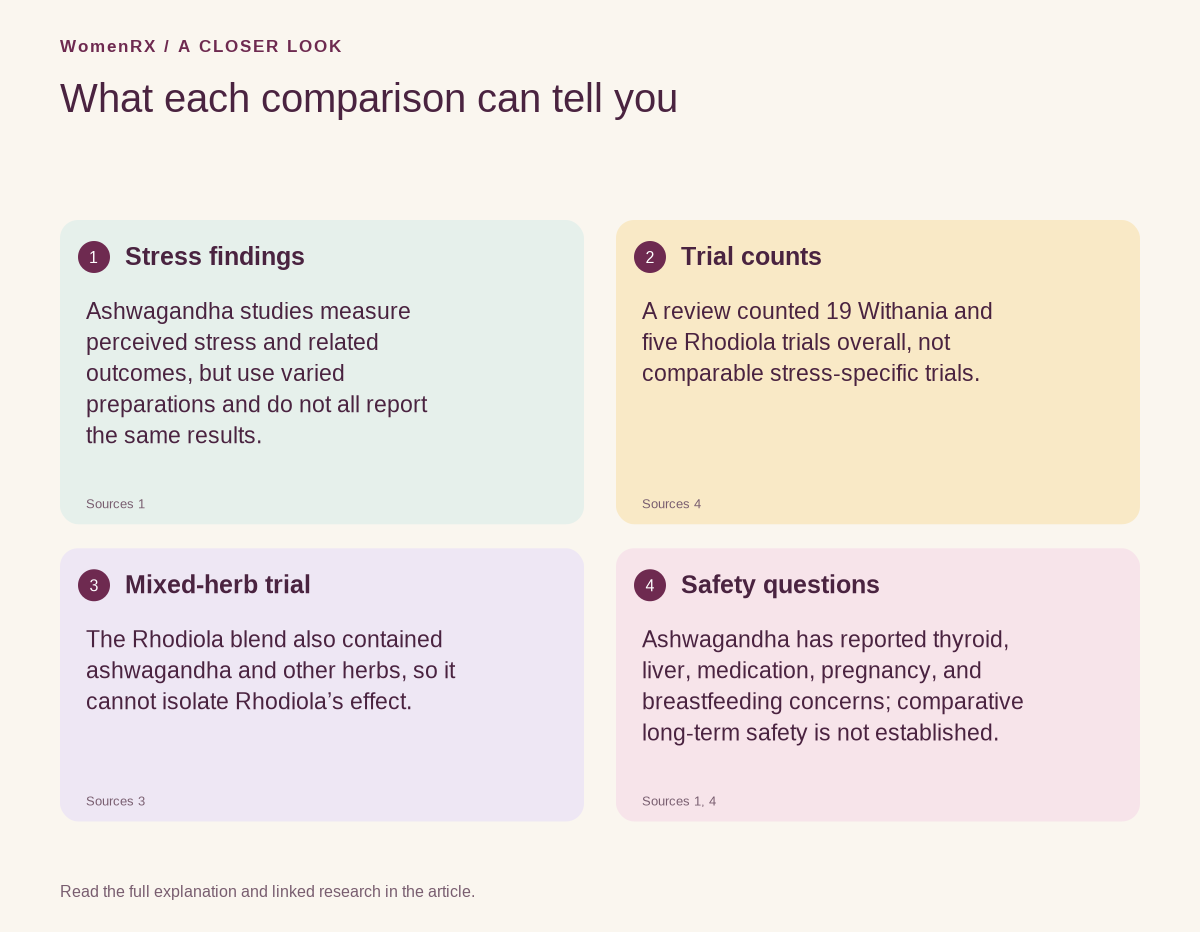
What each comparison can tell you
Stress findings: Ashwagandha studies measure perceived stress and related outcomes, but use varied preparations and do not all report the same results.1
Trial counts: A review counted 19 Withania and five Rhodiola trials overall, not comparable stress-specific trials.4
Mixed-herb trial: The Rhodiola blend also contained ashwagandha and other herbs, so it cannot isolate Rhodiola’s effect.3
Safety questions: Ashwagandha has reported thyroid, liver, medication, pregnancy, and breastfeeding concerns; comparative long-term safety is not established.14
Read the figure as text
The study counts, stress outcomes, mixed-herb trial, and safety information answer different questions; none establishes a clear winner.- Stress findings: Ashwagandha studies measure perceived stress and related outcomes, but use varied preparations and do not all report the same results.1
- Trial counts: A review counted 19 Withania and five Rhodiola trials overall, not comparable stress-specific trials.4
- Mixed-herb trial: The Rhodiola blend also contained ashwagandha and other herbs, so it cannot isolate Rhodiola’s effect.3
- Safety questions: Ashwagandha has reported thyroid, liver, medication, pregnancy, and breastfeeding concerns; comparative long-term safety is not established.14
More questions, answered
Has a study compared ashwagandha with Rhodiola?
A 60-day trial compared an ashwagandha-root product with a blend containing Rhodiola, ashwagandha, and other herbs. Both products had lower perceived-stress scores than placebo, but the blend can’t show Rhodiola’s effect on its own. 3
Do these supplements have proven different effects in women?
The trial summaries don’t establish women-specific effects or show that either herb works differently by sex. They also don’t establish safety during pregnancy or breastfeeding for Rhodiola. 134
Sources you can check
- Ashwagandha: Is it helpful for stress, anxiety, or sleep? - Health Professional Fact SheetAccessed 2026-09-25Return to first citation
- Stress: MedlinePlusAccessed 2026-09-25Return to first citation
- Effects of multi-herb and ashwagandha root formulas on stress modulation: a randomized, double-blind, placebo-controlled clinical study.McKinney E, Stewart J, Kewalramani R, Singh S. · Trials · 2026Return to first citation
- Clinical evidence for the adaptogenic effects of Withania somnifera and Rhodiola rosea - A systematic review with molecular interpretation of psychometric outcomes.Łuszczak J, Kocki J. · Annals of agricultural and environmental medicine : AAEM · 2026Return to first citation
- Modulation of the hypothalamic-pituitary-adrenal (HPA) axis by plants and phytonutrients: a systematic review of human trials.Lopresti AL, Smith SJ, Drummond PD. · Nutritional neuroscience · 2022Return to first citation