Ashwagandha Trial Timelines for Stress and Sleep
Trials usually measured stress and sleep over weeks, not hours, and their check-in dates are not a promise of when you’ll feel a difference.
In studies, stress outcomes were commonly assessed after 6 to 8 weeks, while sleep trials often ran 6 to 12 weeks; some found stronger sleep results in studies lasting at least 8 weeks. Those are research timelines, not guaranteed onset times. Extracts differ, and these group-level results don’t establish a special effect for women. 1 4
What the study timelines can, and can’t, tell you
If you’re trying to decide whether ashwagandha is doing anything, the most useful takeaway is that researchers usually looked for changes over several weeks. A trial’s final visit tells you when researchers measured an outcome, not when every participant first noticed a change. It also doesn’t establish how long you should take a product.
The studies used different extracts, plant parts, and measures. A result for one preparation can’t automatically be applied to another supplement on a store shelf. 1
Stress: one newer trial checked outcomes from day 14
A review summarized seven randomized trials of adults in India who took ashwagandha or a placebo for 6 to 8 weeks. The studies assessed stress and anxiety with rating scales, and some also measured cortisol, a stress-related hormone. The review covered different preparations, so that window doesn’t represent one specific extract. 1
A newer 84-day randomized trial tested Zenroot, a specific ashwagandha formulation, and checked outcomes on days 14, 28, 56, and 84. Participants receiving it had better scores than the placebo group on some stress and anxiety measures at days 28, 56, and 84. But cortisol and salivary alpha-amylase didn’t differ significantly between groups. That split is a useful reminder: a change in how someone rates stress doesn’t necessarily show up in every biological measure. The findings apply to this formulation and the study participants, not to ashwagandha products as a whole. 2
So, if you’re considering a personal check-in, around 6 to 8 weeks is a reasonable point to compare how you’re feeling with where you started. Treat it as a practical review point based on common trial lengths, not a clinically proven rule or a promise of benefit. Notice the outcome you care about, such as feeling less stressed in daily situations, rather than relying on a study’s cortisol results as a stand-in for your experience.
Sleep: the extract matters as much as the window
Sleep studies assessed a mix of outcomes: people’s ratings of sleep quality, how long it took to fall asleep, total sleep time, and, in some trials, actigraphy, a wrist-worn measure of movement used to estimate sleep. 1
A 2021 review of five randomized trials involving 400 adults found a small overall benefit for sleep. Its subgroup analysis suggested more prominent results among people with insomnia and in studies lasting at least 8 weeks. That finding points to a research pattern, not a guarantee that waiting eight weeks will help an individual. 4
Two capsule trials show why the preparation belongs alongside the duration. In a 6-week study, adults with sleep problems took Shoden, a root-and-leaf extract; researchers measured sleep ratings and actigraphy. In an 8-week study, adults with and without insomnia took KSM-66, a root extract; the study assessed sleep with actigraphy and validated rating scales. These are different extracts and study groups, so the dates aren’t a head-to-head comparison. 1
A separate small trial tested ashwagandha in enriched milk for 90 days, rather than as a capsule extract. Its sleep-quality ratings favored the ashwagandha groups on one measure, but differences between groups on the Pittsburgh Sleep Quality Index were not significant. The milk format and small groups also make it a limited comparison with a typical capsule. 3
For sleep, a check-in around 6 to 8 weeks lets you compare your own sleep with the time window used in many trials, while recognizing that some research continued longer. Pick a specific change to assess, such as sleep quality or time to fall asleep. Don’t treat a trial’s follow-up period as evidence that a supplement needs to be continued if you’re not seeing a useful change.
Make the comparison meaningful
Before you start, decide what you would count as a worthwhile difference. For example, you might focus on whether you’re less tense during a recurring stressful part of your day, or whether falling asleep feels easier. Keep the comparison simple: use the same measure at the start and at your chosen review point, and consider whether other changes in your routine could explain the difference.
Be cautious about comparing your experience with a study headline. The stress and sleep research used a range of extracts and doses, and the National Institutes of Health notes that this variation makes it difficult to identify a specific preparation or general recommendation. 1 The NIH summary identifies some stress and sleep studies with mixed-sex groups, but those group-level findings don’t establish a special effect for women or whether effects differ by sex or life stage. 1
Safety belongs in the same review
Short trials suggest ashwagandha is often tolerated for up to about three months, but that doesn’t establish safety for longer use. Mild stomach upset, loose stools, nausea, and drowsiness have been reported; there are also reports of liver injury, and ashwagandha may affect thyroid function. It may interact with sedatives, thyroid hormone medicines, and some medicines for diabetes, blood pressure, or immune suppression. If any of those apply to you, check with a clinician or pharmacist before using it. 1
Expert recommendations advise against ashwagandha during pregnancy, and an agency recommendation also advises against use while breastfeeding. The concern about pregnancy is not proof that the supplement causes miscarriage; the safety question remains unsettled. 1
A useful bottom line: research suggests reassessing stress or sleep over weeks, with many studies checking outcomes around 6 to 8 weeks. That’s a way to frame a thoughtful review, not a promised onset or a reason to ignore side effects. Longer-term safety is unknown, and the group-level results described here don’t establish a special effect for women.
Trial windows by extract and outcome
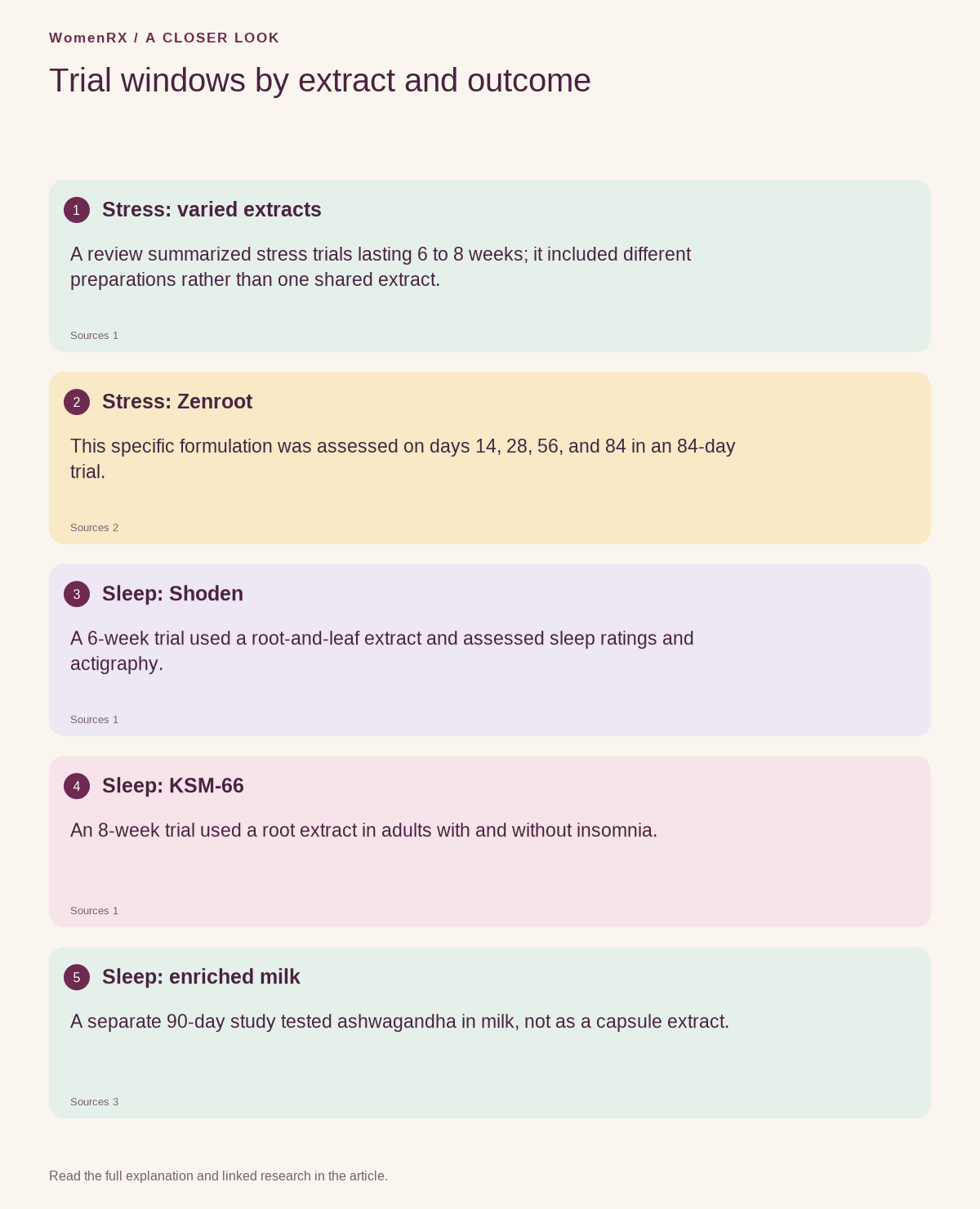
Stress: varied extracts: A review summarized stress trials lasting 6 to 8 weeks; it included different preparations rather than one shared extract.1
Stress: Zenroot: This specific formulation was assessed on days 14, 28, 56, and 84 in an 84-day trial.2
Sleep: Shoden: A 6-week trial used a root-and-leaf extract and assessed sleep ratings and actigraphy.1
Sleep: KSM-66: An 8-week trial used a root extract in adults with and without insomnia.1
Sleep: enriched milk: A separate 90-day study tested ashwagandha in milk, not as a capsule extract.3
Read the figure as text
These are research assessment windows, not predicted onset dates. The extracts, populations, and formats differ, so the studies are not direct comparisons.- Stress: varied extracts: A review summarized stress trials lasting 6 to 8 weeks; it included different preparations rather than one shared extract.1
- Stress: Zenroot: This specific formulation was assessed on days 14, 28, 56, and 84 in an 84-day trial.2
- Sleep: Shoden: A 6-week trial used a root-and-leaf extract and assessed sleep ratings and actigraphy.1
- Sleep: KSM-66: An 8-week trial used a root extract in adults with and without insomnia.1
- Sleep: enriched milk: A separate 90-day study tested ashwagandha in milk, not as a capsule extract.3
More questions, answered
Do stress and sleep measures show the same kind of benefit?
Not necessarily. Trials used subjective ratings for stress and sleep, and some used measures such as cortisol or actigraphy. In one 84-day stress trial, some rating-scale outcomes favored the extract, but cortisol and salivary alpha-amylase did not differ significantly from placebo. 1 2
Is the research specific to women?
The NIH summary identifies some stress and sleep studies with mixed-sex groups, but the group-level findings it describes don’t establish a special effect for women or show whether effects differ by sex or life stage. 1
Sources you can check
- Ashwagandha: Is it helpful for stress, anxiety, or sleep? - Health Professional Fact SheetAccessed 2026-09-25Return to first citation
- A New Ashwagandha Formulation (Zenroot™) Alleviates Stress and Anxiety Symptoms While Improving Mood and Sleep Quality: A Randomized, Double-Blind, Placebo-Controlled Clinical Study.Mahadevan M, Gopukumar K, Gupta R, Morde A, Patni P, Srinivas SS, Bhuvanendran A, Phanindra A. · Advances in therapy · 2025Return to first citation
- Effectiveness of Enriched Milk with Ashwagandha Extract and Tryptophan for Improving Subjective Sleep Quality in Adults with Sleep Problems: A Randomized Double-Blind Controlled Trial.Pérez-Piñero S, Muñoz-Carrillo JC, Echepare-Taberna J, Muñoz-Cámara M, Herrera-Fernández C, Ávila-Gandía V, Heres Fernández Ladreda M, Menéndez Martínez J, López-Román FJ. · Clocks & sleep · 2024Return to first citation
- Effect of Ashwagandha (Withania somnifera) extract on sleep: A systematic review and meta-analysis.Cheah KL, Norhayati MN, Husniati Yaacob L, Abdul Rahman R. · PloS one · 2021Return to first citation