Ashwagandha for Stress or Sleep: What Trials Show
Short trials suggest possible benefits for stress and sleep, but the outcome and extract tested make a difference.
Ashwagandha extracts have improved stress ratings in several short trials, though one 12-week trial found no greater stress benefit than placebo. Sleep studies show a small average benefit, more noticeable among people with insomnia. Anxiety findings are promising but don’t establish ashwagandha as a substitute for established care. Check the extract studied against your product, then weigh thyroid, liver, medicine, and reproductive safety questions. 1 3 2
Start with the result you want
If you’re considering ashwagandha, “does it work?” has three different answers. Feeling less stressed, having fewer anxiety symptoms, and sleeping better are related goals, but a trial measuring one doesn’t prove a benefit for the others.
For perceived stress, the short-term results are encouraging but mixed. A 2021 review covered seven randomized studies involving 491 adults in India with high stress or anxiety, or a diagnosed anxiety disorder. Over six to eight weeks, stress and anxiety ratings improved more with ashwagandha than with placebo overall. The studies used different preparations, including root extracts, root-and-leaf extracts, and whole-root granules. 1
A more recent eight-week trial tested a specific root-and-leaf extract, Sensoril, in adults seeking help for chronic stress symptoms. Stress ratings improved compared with placebo; 131 adults enrolled, and 98 were included in the final analysis. That’s evidence about this extract in this study group, not every bottle labeled ashwagandha. 4
The findings aren’t uniformly positive. In a 12-week placebo-controlled trial of a root extract called Witholytin, participants were adults aged 40 to 75 who were overweight or mildly obese and reported stress and fatigue. Their perceived-stress scores improved, but not more than with placebo. Fatigue improved more in the ashwagandha group. A fatigue result shouldn’t be sold as a demonstrated stress result. 3
For sleep, the average benefit looks small. A 2021 review combined five studies involving 372 adults in India who described themselves as healthy or had insomnia. Compared with placebo, ashwagandha extracts produced a small improvement in sleep across studies lasting six to twelve weeks. Benefits appeared more pronounced among participants with insomnia. Individual trials assessed measures including sleep quality, time to fall asleep, and time spent asleep, but the review doesn’t establish that any ashwagandha product will help with your particular sleep problem. 1
For anxiety, separate symptoms from an anxiety disorder. Some ashwagandha trials measured anxiety ratings alongside stress. An international taskforce made a provisional recommendation for a particular type of root extract in generalized anxiety disorder, while saying more evidence was needed for a stronger recommendation. If worry is persistent or interfering with work, relationships, or daily activities, that calls for a different conversation than choosing a stress supplement. Psychotherapy, medicines, or both are the main treatments for anxiety disorders. 1 2
Compare your label with the actual trial
Ashwagandha is the plant name, not a standardized recipe. Root-only and root-and-leaf extracts have both been studied; extraction methods and standardization also differ. That variety makes it difficult to identify one preparation that works best or transfer a result from one extract to another. 1
When a product cites a study, try three checks:
- Plant part: Does the label say root, root and leaf, or neither? A root-and-leaf trial isn’t a direct test of a root-only product. 1
- Extract identity: Is the named extract in the study actually identified on the label? A shared plant name alone is a weak match. 1
- Outcome and group: Did the trial measure stress, sleep, or anxiety, and were its participants dealing with something like your concern? For example, a sleep finding in people with insomnia is more relevant to insomnia than a stress finding in adults reporting fatigue. 1 3
Even a close match tells you which research is most relevant, not whether a product is equivalent to the one tested or whether you’ll get the same result. Most trials also lasted weeks, not years. 1
The safety questions that can change the decision
Ashwagandha was generally tolerated in trials lasting up to about three months, but safety over many months or years isn’t known. Stomach upset, loose stools, nausea, and drowsiness have been reported. There are also reports of liver injury associated with use. Some involved combination products or products whose contents weren’t independently verified, so these reports don’t tell us how often injury occurs. Reported signs in liver-injury cases included yellowing of the eyes or skin, itching, and abdominal discomfort. 1
Thyroid effects deserve attention if you have a thyroid condition or take thyroid hormone medicine. In a small trial involving people with subclinical hypothyroidism, thyroid blood tests changed with ashwagandha compared with placebo; case reports have also described thyrotoxicosis in women taking extracts. These findings don’t make ashwagandha a thyroid treatment. They do make it worth checking with your prescriber before using it. Possible interactions have also been flagged with sedatives, medicines for diabetes or high blood pressure, and immunosuppressants. 1
Pregnancy and breastfeeding are separate safety decisions. Short stress and sleep trials in adults don’t establish safety during either period. Some experts advise against use in pregnancy, and a French food-safety agency has recommended against use during pregnancy and breastfeeding. Claims that ashwagandha causes pregnancy loss remain disputed; it would be wrong to present that as a proven effect. If you’re pregnant or breastfeeding, don’t assume a supplement marketed as “natural” has been shown safe for you. 1
Finally, findings in mixed-sex adult groups shouldn’t be relabeled as evidence for postpartum stress or menopause-related sleep problems. The trials above don’t establish a distinct benefit for either situation. The most useful next move is to match the study to your goal and product, then decide whether the possible short-term benefit is worth the safety questions in your circumstances. 1
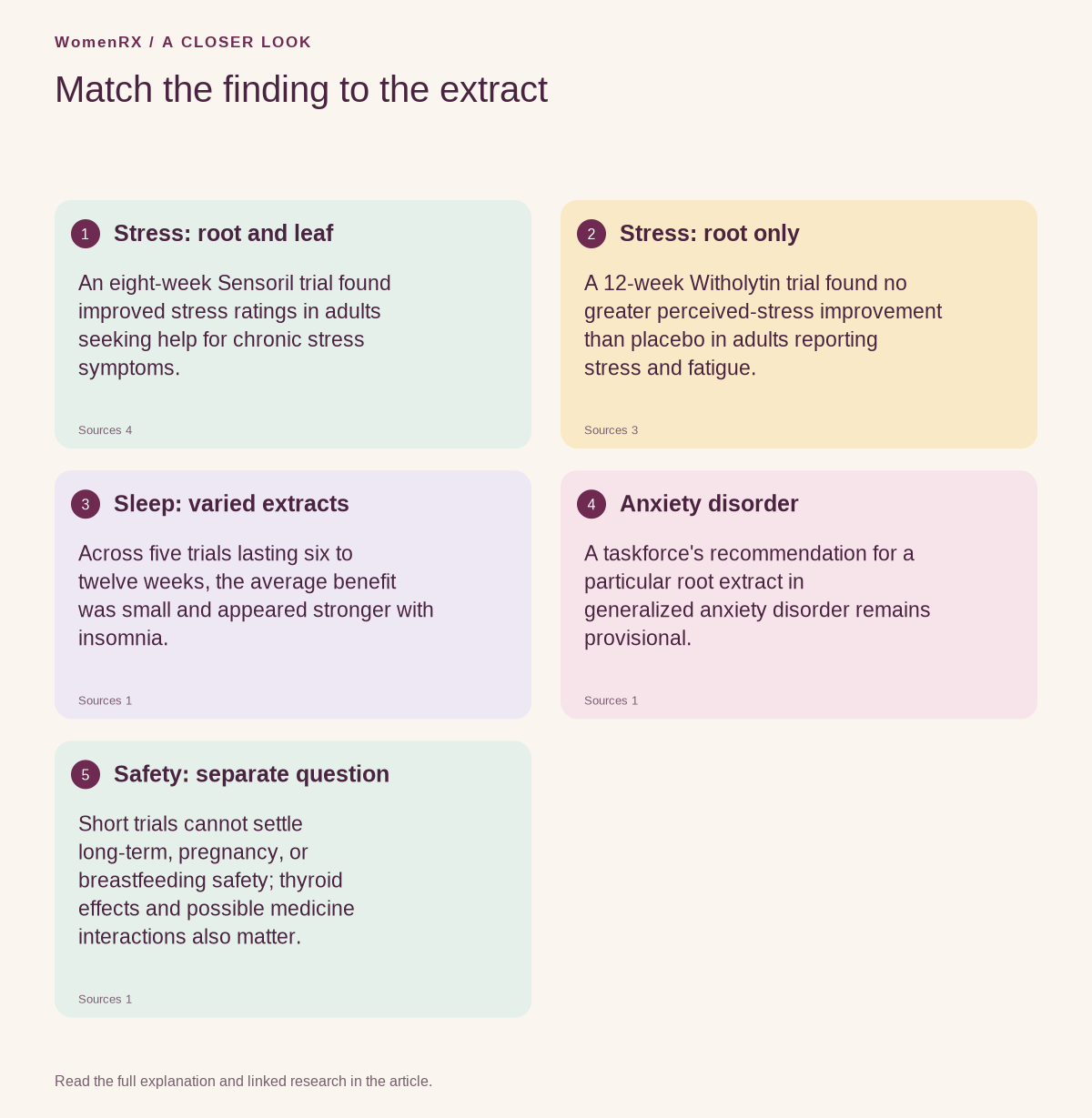
Match the finding to the extract
Stress: root and leaf: An eight-week Sensoril trial found improved stress ratings in adults seeking help for chronic stress symptoms.4
Stress: root only: A 12-week Witholytin trial found no greater perceived-stress improvement than placebo in adults reporting stress and fatigue.3
Sleep: varied extracts: Across five trials lasting six to twelve weeks, the average benefit was small and appeared stronger with insomnia.1
Anxiety disorder: A taskforce's recommendation for a particular root extract in generalized anxiety disorder remains provisional.1
Safety: separate question: Short trials cannot settle long-term, pregnancy, or breastfeeding safety; thyroid effects and possible medicine interactions also matter.1
Read the figure as text
These studies answer different questions, even though each tested something called ashwagandha.- Stress: root and leaf: An eight-week Sensoril trial found improved stress ratings in adults seeking help for chronic stress symptoms.4
- Stress: root only: A 12-week Witholytin trial found no greater perceived-stress improvement than placebo in adults reporting stress and fatigue.3
- Sleep: varied extracts: Across five trials lasting six to twelve weeks, the average benefit was small and appeared stronger with insomnia.1
- Anxiety disorder: A taskforce's recommendation for a particular root extract in generalized anxiety disorder remains provisional.1
- Safety: separate question: Short trials cannot settle long-term, pregnancy, or breastfeeding safety; thyroid effects and possible medicine interactions also matter.1
More questions, answered
Does a lower cortisol result mean I’ll feel less stressed?
Not necessarily. Some trials measured both cortisol and how participants rated their stress, but they aren’t interchangeable outcomes. In one 12-week root-extract trial, the primary perceived-stress outcome was no better than placebo. Look for a result on the symptom you care about, not a hormone result alone. 1 3
Do these results apply to postpartum or menopause-related symptoms?
Not automatically. Several trials included both men and women, but the findings described here don’t establish separate effects on postpartum stress or menopause-related sleep problems. Breastfeeding also raises a safety question that general adult trials don’t answer. 1
Sources you can check
- Ashwagandha: Is it helpful for stress, anxiety, or sleep? - Health Professional Fact SheetAccessed 2026-09-25Return to first citation
- Anxiety: MedlinePlusAccessed 2026-09-25Return to first citation
- Exploring the efficacy and safety of a novel standardized ashwagandha (Withania somnifera) root extract (Witholytin®) in adults experiencing high stress and fatigue in a randomized, double-blind, placebo-controlled trial.Smith SJ, Lopresti AL, Fairchild TJ. · Journal of psychopharmacology (Oxford, England) · 2023Return to first citation
- Effects of Withania somnifera Extract in Chronically Stressed Adults: A Randomized Controlled Trial.Pandit S, Srivastav AK, Sur TK, Chaudhuri S, Wang Y, Biswas TK. · Nutrients · 2024Return to first citation