Ashwagandha for Sleep: What the Trials Actually Show
Some trials report better sleep, but the results depend on who was studied and what “better” meant.
Ashwagandha may improve some measures of sleep in adults, but the evidence is still limited and doesn’t mean it’s a proven treatment for insomnia. Trials have measured different things, including people’s ratings of sleep quality and device-recorded time to fall asleep. A small trial in postmenopausal women is directly relevant to that life stage; results don’t automatically apply to other women. 3 2
“Better sleep” can mean different things
A sleep study might ask whether you feel more rested, measure how long it takes you to fall asleep, or assess whether you wake during the night. Those outcomes are related, but they aren’t interchangeable. A change in a sleep-quality questionnaire doesn’t necessarily show that someone with persistent insomnia falls asleep faster or stays asleep all night.
That distinction matters because the studies of ashwagandha, also called Withania somnifera, enrolled different groups and measured different outcomes. In one six-week placebo-controlled trial, 150 healthy adults with non-restorative sleep were assigned to a standardized extract or placebo. Researchers assessed participants’ reported sleep quality and used activity monitors to measure sleep onset, total sleep time, sleep efficiency, and wakefulness after falling asleep. This was a study of non-restorative sleep in otherwise healthy adults, not a trial limited to people diagnosed with insomnia. 1
A 2021 systematic review pooled five randomized trials involving 400 adults. It found an overall improvement in sleep compared with placebo, but the studies differed enough that results varied across them. The review found more prominent effects in the subgroup diagnosed with insomnia, but that subgroup finding doesn’t establish ashwagandha as an established insomnia treatment. 3
What the findings mean for women
The older sleep studies summarized in that review included people with insomnia, stressed healthy adults, and older adults. The reported summaries don’t establish that their results apply specifically to women or to a particular reproductive life stage. 3
There is a more directly relevant trial for postmenopause: a randomized, placebo-controlled study enrolled 66 postmenopausal women, with 63 completing 12 weeks. Sleep quality, measured with the Pittsburgh Sleep Quality Index, improved more in the ashwagandha group than in the placebo group. That’s a useful early finding for postmenopausal women, but it comes from a small, single-center study, so it shouldn’t be treated as a settled answer for everyone. 2
A separate 12-week open-label trial enrolled 70 women in their second trimester of pregnancy. Ashwagandha was added to standard hematinic therapy, and sleep was a secondary outcome. The study reported improvements in some sleep measures and no adverse events among participants. Because it was small, open-label, and assessed a particular combination of care, it doesn’t establish broad pregnancy safety. It also doesn’t answer whether results apply postpartum. 4
Extracts and study results aren’t one-size-fits-all
The trials used different extracts, amounts, and study lengths. For example, the healthy-adult trial used a standardized extract for six weeks, while the postmenopausal trial tested root extract for 12 weeks. The review also included studies using other formulations and schedules. That makes it difficult to assume a product on a store shelf will match a studied extract or produce the same result. 1 2 3
If you’re comparing a supplement with a study, check the extract and formulation, not just the word “ashwagandha.” Even a close match doesn’t guarantee the same result: one trial’s findings apply to its participants and its study conditions.
A practical safety check
Short trials reporting no serious problems aren’t enough to settle long-term safety. The systematic review found no serious side effects reported in the included trials, but noted that serious-effect data were limited and more information was needed about long-term use. 3
Before trying it, consider:
- Your life stage: A short pregnancy trial is not general proof of safety in pregnancy. If you’re pregnant, discuss the specific product with your prenatal care team before using it. 4
- What you’re trying to improve: A study of people who feel unrefreshed doesn’t necessarily answer what will help with ongoing insomnia. 1 3
- The exact product: Research used particular extracts. A different product may not have the same evidence behind it. 1 2 3
- Other medicines or supplements: The sleep trials don’t establish that combining ashwagandha with other products or medicines is safe. A pharmacist or clinician can review the exact label and your current medicines.
If sleep difficulty keeps happening or is disrupting your days, don’t rely on a supplement trial as a substitute for getting the problem assessed. The studies show early signals on selected sleep measures, not that ashwagandha identifies or resolves every reason sleep can be difficult.
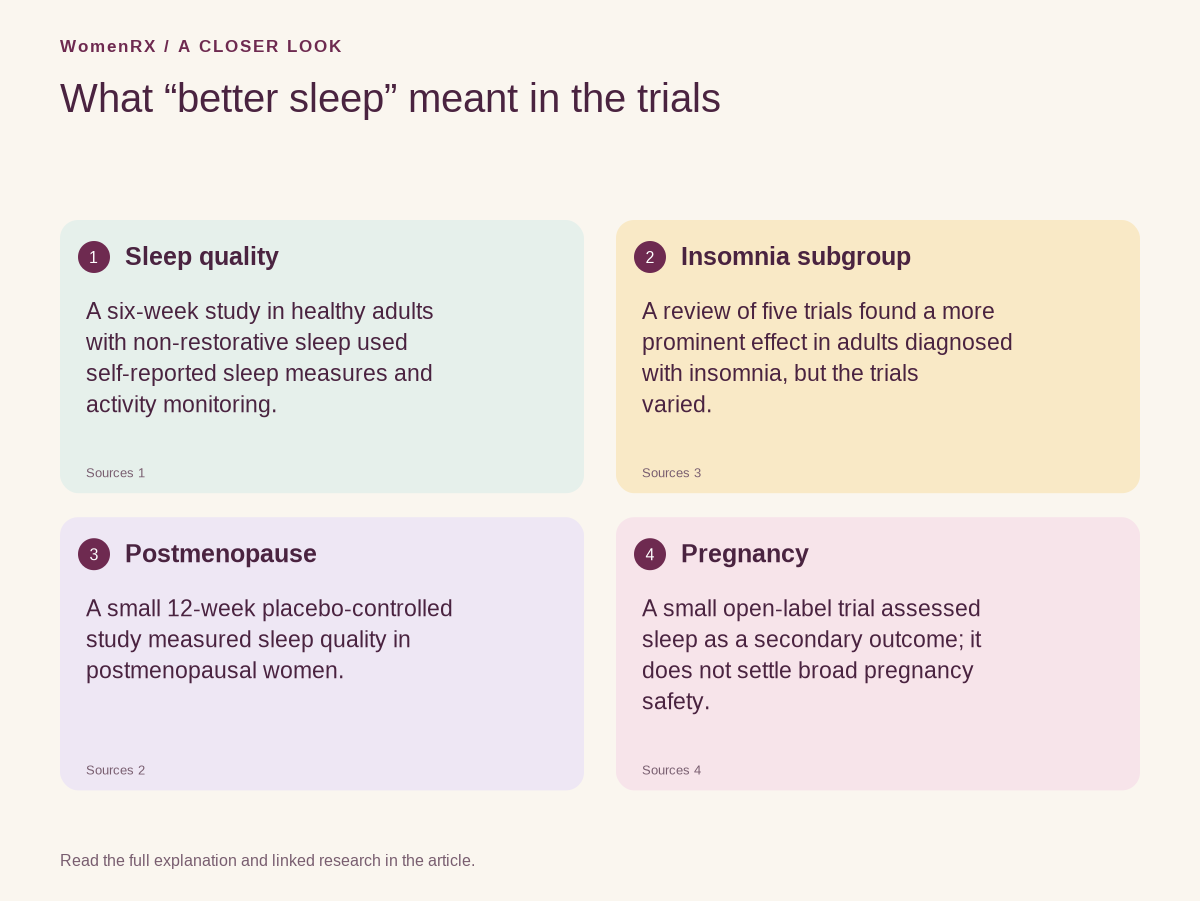
What “better sleep” meant in the trials
Sleep quality: A six-week study in healthy adults with non-restorative sleep used self-reported sleep measures and activity monitoring.1
Insomnia subgroup: A review of five trials found a more prominent effect in adults diagnosed with insomnia, but the trials varied.3
Postmenopause: A small 12-week placebo-controlled study measured sleep quality in postmenopausal women.2
Pregnancy: A small open-label trial assessed sleep as a secondary outcome; it does not settle broad pregnancy safety.4
Read the figure as text
These studies measured different sleep outcomes in different groups, so a positive result in one setting does not answer every sleep question.- Sleep quality: A six-week study in healthy adults with non-restorative sleep used self-reported sleep measures and activity monitoring.1
- Insomnia subgroup: A review of five trials found a more prominent effect in adults diagnosed with insomnia, but the trials varied.3
- Postmenopause: A small 12-week placebo-controlled study measured sleep quality in postmenopausal women.2
- Pregnancy: A small open-label trial assessed sleep as a secondary outcome; it does not settle broad pregnancy safety.4
More questions, answered
Does better sleep quality mean ashwagandha treats insomnia?
Not necessarily. Sleep-quality ratings, time to fall asleep, and a diagnosis of insomnia are different measures. The trial results are promising for some outcomes, but they don’t establish ashwagandha as a proven insomnia treatment. 1 3
Do the sleep studies show that ashwagandha is safe for long-term use?
No. The review found no serious side effects reported in the included trials, but said serious-effect data were limited and that more evidence is needed to assess long-term use. 3
Sources you can check
- A randomized, double blind, placebo controlled study to evaluate the effects of ashwagandha (Withania somnifera) extract on sleep quality in healthy adults.Deshpande A, Irani N, Balkrishnan R, Benny IR. · Sleep medicine · 2020Return to first citation
- Effects of Withania somnifera root extract on sleep quality, body composition, and menopausal symptoms in postmenopausal women: a randomized, double-blind, placebo-controlled trial.Obhrai S, Shenoy S, Arora M. · Menopause (New York, N.Y.) · 2026Return to first citation
- Effect of Ashwagandha (Withania somnifera) extract on sleep: A systematic review and meta-analysis.Cheah KL, Norhayati MN, Husniati Yaacob L, Abdul Rahman R. · PloS one · 2021Return to first citation
- Efficacy and safety of Ashwagandha (Withania somnifera) root extract in pregnant women: a prospective, randomized, comparative, open-label, 12-week study.Ajgaonkar A, Tayade H, Nayak A. · Frontiers in global women's health · 2026Return to first citation