Ashwagandha After 40: What Menopause Trials Show
A few trials directly studied women with menopause symptoms, but age alone doesn’t tell you whether their findings fit your stage or concern.
Yes, a small amount of research directly includes women in a named menopause stage: one placebo-controlled trial enrolled women with perimenopausal symptoms, and another studied postmenopausal women. A separate trial enrolled women aged 45-55 with menopause symptoms but did not state their stage. These findings are promising but short-term, and they don’t establish ashwagandha as a standard menopause treatment. 4 6 5
Age and menopause stage aren’t the same thing
If you’re over 40 and considering ashwagandha, a study’s age range is only part of the story. A trial that names perimenopause or postmenopause tells you more about who was studied than one that simply enrolled women in midlife. It also matters whether the researchers measured the concern you have, such as sleep or hot flashes.
Much of the broader ashwagandha research looks at stress, anxiety, or sleep in adults. Some studies include both men and women, and menopause stage or results for women specifically aren’t reported. Those findings may be relevant to general stress or sleep, but they don’t show that ashwagandha treats menopause symptoms. 1
What the stage-specific trials found
One randomized, placebo-controlled trial enrolled 100 women with perimenopausal symptoms; 91 completed the eight-week study. Compared with placebo, the ashwagandha group had greater improvement in total menopause symptom scores and menopause-related quality-of-life scores. The study also reported differences in some hormone measurements. These results apply to the women and outcomes studied, over eight weeks; they don’t establish how long any benefit lasts. 4
A separate randomized, placebo-controlled trial studied 66 postmenopausal women aged 45 to 65 at one center in India. Sixty-three completed 12 weeks. Compared with placebo, the ashwagandha group had greater improvements in sleep quality and menopause symptom scores. This is direct evidence in postmenopausal women, but a small, single-center trial cannot answer how reliably the result applies to other women or lasts beyond the study period. 6
There’s also a trial of 60 women aged 45 to 55 with menopause symptoms. It reported improvements in symptom scores and hot-flash events compared with placebo over 56 days. But its abstract doesn’t specify whether participants were perimenopausal or postmenopausal, so age and symptoms alone can’t tell you which stage the results represent. 5
Taken together, the stage-specific studies offer early evidence about symptom scores and sleep. They don’t establish that ashwagandha prevents health changes associated with menopause, or that it works as well as established treatments.
Match the evidence to the reason you’re considering it
For general stress: Several adult studies suggest possible benefits for perceived stress or anxiety, but they aren’t the same as trials of menopause-related stress. Their results don’t establish a menopause-specific effect. 1
For sleep: General adult studies and the postmenopausal trial provide some evidence that sleep may improve for some participants. The postmenopausal finding is relevant, but it comes from one small, short trial. It also doesn’t establish what is causing your sleep disruption or whether ashwagandha addresses that cause. 1 6
For hot flashes: Don’t assume that stress or sleep findings apply. The North American Menopause Society’s 2023 statement did not recommend supplements or herbal remedies for vasomotor symptoms, based on the evidence it reviewed. That statement predates the newer menopause trials; those trials add information, but they’re not enough to settle the question. 3 5 6
For bothersome hot flashes, the North American Menopause Society identifies hormone therapy as the most effective treatment for vasomotor symptoms. Its nonhormone statement also lists evidence-supported options, including certain prescription medicines and cognitive behavioral therapy. The right fit depends on your symptoms, health history, and preferences. 2 3
The practical tradeoff
Direct studies in perimenopausal and postmenopausal women make the evidence more relevant to midlife than a general adult stress study. But a trial result belongs to the participants, preparation, and timeframe actually studied. Broader ashwagandha research has used different plant parts and extracts, and different methods of preparation and standardization. That makes it hard to assume a product on a store shelf matches a studied extract. The menopause trial abstracts don’t resolve that question for a particular product. 1 4 6
Safety is part of the decision, too. Short-term studies commonly report mild effects such as stomach upset, loose stools, nausea, or drowsiness. Longer-term safety is not known. Ashwagandha may affect thyroid function, has been linked to reports of liver injury, and may interact with thyroid hormone medicines, sedatives, medicines for diabetes or blood pressure, and immunosuppressants. If one of these applies to you, check the specific risk with your prescriber or pharmacist before using it. 1
there is direct, early research in women with perimenopausal symptoms and in postmenopausal women, plus a midlife-age study that doesn’t identify participants’ stage. That makes ashwagandha worth distinguishing from supplements studied only in mixed-sex adult groups, but it doesn’t make being over 40 an indication or establish it as a proven treatment for menopause symptoms.
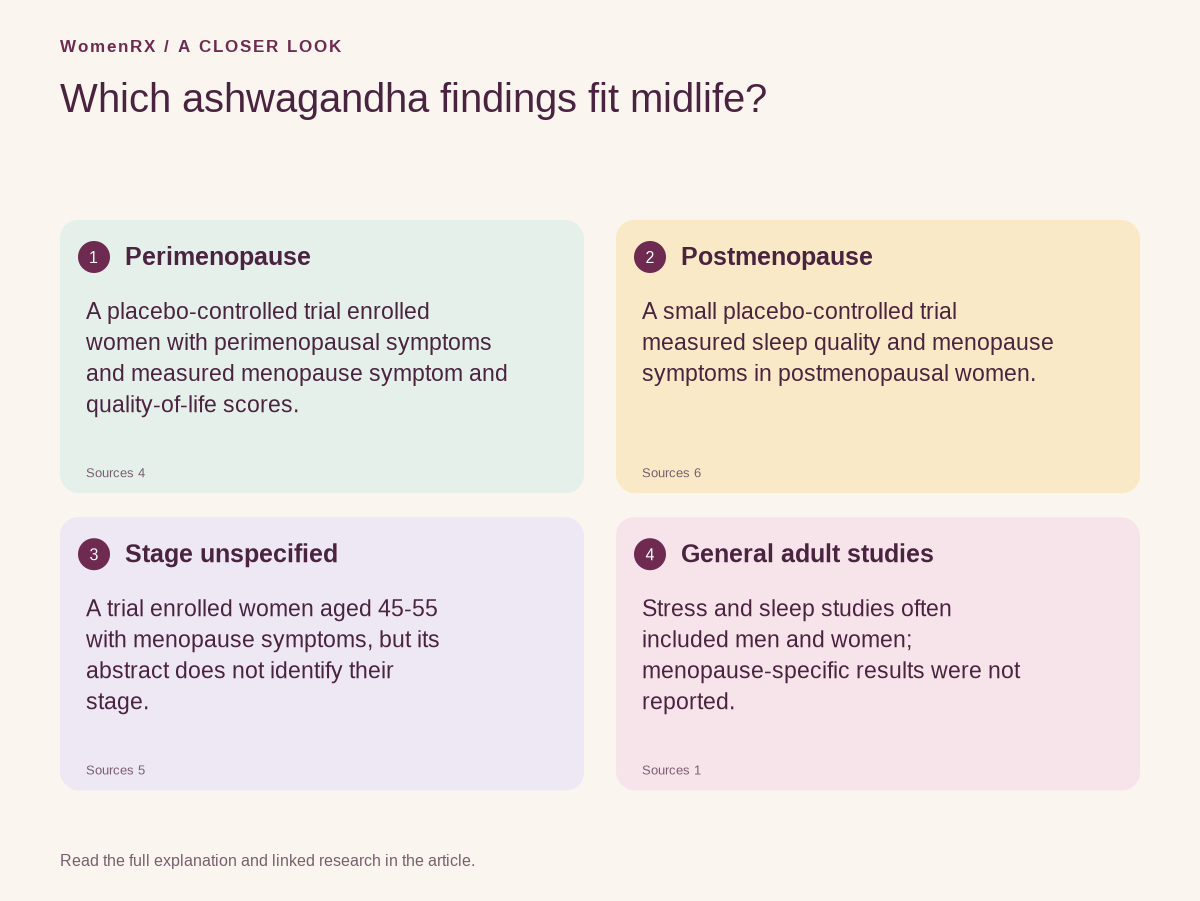
Which ashwagandha findings fit midlife?
Perimenopause: A placebo-controlled trial enrolled women with perimenopausal symptoms and measured menopause symptom and quality-of-life scores.4
Postmenopause: A small placebo-controlled trial measured sleep quality and menopause symptoms in postmenopausal women.6
Stage unspecified: A trial enrolled women aged 45-55 with menopause symptoms, but its abstract does not identify their stage.5
General adult studies: Stress and sleep studies often included men and women; menopause-specific results were not reported.1
Read the figure as text
The evidence is more directly relevant when a study identifies menopause stage and measures a concern that matches yours.- Perimenopause: A placebo-controlled trial enrolled women with perimenopausal symptoms and measured menopause symptom and quality-of-life scores.4
- Postmenopause: A small placebo-controlled trial measured sleep quality and menopause symptoms in postmenopausal women.6
- Stage unspecified: A trial enrolled women aged 45-55 with menopause symptoms, but its abstract does not identify their stage.5
- General adult studies: Stress and sleep studies often included men and women; menopause-specific results were not reported.1
More questions, answered
Does a study in women aged 45 to 55 prove it works in perimenopause?
No. Age doesn’t identify menopause stage. One trial in women aged 45 to 55 reported improvements in menopause symptom scores and hot-flash events, but its abstract doesn’t say whether participants were perimenopausal or postmenopausal. A separate study explicitly enrolled women with perimenopausal symptoms. 4 5
Can ashwagandha replace established treatment for hot flashes?
The available trials don’t establish that. Menopause guidance identifies hormone therapy as the most effective treatment for vasomotor symptoms and lists evidence-supported nonhormone options; its 2023 statement did not recommend supplements or herbal remedies for those symptoms. 2 3
Sources you can check
- Ashwagandha: Is it helpful for stress, anxiety, or sleep? - Health Professional Fact SheetAccessed 2026-09-25Return to first citation
- The 2022 hormone therapy position statement of The North American Menopause Society.“The 2022 Hormone Therapy Position Statement of The North American Menopause Society” Advisory Panel. · Menopause (New York, N.Y.) · 2022Return to first citation
- The 2023 nonhormone therapy position statement of The North American Menopause Society.Menopause (New York, N.Y.) · 2023Return to first citation
- Effect of an ashwagandha (Withania Somnifera) root extract on climacteric symptoms in women during perimenopause: A randomized, double-blind, placebo-controlled study.Gopal S, Ajgaonkar A, Kanchi P, Kaundinya A, Thakare V, Chauhan S, Langade D. · The journal of obstetrics and gynaecology research · 2021Return to first citation
- A prospective, randomized, double-blind, placebo-controlled study on efficacy and safety of Ashwagandha root extract (Withania somnifera) for managing menopausal symptoms in women.Vani I, Muralidhar G, Rao BS. · Frontiers in reproductive health · 2025Return to first citation
- Effects of Withania somnifera root extract on sleep quality, body composition, and menopausal symptoms in postmenopausal women: a randomized, double-blind, placebo-controlled trial.Obhrai S, Shenoy S, Arora M. · Menopause (New York, N.Y.) · 2026Return to first citation