Ashwagandha for Menopause: Benefits, Limits, and Safety
Small trials suggest possible benefits for menopause symptom scores and sleep, but ashwagandha is not a proven replacement for established treatment.
Ashwagandha has been tested in small, short placebo-controlled trials involving women in perimenopause and postmenopause. Both reported improvements in menopause symptom scores, and the postmenopausal trial also found better sleep scores. These findings don’t establish lasting benefit or make ashwagandha a substitute for treatments with stronger evidence. Side effects, possible thyroid effects, medication interactions, and uncertain long-term safety matter too. 5 6 1
The menopause research is more specific than a stress claim
If you’re considering ashwagandha for night sweats, poor sleep, or a general sense that menopause has thrown you off, start with the symptom you hope it will help. Research on stress in adults cannot, by itself, tell you whether a supplement treats menopause symptoms. There are also trials in women at different menopause stages, though they’re small and short.
In an eight-week placebo-controlled trial, 100 women with perimenopausal symptoms enrolled and 91 completed the study. Women assigned an ashwagandha root extract had greater improvements in menopause symptom and menopause-related quality-of-life scores than those assigned placebo. Researchers also found differences in several hormone measurements. 5
A separate, 12-week placebo-controlled trial enrolled 66 postmenopausal women, of whom 63 completed it. The ashwagandha group improved more than the placebo group on sleep quality and menopause symptom scores. There was no significant difference between groups in bone mineral density. 6
A third trial enrolled 60 women aged 45 to 55 for 56 days and reported improvements in menopause symptom scores, hot-flash events, stress scores, and quality of life compared with placebo. Their specific menopause stage is unclear, so that result is less useful if you’re trying to predict an effect specifically in perimenopause or postmenopause. 7
These trials offer an early signal, not a dependable estimate of what you personally would feel. They don’t establish how long improvements last, whether different ashwagandha products have the same effects, or whether changes in hormone measurements translate into the benefits of hormone therapy. 5 6 7
Match the evidence to the symptom
The postmenopause study measured sleep directly, which makes it more relevant to a sleep question than a broad claim that ashwagandha “balances hormones.” The perimenopause study found improvement on overall symptom scales, but that doesn’t mean every symptom will respond equally. The 56-day trial reported fewer hot-flash events, yet its participants’ menopause stage is unclear. 5 6 7
For bothersome hot flashes and night sweats, the North American Menopause Society’s 2023 evidence review did not recommend supplements or herbal remedies. That guidance doesn’t erase the small trials, including newer ones; it does mean the evidence has not established herbal supplements as a reliable hot-flash treatment. 4 6 7
There are better-supported choices if hot flashes are disrupting your days or sleep. Hormone therapy remains the most effective treatment for these symptoms, though its risks and benefits depend on your health and the treatment used. Evidence-backed nonhormonal options include cognitive behavioral therapy, clinical hypnosis, and certain prescription medicines. This is a comparison of evidence, not a reason you must choose a particular treatment. 3 4
Three questions to settle before trying it
Could pregnancy still be possible? Irregular periods in perimenopause don’t rule it out. Pregnancy can occur during this transition, and some experts advise against ashwagandha use during pregnancy. 2 1
Do you have a thyroid concern or take medication? Ashwagandha might affect thyroid function and interact with some medicines. A pharmacist or clinician can assess your actual medication list and health conditions rather than guessing from a general claim that the supplement is “natural.” 1
What would make you stop? Loose stools, nausea, and drowsiness are possible. Liver injury has also been reported. Ashwagandha appears reasonably tolerated for up to about three months, but longer-term safety is unknown; a short trial without serious adverse events cannot settle that question. 1 6
The practical distinction is between possible short-term benefit and proven menopause care. If ashwagandha interests you, be clear about the symptom you’re targeting and consider its safety alongside options supported by stronger evidence. 3 4 5 6
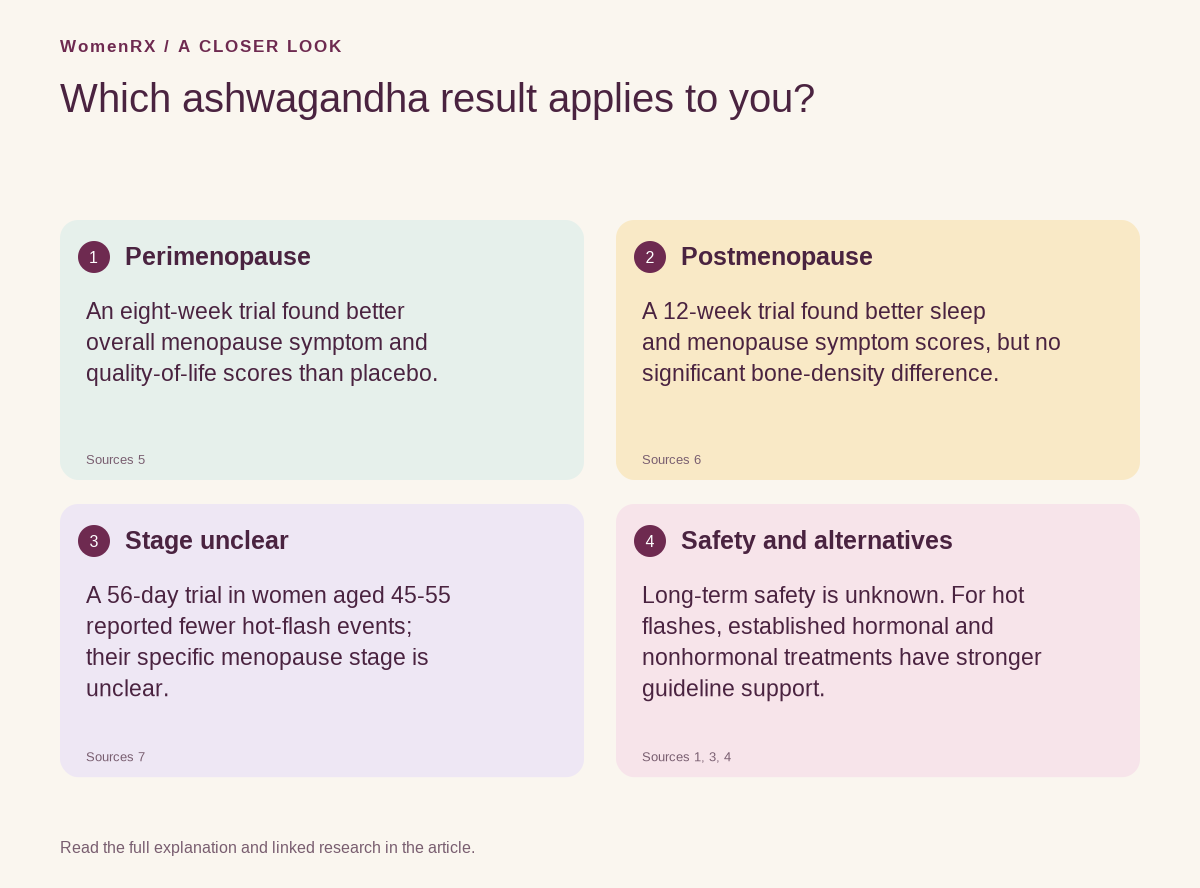
Which ashwagandha result applies to you?
Perimenopause: An eight-week trial found better overall menopause symptom and quality-of-life scores than placebo.5
Postmenopause: A 12-week trial found better sleep and menopause symptom scores, but no significant bone-density difference.6
Stage unclear: A 56-day trial in women aged 45-55 reported fewer hot-flash events; their specific menopause stage is unclear.7
Safety and alternatives: Long-term safety is unknown. For hot flashes, established hormonal and nonhormonal treatments have stronger guideline support.134
Read the figure as text
Compare the participants and outcomes before treating a menopause claim as relevant to your symptom.- Perimenopause: An eight-week trial found better overall menopause symptom and quality-of-life scores than placebo.5
- Postmenopause: A 12-week trial found better sleep and menopause symptom scores, but no significant bone-density difference.6
- Stage unclear: A 56-day trial in women aged 45-55 reported fewer hot-flash events; their specific menopause stage is unclear.7
- Safety and alternatives: Long-term safety is unknown. For hot flashes, established hormonal and nonhormonal treatments have stronger guideline support.134
Sources you can check
- Ashwagandha: Is it helpful for stress, anxiety, or sleep? - Health Professional Fact SheetAccessed 2026-09-25Return to first citation
- Contraception in perimenopause.Soltes BA. · Menopause (New York, N.Y.) · 2025Return to first citation
- The 2022 hormone therapy position statement of The North American Menopause Society.“The 2022 Hormone Therapy Position Statement of The North American Menopause Society” Advisory Panel. · Menopause (New York, N.Y.) · 2022Return to first citation
- The 2023 nonhormone therapy position statement of The North American Menopause Society.Menopause (New York, N.Y.) · 2023Return to first citation
- Effect of an ashwagandha (Withania Somnifera) root extract on climacteric symptoms in women during perimenopause: A randomized, double-blind, placebo-controlled study.Gopal S, Ajgaonkar A, Kanchi P, Kaundinya A, Thakare V, Chauhan S, Langade D. · The journal of obstetrics and gynaecology research · 2021Return to first citation
- Effects of Withania somnifera root extract on sleep quality, body composition, and menopausal symptoms in postmenopausal women: a randomized, double-blind, placebo-controlled trial.Obhrai S, Shenoy S, Arora M. · Menopause (New York, N.Y.) · 2026Return to first citation
- A prospective, randomized, double-blind, placebo-controlled study on efficacy and safety of Ashwagandha root extract (Withania somnifera) for managing menopausal symptoms in women.Vani I, Muralidhar G, Rao BS. · Frontiers in reproductive health · 2025Return to first citation