Ashwagandha for Low Energy: What the Evidence Shows
One trial found lower fatigue scores, but that doesn’t establish ashwagandha as a fix for persistent low energy.
Ashwagandha has a limited, promising signal for fatigue: in one 12-week trial, 120 overweight or mildly obese adults who reported stress and fatigue had a greater improvement in fatigue scores than people taking placebo. The trial’s primary stress measure did not differ between groups, and it did not report a separate result for women. Persistent fatigue still deserves attention to its possible causes. 1 3
A fatigue result, not an all-purpose energy boost
The most direct evidence comes from a 12-week randomized, placebo-controlled trial of 120 adults ages 40 to 75 who were overweight or mildly obese and reported stress and fatigue. The study tested a standardized ashwagandha root extract. Participants taking it had a greater reduction in fatigue symptoms on a questionnaire than those taking placebo. 1 3
There’s an important distinction in the results: fatigue was a secondary outcome, while perceived stress was the primary one. Ashwagandha did not outperform placebo on that primary stress measure. And a change in a fatigue questionnaire doesn’t tell us whether someone’s everyday energy improved enough to matter, or why the fatigue changed. The reported findings don’t establish that ashwagandha treats fatigue caused by a particular health condition. 3
The study included men and women, but its reported results don’t break out a women-specific effect. It therefore can’t tell us whether the result applies differently to women, or to pregnancy, recovery after birth, or menopause. 3
Stress, sleep, and exercise are different outcomes
Some studies measure related experiences rather than persistent low energy. For example, one trial in healthy athletic adults measured endurance and recovery, while another, shorter study in male handball players found no meaningful difference between groups in perceived fatigue or recovery. Exercise performance and recovery findings don’t answer whether a supplement helps fatigue during ordinary daily life. 4 6
Sleep is another separate question. A six-week study enrolled healthy adults with non-restorative sleep and measured sleep quality and other sleep outcomes. Those results may be relevant if sleep is the issue, but they aren’t evidence that ashwagandha treats unexplained, ongoing fatigue. 5
Ashwagandha studies also use different extracts and preparations, which makes results harder to apply to a product on a store shelf. The NIH Office of Dietary Supplements notes that studies have used varied preparations and that this complicates drawing recommendations about specific products or amounts. 1
Persistent fatigue has many possible explanations
Fatigue is a symptom, not a diagnosis. It can be related to too little sleep, stress, activity levels, or pregnancy; it can also be associated with conditions such as anemia, thyroid disease, diabetes, infection, sleep apnea, depression, and anxiety. If you’ve felt fatigued for several weeks, or it’s interfering with your usual activities, finding out what may be contributing is more useful than assuming a supplement is the answer. 2
When you talk about it, a concise picture can help: when it started, what the fatigue feels like, and any changes in sleep, daily activities, appetite, or exercise. Include relevant life-stage timing, such as pregnancy, a recent birth, or the menopause transition, without assuming that timing explains the symptoms. Also bring up known health conditions, treatments, medicines, and other supplements. These details help put a possible supplement benefit in context. 2
What to know before considering ashwagandha
Short studies suggest ashwagandha is often tolerated for up to about three months, but long-term safety is not known. Reported side effects include stomach upset, loose stools, nausea, and drowsiness. There are also reports of liver injury associated with ashwagandha use; reported symptoms have included yellowing of the skin or eyes, itching, nausea, and abdominal discomfort. 1
Ashwagandha may affect thyroid function and could interact with thyroid hormone medicines, sedatives, medicines for diabetes or high blood pressure, and immunosuppressants. If you’re considering it, share the exact product label and your medicine and supplement list with a clinician or pharmacist so they can check for relevant risks. 1
The NIH Office of Dietary Supplements notes that some experts advise against ashwagandha during pregnancy and breastfeeding. That’s especially relevant if fatigue occurs during pregnancy or while breastfeeding: the fatigue trial does not establish benefit or safety for either life stage. 1 3
The practical takeaway is narrow: one mixed-sex trial found a greater improvement in self-reported fatigue, but it doesn’t establish a general energy boost or replace assessment of fatigue that persists.
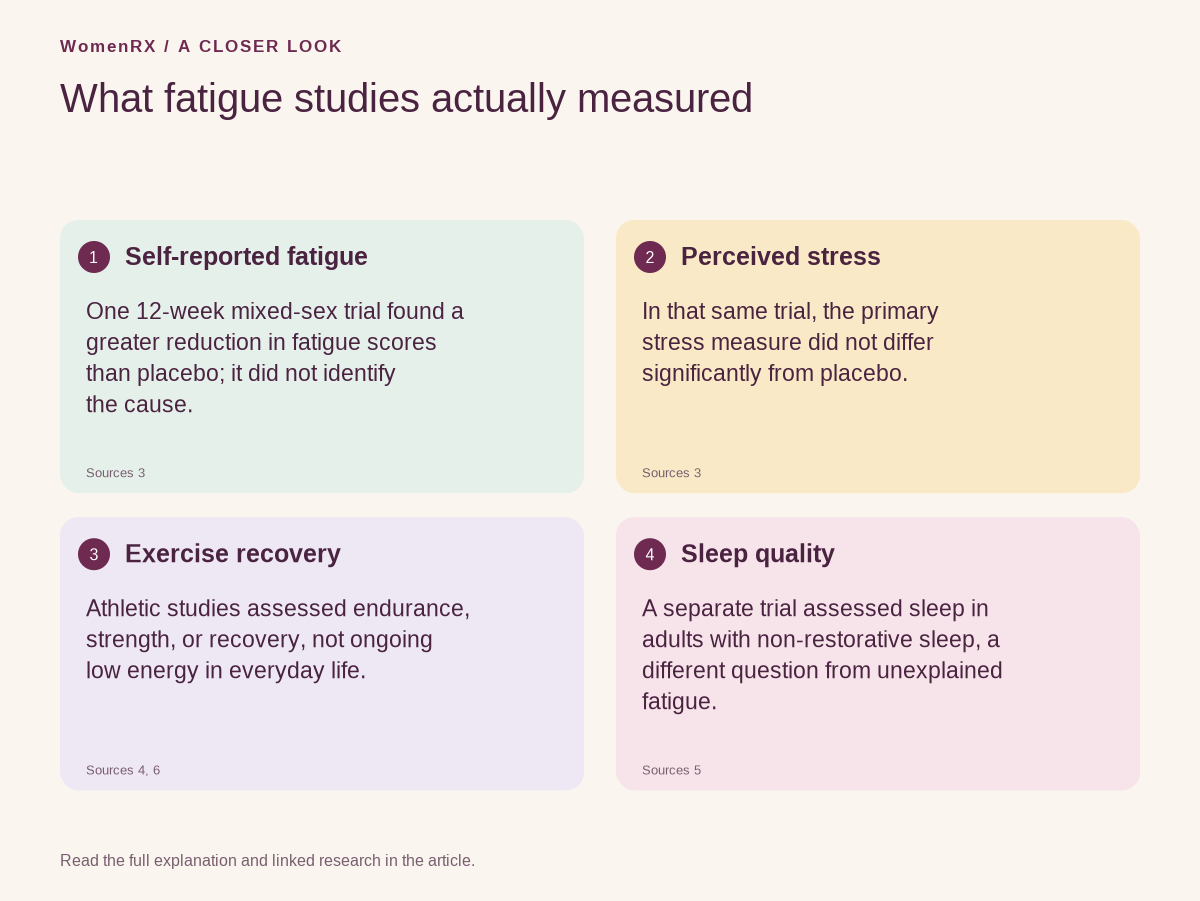
What fatigue studies actually measured
Self-reported fatigue: One 12-week mixed-sex trial found a greater reduction in fatigue scores than placebo; it did not identify the cause.3
Perceived stress: In that same trial, the primary stress measure did not differ significantly from placebo.3
Exercise recovery: Athletic studies assessed endurance, strength, or recovery, not ongoing low energy in everyday life.46
Sleep quality: A separate trial assessed sleep in adults with non-restorative sleep, a different question from unexplained fatigue.5
Read the figure as text
These outcomes are related, but they answer different questions about energy, stress, sleep, and exercise.- Self-reported fatigue: One 12-week mixed-sex trial found a greater reduction in fatigue scores than placebo; it did not identify the cause.3
- Perceived stress: In that same trial, the primary stress measure did not differ significantly from placebo.3
- Exercise recovery: Athletic studies assessed endurance, strength, or recovery, not ongoing low energy in everyday life.46
- Sleep quality: A separate trial assessed sleep in adults with non-restorative sleep, a different question from unexplained fatigue.5
More questions, answered
Did the fatigue study show that ashwagandha works differently for women?
It included men and women, but the reported results don’t give a separate outcome for women. The study therefore can’t show whether the effect differs by sex or life stage. 3
Do exercise studies show that ashwagandha helps everyday energy?
No. Endurance, strength, and exercise-recovery measures describe performance in specific settings. They don’t establish that ashwagandha helps persistent low energy in daily life. 4 6
Sources you can check
- Ashwagandha: Is it helpful for stress, anxiety, or sleep? - Health Professional Fact SheetAccessed 2026-09-25Return to first citation
- Fatigue: MedlinePlusAccessed 2026-09-25Return to first citation
- Exploring the efficacy and safety of a novel standardized ashwagandha (Withania somnifera) root extract (Witholytin®) in adults experiencing high stress and fatigue in a randomized, double-blind, placebo-controlled trial.Smith SJ, Lopresti AL, Fairchild TJ. · Journal of psychopharmacology (Oxford, England) · 2023Return to first citation
- A double-blind, randomized, placebo-controlled trial on the effect of Ashwagandha (Withania somnifera dunal.) root extract in improving cardiorespiratory endurance and recovery in healthy athletic adults.Tiwari S, Gupta SK, Pathak AK. · Journal of ethnopharmacology · 2021Return to first citation
- A randomized, double blind, placebo controlled study to evaluate the effects of ashwagandha (Withania somnifera) extract on sleep quality in healthy adults.Deshpande A, Irani N, Balkrishnan R, Benny IR. · Sleep medicine · 2020Return to first citation
- Effects of 8 days of Ashwagandha supplementation on strength, fatigue, soreness, and recovery in amateur handball players: A double-blind, randomized, placebo-controlled trial.Ferreira JF, Maia F, Ferreira RM, Martinho DV, Fernandes LG, Leão C, Pimenta N. · Nutrition and health · 2026Return to first citation