Ashwagandha and Women’s Sexual Desire: What the Evidence Shows
Two small trials found some improvements in sexual-function scores, but whether ashwagandha increases desire is less clear.
Ashwagandha hasn’t been shown reliably to increase women’s sexual desire. In one small trial, desire did not improve significantly, even though arousal, lubrication, orgasm, satisfaction, and sexual distress scores did. A later trial reported improvements across all measured Female Sexual Function Index domains, including desire. Both lasted eight weeks and studied selected groups of women, so the results don’t establish how it works for menopause, postpartum changes, or other causes of lower desire. 3 4
Desire is only one part of sexual wellbeing
Wanting sex, feeling aroused, enjoying physical intimacy, having an orgasm, and feeling satisfied are related, but they aren’t interchangeable. The Female Sexual Function Index (FSFI), used in both ashwagandha trials, scores several separate areas, including desire, arousal, lubrication, orgasm, satisfaction, and pain. The Female Sexual Distress Scale (FSDS), also used in the trials, measures distress related to sexual concerns. 3 4
That distinction matters when reading headlines about “libido.” A change in an overall sexual-function score doesn’t necessarily mean a person feels more desire. And a lower level of desire isn’t automatically a problem if it doesn’t bother you.
What the two trials found
In a 2015 pilot trial, 50 women were randomized to ashwagandha root extract or placebo for eight weeks. The researchers reported greater improvement with the extract in overall FSFI scores, including arousal, lubrication, orgasm, and satisfaction. Distress scores and successful sexual encounters also improved more than with placebo. But the study did not find a significant improvement in the FSFI desire score or in the total number of sexual encounters. The authors cautioned that their findings shouldn’t be taken to mean ashwagandha is an aphrodisiac. 3
A later randomized, placebo-controlled study included 80 women aged 18 to 50 who met the study’s screening criteria for low sexual function or distress and had no hormonal disturbances. After eight weeks, the researchers reported greater improvement with ashwagandha than placebo across all FSFI subscales, including desire, as well as in distress scores and satisfying sexual encounters. 4
So the findings are mixed on desire specifically: one trial did not find a significant change, while the other reported improvement. Both studies were small and short. They tested particular standardized root extracts, which means their results don’t show that every ashwagandha supplement will have the same effects. 3 4
Who was studied, and who wasn’t
The 2015 trial excluded women who were menopausal, pregnant, or lactating, among others. The later study focused on healthy women without hormonal disturbances. These trials therefore don’t establish whether ashwagandha helps with lower desire during menopause or postpartum, or when a medical condition, pain, or another factor is involved. 3 4
Those other factors can be worth considering without assuming there’s one cause. MedlinePlus lists medicines and chronic conditions among influences on sexual health. Some antidepressants, including SSRIs and SNRIs, can have reduced sex drive as a side effect. 1 2 Pain is also a distinct sexual-function outcome, not the same thing as desire: the later trial measured pain separately from its other FSFI domains. 4
A useful way to think through a change
If your desire has changed and you’re deciding what to do next, you might ask yourself:
- Is the change bothering me, or do I mainly feel pressure to want sex more often?
- Did it start around a medication change, a health change, a stressful period, or a shift in sleep or energy?
- Is sex uncomfortable or painful, or is the concern mainly about wanting it less?
- Does the change feel different with a partner, in a particular situation, or across the board?
- What would I want to improve: desire, comfort, arousal, satisfaction, or distress about the change?
These are prompts for sorting out what matters to you, not a test for a disorder. If you raise the concern with a clinician, naming the specific change and any timing around medication, pain, or a life transition can make the conversation more useful. Sexual health can also involve affection and intimacy, not just how often sex happens. 1
What you can reasonably conclude
There’s an early signal that a specific ashwagandha root extract may improve some measured aspects of sexual function in selected women. The evidence for desire itself is inconsistent, and the trials don’t answer whether benefits last, apply to menopause or postpartum, or extend to other products. If you’re weighing a supplement, the clearest takeaway is to separate the outcome you want from the broader claim that it “boosts libido.”
What the trials measured
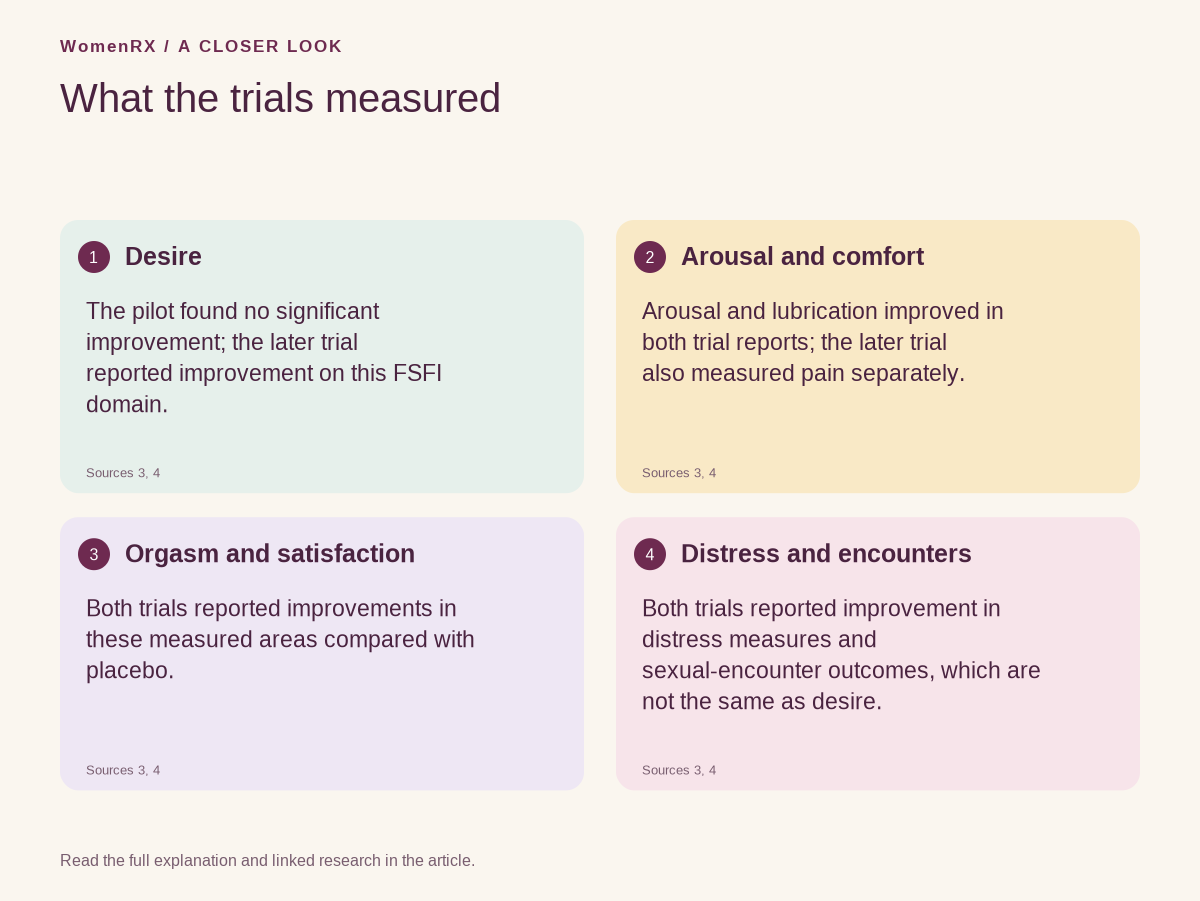
Desire: The pilot found no significant improvement; the later trial reported improvement on this FSFI domain.34
Arousal and comfort: Arousal and lubrication improved in both trial reports; the later trial also measured pain separately.34
Orgasm and satisfaction: Both trials reported improvements in these measured areas compared with placebo.34
Distress and encounters: Both trials reported improvement in distress measures and sexual-encounter outcomes, which are not the same as desire.34
Read the figure as text
The overall sexual-function score combines distinct outcomes. The findings for desire differed between the two trials.- Desire: The pilot found no significant improvement; the later trial reported improvement on this FSFI domain.34
- Arousal and comfort: Arousal and lubrication improved in both trial reports; the later trial also measured pain separately.34
- Orgasm and satisfaction: Both trials reported improvements in these measured areas compared with placebo.34
- Distress and encounters: Both trials reported improvement in distress measures and sexual-encounter outcomes, which are not the same as desire.34
More questions, answered
Do these studies show that any ashwagandha supplement will work?
No. The trials tested particular standardized root extracts, so their results don’t establish that products with different formulations have the same effects. 3 4
Sources you can check
- Sexual Health | MedlinePlusAccessed 2026-09-25Return to first citation
- Other medicines for menopause symptoms - NHSAccessed 2026-09-25Return to first citation
- Efficacy and Safety of Ashwagandha (Withania somnifera) Root Extract in Improving Sexual Function in Women: A Pilot Study.Dongre S, Langade D, Bhattacharyya S. · BioMed research international · 2015Return to first citation
- Efficacy and Safety of Ashwagandha (Withania somnifera) Root Extract for Improvement of Sexual Health in Healthy Women: A Prospective, Randomized, Placebo-Controlled Study.Ajgaonkar A, Jain M, Debnath K. · Cureus · 2022Return to first citation