Estrogen, Menopause, and Sexual Desire: What the Evidence Shows
Estrogen may ease vaginal symptoms that make sex uncomfortable, but evidence that it directly restores desire is limited.
Estrogen can help with some menopause-related vaginal symptoms, including dryness and pain, which may make sex more comfortable. But that is different from increasing desire: research on hormone therapy measures several aspects of sexual function, and the clearest benefits are in areas such as lubrication and pain. Whether desire changes depends on more than estrogen alone. 2 3
Comfort and desire are related, but they aren't the same outcome
Menopause-related changes in vaginal and urinary tissues can make sex dry or painful. When discomfort is part of the problem, treating those symptoms may remove one barrier to wanting or enjoying sex. That doesn't mean estrogen acts as a direct switch for desire, or that low desire is necessarily caused by low estrogen.
It helps to separate two questions: Is sex physically comfortable? And do you feel interested in sex? They can affect each other, but they aren't interchangeable. Desire can also be shaped by health conditions, medicines, and relationship factors. 1
What hormone-therapy studies actually show
A 2023 Cochrane review included 36 randomized trials with 23,299 women. Thirty-five trials studied postmenopausal women and one studied perimenopausal women. None enrolled only women with sexual dysfunction, and just seven assessed sexual function as a primary outcome. That makes the findings more useful for understanding average changes in sexual-function scores than for predicting what will happen to one woman's desire. 3
For estrogen alone, the review found a small likely improvement in the overall sexual-function score among women with menopause symptoms or early postmenopause. The review's conclusion points especially to lubrication, pain, and satisfaction. In women selected regardless of symptoms or time since menopause, the overall score probably changed little or not at all. A combined estrogen-progestogen regimen had too little, very uncertain evidence to draw a firm conclusion about sexual function. 3
These results don't show that estrogen reliably increases desire. A total sexual-function score combines different experiences, and improvement in comfort or satisfaction doesn't necessarily mean a woman feels more spontaneous interest in sex. The evidence is also much stronger for postmenopause than for perimenopause. 3
Local vaginal treatment and systemic therapy have different roles
If dryness or pain is the main concern, it's worth describing that specifically in care rather than asking only for a treatment to raise libido. The North American Menopause Society's 2022 position statement recommends considering low-dose vaginal estrogen, among other options, for bothersome genitourinary symptoms that haven't improved with over-the-counter therapies when there isn't a reason to use systemic hormone therapy. This is guidance for those local symptoms, not a promise that desire will increase. 2
Systemic hormone therapy is a different discussion. The same position statement describes it as an effective treatment for bothersome hot flashes and genitourinary symptoms, with benefits and risks that vary by treatment type, route, timing, duration, and whether a progestogen is used. Sexual desire by itself shouldn't be assumed to establish that systemic estrogen is the right fit. 2
A useful distinction to bring into a conversation is whether discomfort is present, whether hot flashes or other menopause symptoms also need attention, and whether reduced interest remains even when sex is comfortable. Those are different treatment questions.
Desire deserves a broader look
Estrogen is only one possible piece. Health conditions and medicines can affect sexual desire or sexual function, and sexuality is also connected with intimacy and relationships. 1 If your interest has changed, it can help to name what changed and what bothers you: less interest in general, less interest with a partner, pain during sex, difficulty with arousal, or a change linked to a medicine or health issue. These details help clarify whether the priority is comfort, another health factor, or desire itself.
For example, if sex has become painful, the first useful discussion may be about the pain and vaginal symptoms. If sex is comfortable but desire is still lower than you want, the question is different; estrogen studies don't establish that it will solve that concern. Either way, your experience is worth discussing without presuming that one hormone explains it all.
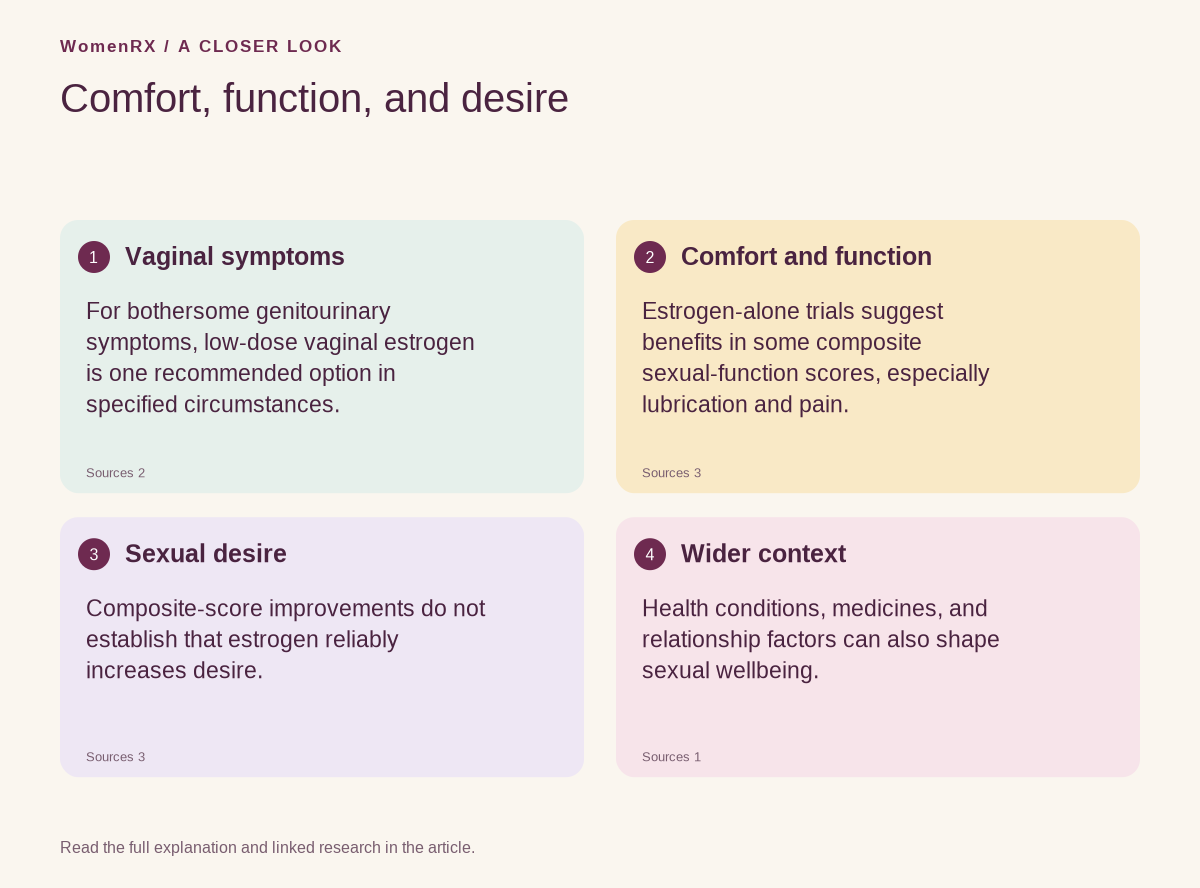
Comfort, function, and desire
Vaginal symptoms: For bothersome genitourinary symptoms, low-dose vaginal estrogen is one recommended option in specified circumstances.2
Comfort and function: Estrogen-alone trials suggest benefits in some composite sexual-function scores, especially lubrication and pain.3
Sexual desire: Composite-score improvements do not establish that estrogen reliably increases desire.3
Wider context: Health conditions, medicines, and relationship factors can also shape sexual wellbeing.1
Read the figure as text
These evidence distinctions show why improvement in one aspect of sex doesn't automatically mean desire will increase.- Vaginal symptoms: For bothersome genitourinary symptoms, low-dose vaginal estrogen is one recommended option in specified circumstances.2
- Comfort and function: Estrogen-alone trials suggest benefits in some composite sexual-function scores, especially lubrication and pain.3
- Sexual desire: Composite-score improvements do not establish that estrogen reliably increases desire.3
- Wider context: Health conditions, medicines, and relationship factors can also shape sexual wellbeing.1
More questions, answered
If vaginal symptoms improve, will my desire come back?
It may remove discomfort as one obstacle, but improved lubrication or less pain doesn't guarantee an increase in desire. Studies measure several sexual-function outcomes, and their results don't establish that estrogen reliably restores interest in sex. 3
Does the evidence apply equally during perimenopause?
No. In the 2023 review, 35 of 36 trials studied postmenopausal women and only one studied perimenopausal women. The evidence is therefore much thinner for changes in sexual function during perimenopause. 3
Sources you can check
- Sexual Health | MedlinePlusAccessed 2026-09-25Return to first citation
- The 2022 hormone therapy position statement of The North American Menopause Society.“The 2022 Hormone Therapy Position Statement of The North American Menopause Society” Advisory Panel. · Menopause (New York, N.Y.) · 2022Return to first citation
- Hormone therapy for sexual function in perimenopausal and postmenopausal women.Lara LA, Cartagena-Ramos D, Figueiredo JB, Rosa-E-Silva ACJ, Ferriani RA, Martins WP, Fuentealba-Torres M. · The Cochrane database of systematic reviews · 2023Return to first citation