Menopause, Hormones, and Changes in Sexual Desire
Hormones can affect sexual comfort, but desire also reflects mood, health, sleep, and relationship context.
Around menopause, lower estrogen can contribute to vaginal dryness and pain, which may make sex less appealing. That’s a possible indirect effect on desire, not proof that one hormone level controls it. Desire is also associated with mood, sleep, health, and relationship factors. Testosterone treatment research and studies of hormone levels answer different questions, and neither makes a single blood result a complete explanation. 3 4 5 6
Start with comfort, then consider desire
If sex has become painful or dry, estrogen may be part of the picture. After menopause, lower circulating estrogen can contribute to changes in vaginal tissue, including dryness and pain with sex. Discomfort can make sexual activity less appealing or lead you to avoid it. That’s a route by which hormonal change may affect desire indirectly. It doesn’t show that estrogen levels alone determine how much desire you feel. 4
This distinction matters because treating discomfort and addressing low desire are not always the same task. In a 12-week randomized, placebo-controlled trial, postmenopausal women with vulvar and vaginal atrophy who received ospemifene had greater improvement in sexual-function scores, including the desire domain, than those who received placebo. Changes in serum hormones were minor and did not correlate with changes in sexual function. The findings concern women with this specific condition; they don’t mean that treating vaginal symptoms will resolve low desire for everyone. 4
For bothersome genitourinary symptoms that haven’t improved with over-the-counter options, the North American Menopause Society lists low-dose vaginal estrogen and other therapies as options for appropriate women who don’t have another reason to use systemic hormone therapy. These are options for genitourinary symptoms, not a universal treatment for a change in desire. 2
Desire has more than one influence
Desire can change during the menopause transition, but women’s experiences differ. A 2026 scoping review found that some women reported stable or increased desire after menopause, even as others experienced a decline. Across the studies it reviewed, desire was associated with sexual symptoms such as dryness and pain, sleep disruption, general health, anxiety and depression, body image, and relationship factors. These are associations, not a formula that predicts what’s happening for any one woman. 3
That wider view can make the next step clearer. For example, if interest dropped after sex became painful, comfort may be a useful place to focus. If there’s no pain or dryness, but sleep, mood, health, a medication, or relationship circumstances have changed, those may be relevant too. Medicines and chronic health conditions can affect sexual desire or function. Considering them doesn’t make your concern any less real; it helps separate possible contributors rather than assuming hormones explain everything. 1 3
Testosterone: treatment studies and blood tests ask different things
Testosterone is sometimes described as a direct fix for low desire. A 2018 evidence review selected 11 sources: three guidelines, one systematic review with a meta-analysis, and seven randomized trials. The review reported short-term improvements in sexual function and desire among postmenopausal women using testosterone. It also cautioned that small samples and short follow-up limited conclusions about longer-term benefits and safety. 5
A different kind of evidence comes from a 2026 cross-sectional study of women aged 40 to 69. Among its 595 perimenopausal and postmenopausal participants, measured sex hormones were not associated with sexual desire or difficulty with desire after adjustment for other factors. Because the study examined associations at one point in time, it did not test whether testosterone treatment changes desire. Its authors said measuring these hormones should not be part of routine assessment for sexual concerns. 6
These findings aren’t answers to the same question. Treatment trials ask whether using testosterone changes outcomes; a study of blood levels asks whether measured hormone concentrations and desire vary together. The evidence reviewed in 2018 suggests possible short-term treatment benefit, while the 2026 study found no association between hormone levels and desire in its midlife sample. Together, they leave room for testosterone to help some women while showing why a blood level alone can’t explain an individual’s desire. Longer-term treatment outcomes remain uncertain in the review. 5 6
Match the question to what changed
It may help to name the change precisely: Is sex uncomfortable? Is interest lower even when sex is comfortable? Has arousal changed, or have mood and energy shifted too? Those are different experiences, and they may point toward different contributors. A hormone level doesn’t tell the whole story, and hormone therapy isn’t automatically the answer to every change in desire.
If dryness or pain is the main barrier, ask about options aimed at those symptoms. If desire itself has changed, consider the broader pattern, including sleep, mood, health, medicines, and relationship context. You don’t have to settle on one cause before raising the concern; the useful starting point is identifying what part of sex or desire has changed for you. 1 2 3
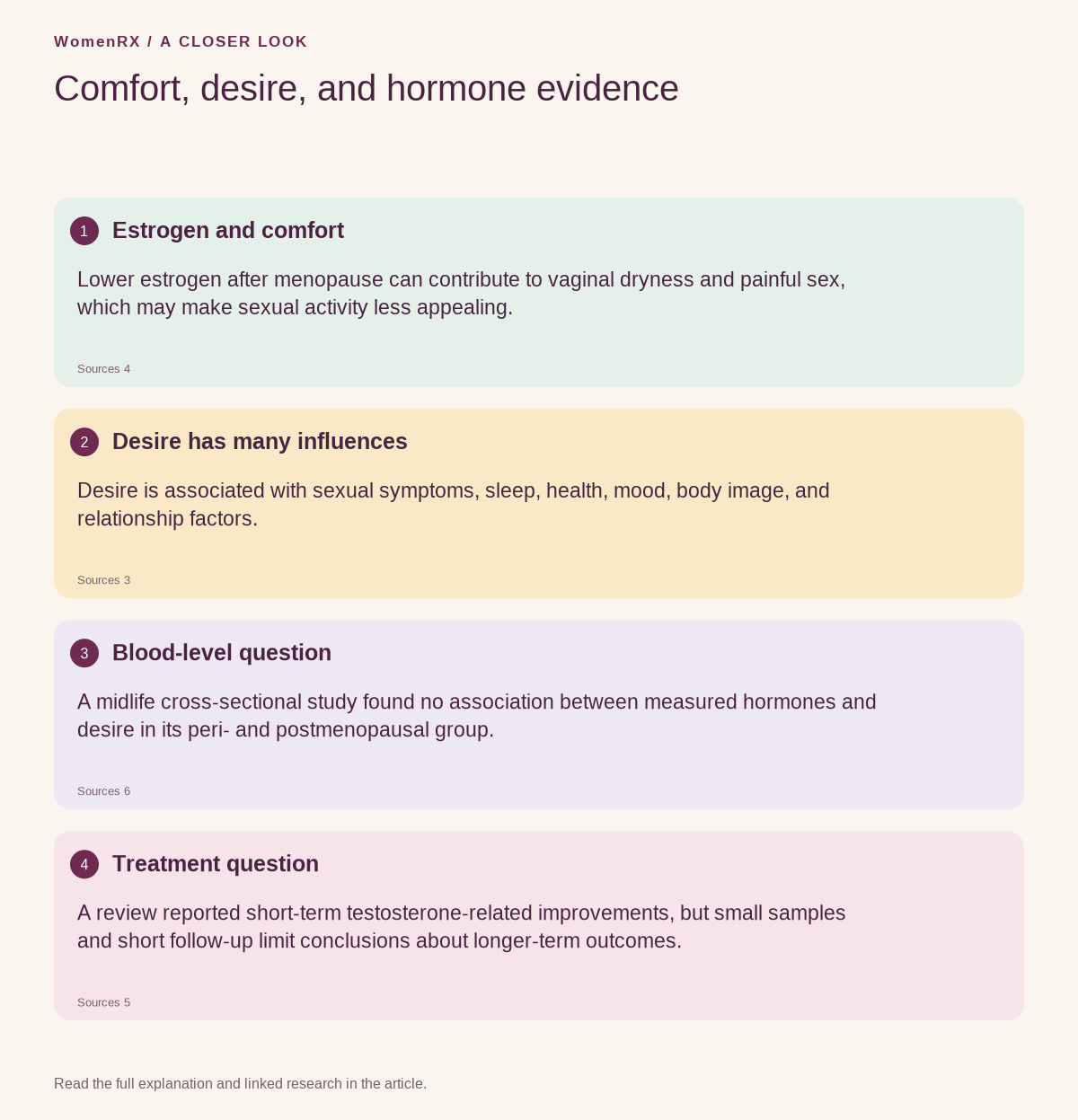
Comfort, desire, and hormone evidence
Estrogen and comfort: Lower estrogen after menopause can contribute to vaginal dryness and painful sex, which may make sexual activity less appealing.4
Desire has many influences: Desire is associated with sexual symptoms, sleep, health, mood, body image, and relationship factors.3
Blood-level question: A midlife cross-sectional study found no association between measured hormones and desire in its peri- and postmenopausal group.6
Treatment question: A review reported short-term testosterone-related improvements, but small samples and short follow-up limit conclusions about longer-term outcomes.5
Read the figure as text
Follow the possible paths from hormonal change to sexual comfort, then separate that from what desire studies and testosterone research actually show.- Estrogen and comfort: Lower estrogen after menopause can contribute to vaginal dryness and painful sex, which may make sexual activity less appealing.4
- Desire has many influences: Desire is associated with sexual symptoms, sleep, health, mood, body image, and relationship factors.3
- Blood-level question: A midlife cross-sectional study found no association between measured hormones and desire in its peri- and postmenopausal group.6
- Treatment question: A review reported short-term testosterone-related improvements, but small samples and short follow-up limit conclusions about longer-term outcomes.5
More questions, answered
Can a blood test show whether hormones are causing low desire?
A blood test can measure hormone levels, but it can’t by itself establish why your desire changed. In one cross-sectional study of midlife women, measured hormones were not associated with desire or desire difficulty in the perimenopausal and postmenopausal group. The study authors said these measurements should not be part of routine assessment for sexual concerns. 6
Sources you can check
- Sexual Health | MedlinePlusAccessed 2026-09-25Return to first citation
- The 2022 hormone therapy position statement of The North American Menopause Society.“The 2022 Hormone Therapy Position Statement of The North American Menopause Society” Advisory Panel. · Menopause (New York, N.Y.) · 2022Return to first citation
- A scoping review of the biopsychosocial factors influencing sexual desire in menopause.Metcalfe KB, Meston CM. · Sexual medicine reviews · 2026Return to first citation
- Female sexual function improved with ospemifene in postmenopausal women with vulvar and vaginal atrophy: results of a randomized, placebo-controlled trial.Constantine G, Graham S, Portman DJ, Rosen RC, Kingsberg SA. · Climacteric : the journal of the International Menopause Society · 2015Return to first citation
- [The Role of Testosterone in The Improvement of Sexual Desire in Postmenopausal Women: An Evidence-Based Clinical Review].Gouveia M, Sanches R, Andrade S, Carmona S, Ferreira C. · Acta medica portuguesa · 2018Return to first citation
- Associations between testosterone and pre-androgens and sexual function; findings from the Australian Women's Midlife Years Study.Wang Y, Islam RM, Hodge A, Handelsman DJ, Karim MN, Bond M, Davis SR. · Fertility and sterility · 2026Return to first citation