Low Sexual Desire After Menopause: What Can You Try Before Testosterone?
The first useful question is whether desire itself is the concern, or whether pain, vaginal symptoms, medication effects, mood, or relationship circumstances need attention too.
Before considering testosterone, clarify what changed and whether the low desire is distressing. Then look for other factors, including vaginal or urinary menopause symptoms, a health condition, medication effects, mood, or relationship concerns. These may call for different discussions. Flibanserin is a US-labeled option for women under 65, with trial evidence in postmenopausal women but some important limits. 1 3 6 7
First separate desire from other sexual concerns
A useful starting point is to describe what has changed: Is desire lower in all situations, or only with a particular partner or circumstance? Is the concern mainly lack of interest, or is sex uncomfortable because of vaginal symptoms? Is the change distressing to you? These distinctions matter because a medicine aimed at desire may not address discomfort or another factor affecting sexual health.
The US prescribing information for flibanserin describes the condition it treats as acquired, generalized low desire that causes distress or interpersonal difficulty. It excludes cases due to a co-existing medical or psychiatric condition, relationship problems, or the effects of a medication or other drug. That gives you a useful way to frame the conversation, but it does not mean your concern is any less real if one of those factors is involved. 3
Match the next discussion to the concern
Vaginal or urinary menopause symptoms: If dryness, irritation, or other genitourinary symptoms are part of the picture, ask about treating those symptoms directly rather than assuming a desire-focused medicine will address them. For bothersome genitourinary symptoms that haven’t improved with over-the-counter therapies, the North American Menopause Society lists low-dose vaginal estrogen, vaginal DHEA, and oral ospemifene as options for appropriate patients who don’t have an indication for systemic hormone therapy. These options target genitourinary symptoms; they should not be assumed to treat low desire itself. 7
A health change or medication: Chronic conditions and medicines can affect sexual health. SSRIs and SNRIs, for example, can be associated with reduced sex drive. If a change in desire began around a new medicine or dose change, ask whether it could be contributing and whether there are reasonable alternatives. Don’t stop a prescription on your own. 1 4
Mood, stress, or relationship context: These can be worth discussing alongside physical symptoms. Relationship problems and co-existing psychiatric conditions are among the explanations excluded from flibanserin’s labeled indication. Identifying them can help clarify what kind of support or treatment discussion fits, rather than treating every change in desire as a hormone problem. 3
More than one factor can be present. For example, vaginal symptoms and a medication effect may overlap, so addressing just one might not resolve the whole concern.
What to know about flibanserin after menopause
Flibanserin (Addyi) is US-labeled for women younger than 65 with acquired, generalized hypoactive sexual desire disorder that causes distress or interpersonal difficulty and isn’t due to the factors described above. Postmenopausal women have been studied, so menopause alone doesn’t mean there is no trial evidence to discuss. 3 5 6
The findings deserve a careful reading. A 2024 systematic review and meta-analysis reported improvement on several measures in postmenopausal women, but it combined studies of both premenopausal and postmenopausal participants in its overall analysis. In one randomized trial specifically in naturally postmenopausal women, desire scores favored flibanserin at week 16, while the difference in satisfying sexual events did not reach statistical significance. The sponsor stopped that trial early, and only 45.3% of participants had completed week 16, limiting how confidently its results can be interpreted. 5 6
Side effects also belong in the tradeoff. The prescribing information warns that flibanserin can cause sleepiness or sedation, and that risk can increase with alcohol, other central nervous system depressants, and certain medicines that increase flibanserin levels. 3
Bremelanotide (Vyleesi) has a different age-and-menopause boundary: its US indication is for premenopausal women with acquired, generalized HSDD. 2
Keep the options distinct
Care for vaginal symptoms, review of a possible medication effect, and treatment aimed at distressing low desire address different concerns. Don’t assume one will stand in for another, or that supplements or general lifestyle changes are proven substitutes for testosterone. A useful discussion is specific: what symptom do you most want help with, what might be contributing, and what benefits and drawbacks matter most to you?
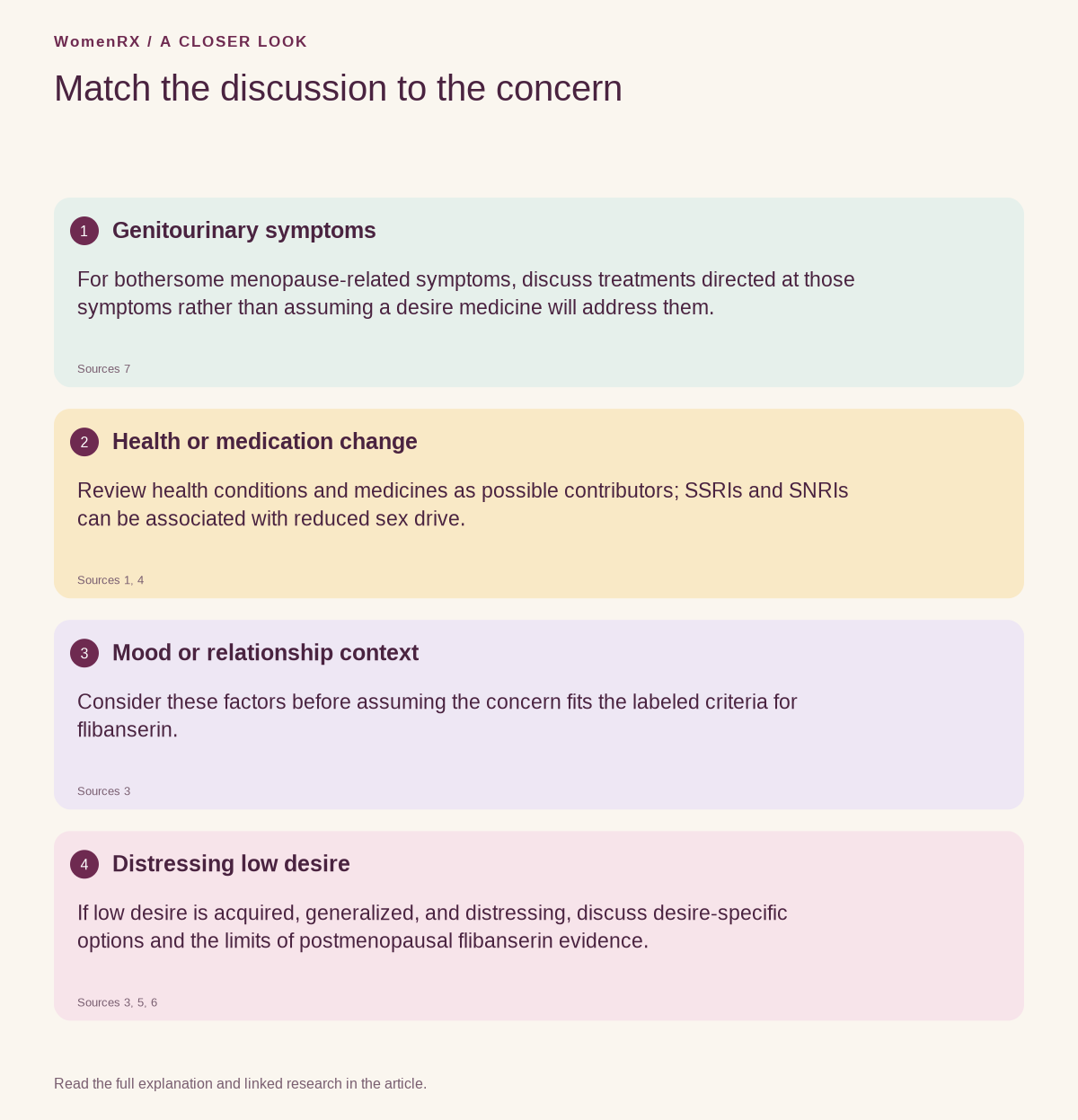
Match the discussion to the concern
Genitourinary symptoms: For bothersome menopause-related symptoms, discuss treatments directed at those symptoms rather than assuming a desire medicine will address them.7
Health or medication change: Review health conditions and medicines as possible contributors; SSRIs and SNRIs can be associated with reduced sex drive.14
Mood or relationship context: Consider these factors before assuming the concern fits the labeled criteria for flibanserin.3
Distressing low desire: If low desire is acquired, generalized, and distressing, discuss desire-specific options and the limits of postmenopausal flibanserin evidence.356
Read the figure as text
Different contributors to low desire point toward different treatment discussions; this flow separates symptom-focused care from desire-specific options.- Genitourinary symptoms: For bothersome menopause-related symptoms, discuss treatments directed at those symptoms rather than assuming a desire medicine will address them.7
- Health or medication change: Review health conditions and medicines as possible contributors; SSRIs and SNRIs can be associated with reduced sex drive.14
- Mood or relationship context: Consider these factors before assuming the concern fits the labeled criteria for flibanserin.3
- Distressing low desire: If low desire is acquired, generalized, and distressing, discuss desire-specific options and the limits of postmenopausal flibanserin evidence.356
More questions, answered
Is flibanserin indicated for postmenopausal women?
The US prescribing information indicates flibanserin for women younger than 65 who meet the criteria for acquired, generalized HSDD. Postmenopausal women were included in trials, though one trial in naturally postmenopausal women ended early, which limits confidence in its results. 3 6
Is bremelanotide indicated after menopause?
Its US indication is for premenopausal women with acquired, generalized HSDD, so it is not indicated for postmenopausal women. 2
Sources you can check
- Sexual Health | MedlinePlusAccessed 2026-09-25Return to first citation
- VYLEESI (BREMELANOTIDE) INJECTION [COSETTE PHARMACEUTICALS, INC.] | US prescribing information and patient instructionsAccessed 2026-09-25Return to first citation
- ADDYI (FLIBANSERIN) TABLET, FILM COATED [SPROUT PHARMACEUTICALS, INC.] | US prescribing information and patient instructionsAccessed 2026-09-25Return to first citation
- Other medicines for menopause symptoms - NHSAccessed 2026-09-25Return to first citation
- Role of flibanserin in managing hypoactive sexual desire disorder in women: A systematic review and meta-analysis.Kamrul-Hasan ABM, Hannan MA, Alam MS, Aalpona FTZ, Nagendra L, Selim S, Dutta D. · Medicine · 2024Return to first citation
- Flibanserin in Postmenopausal Women With Hypoactive Sexual Desire Disorder: Results of the PLUMERIA Study.Portman DJ, Brown L, Yuan J, Kissling R, Kingsberg SA. · The journal of sexual medicine · 2017Return to first citation
- The 2022 hormone therapy position statement of The North American Menopause Society.“The 2022 Hormone Therapy Position Statement of The North American Menopause Society” Advisory Panel. · Menopause (New York, N.Y.) · 2022Return to first citation