How Bremelanotide Works for Low Sexual Desire
Bremelanotide is an as-needed injection studied for distressing, acquired low desire in premenopausal women, but its proposed brain mechanism is not fully established.
Bremelanotide (Vyleesi) is approved for premenopausal women with acquired, generalized hypoactive sexual desire disorder (HSDD), when low desire causes marked distress or interpersonal difficulty and isn’t due to a co-existing medical or psychiatric condition. It has high affinity for melanocortin-4 receptors, but its proposed effects on desire-related brain pathways are based on preclinical research. In trials, desire and related distress scores improved versus placebo, but satisfying sexual events did not. 1 3
What Vyleesi is intended to treat
Vyleesi is the brand name for bremelanotide, a prescription medicine given as an injection under the skin. Its US indication is specific: premenopausal women with acquired, generalized hypoactive sexual desire disorder (HSDD). “Acquired” means the low desire developed after a time without this problem. “Generalized” means it occurs across situations, types of stimulation, or partners. The low desire must also cause marked distress or interpersonal difficulty. 1
That definition is narrower than simply wanting sex less often than a partner, or noticing a change in desire during a stressful period. Low desire can have medical, psychiatric, medication-related, psychological, and social influences. The medicine’s indication excludes HSDD due to a co-existing medical or psychiatric condition; it shouldn’t be assumed to resolve relationship strain or another underlying cause. 1 2 4
Its brain mechanism is a proposal, not a settled explanation
Bremelanotide has high affinity for the melanocortin-4 (MC4) receptor. Researchers have proposed that it may influence central nervous system pathways involved in sexual desire and arousal, drawing on preclinical research. That offers a possible biological explanation for how the drug might help, but it doesn’t establish the precise way it changes desire in a person or mean that it will work for everyone. 3
It may help to keep the mechanism and the treatment evidence separate: a plausible brain pathway explains what researchers are investigating; randomized trials test whether people taking the drug report meaningful changes compared with people taking a placebo.
What the trials found, and what they didn’t
Two 24-week, randomized, placebo-controlled phase 3 trials studied bremelanotide in premenopausal women with acquired, generalized HSDD. Across the combined trials, participants taking it had a greater average improvement in a sexual-desire questionnaire score and a greater average reduction in distress related to low desire than those taking placebo. The differences were statistically significant. 3
The results were not the same for every outcome. In both trials, the average change in the number of satisfying sexual events was essentially zero for the bremelanotide group, and there was no significant difference from placebo. So a change in desire or distress scores should not be read as a promise of more sexual activity or more satisfying sex. 1
Side effects also matter when weighing those results. Nausea, flushing, and headache were reported more often with bremelanotide than with placebo in the phase 3 trials. The prescribing information also reports that more participants taking the drug stopped the 24-week treatment period early than participants taking placebo. 1 3
The studied life stage matters
The pivotal trials enrolled premenopausal women, with a mean age of 39. That evidence doesn’t establish how well the medicine works for women who are postmenopausal, or for desire changes during pregnancy, postpartum, or perimenopause. If your desire changed around one of those transitions, that timing is relevant to the conversation about what might be contributing and whether the trial results apply to you. 1 3
A change in desire can also occur alongside a health condition or medication. MedlinePlus identifies chronic illness and medicines that affect desire or sexual function as possible influences on sexual health. That doesn’t determine the cause in an individual, but it’s one reason to look at the whole picture rather than treating every change as the same condition. 2
What to clarify before considering it
A useful discussion can start with a few specific questions:
- Did the change develop after a period when desire wasn’t a concern, and does it happen across situations or partners?
- Is the distress about your own experience, or mainly about a mismatch with someone else’s expectations?
- Did the change coincide with a medical or mental health condition, a medication, or a major life-stage transition?
- What outcome would matter to you: more desire, less distress, or something else? The trials measured desire and distress separately, and did not show an increase in satisfying sexual events compared with placebo. 1 2 3
- What would using an injection as needed involve? The prescribing information says it is injected under the skin of the abdomen or thigh at least 45 minutes before anticipated sexual activity. It also says the duration of effect after a dose is unknown. 1
Those answers help distinguish a match with the group studied from a different kind of desire change. They also make room to weigh a possible improvement in desire or distress against side effects and the practicalities of an as-needed injection.
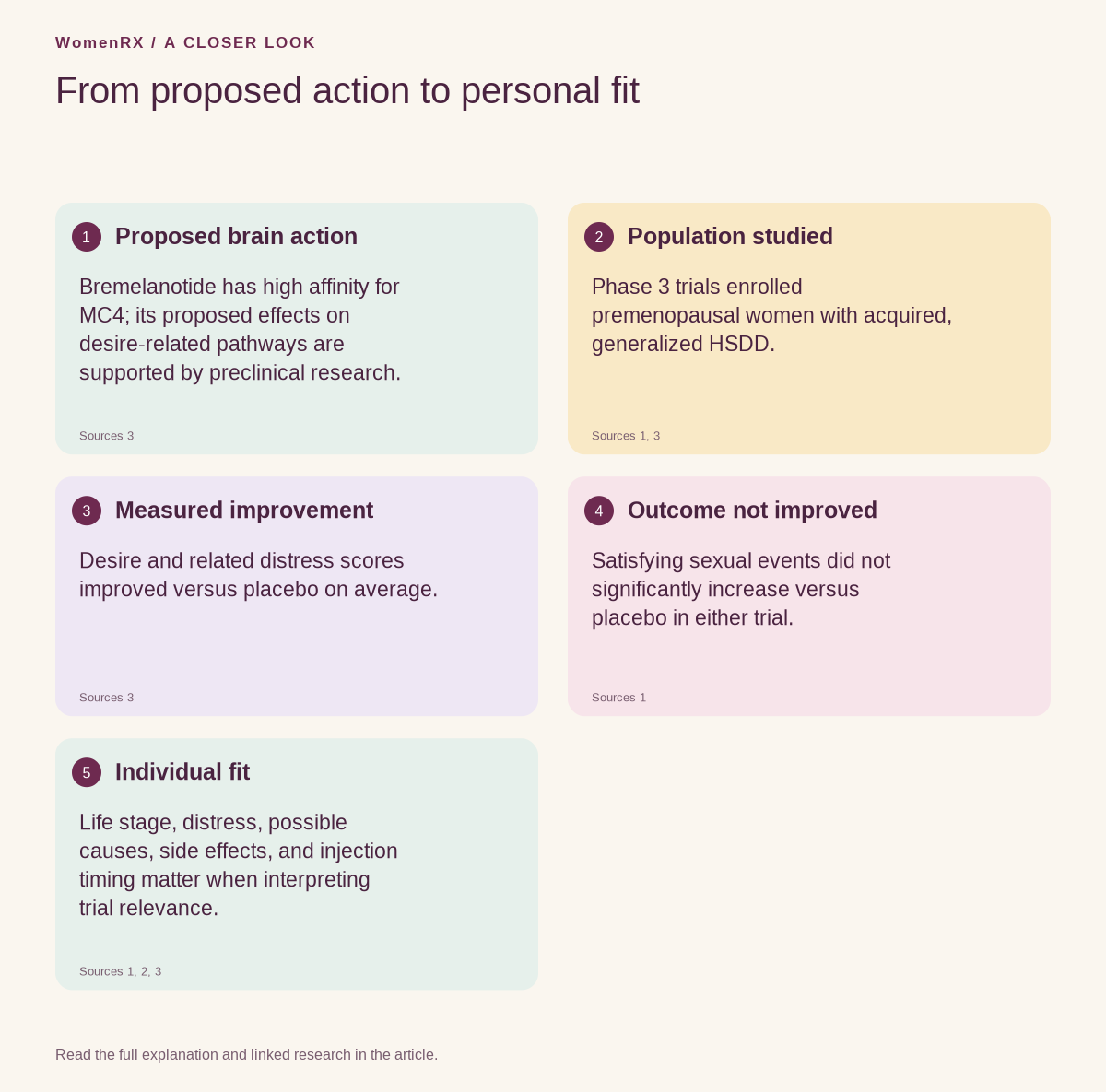
From proposed action to personal fit
Proposed brain action: Bremelanotide has high affinity for MC4; its proposed effects on desire-related pathways are supported by preclinical research.3
Population studied: Phase 3 trials enrolled premenopausal women with acquired, generalized HSDD.13
Measured improvement: Desire and related distress scores improved versus placebo on average.3
Outcome not improved: Satisfying sexual events did not significantly increase versus placebo in either trial.1
Individual fit: Life stage, distress, possible causes, side effects, and injection timing matter when interpreting trial relevance.123
Read the figure as text
The mechanism, trial findings, and treatment fit answer different questions. This comparison keeps them distinct.- Proposed brain action: Bremelanotide has high affinity for MC4; its proposed effects on desire-related pathways are supported by preclinical research.3
- Population studied: Phase 3 trials enrolled premenopausal women with acquired, generalized HSDD.13
- Measured improvement: Desire and related distress scores improved versus placebo on average.3
- Outcome not improved: Satisfying sexual events did not significantly increase versus placebo in either trial.1
- Individual fit: Life stage, distress, possible causes, side effects, and injection timing matter when interpreting trial relevance.123
More questions, answered
Does Vyleesi increase the number of satisfying sexual experiences?
Not in the phase 3 trials compared with placebo. Desire and distress scores improved on average, but the average number of satisfying sexual events did not significantly increase. 1
Was Vyleesi studied for low desire after menopause?
The pivotal trials and US indication described here are for premenopausal women with acquired, generalized HSDD. Those results don’t establish how well it works after menopause. 1 3
Sources you can check
- VYLEESI (BREMELANOTIDE) INJECTION [COSETTE PHARMACEUTICALS, INC.] | US prescribing information and patient instructionsAccessed 2026-09-25Return to first citation
- Sexual Health | MedlinePlusAccessed 2026-09-25Return to first citation
- Bremelanotide for the Treatment of Hypoactive Sexual Desire Disorder: Two Randomized Phase 3 Trials.Kingsberg SA, Clayton AH, Portman D, Williams LA, Krop J, Jordan R, Lucas J, Simon JA. · Obstetrics and gynecology · 2019Return to first citation
- What Women Want? The State of the Art regarding the Treatment of Young Women with Hypoactive Sexual Desire Disorder.de Oliveira L, Vignozzi L, Giraldi A, Varod S, Corona G, Reisman Y. · Pharmacology · 2024Return to first citation