When Is Low Sexual Desire Worth Looking Into?
A change in desire deserves attention when it bothers you or comes with pain, but there’s no single level of desire everyone should have.
A change in desire is worth looking into if it causes distress, affects your wellbeing or relationship, or comes with pain or other symptoms. Desire can be shaped by health conditions, medicines, mood, relationship context, vaginal dryness, and life changes such as postpartum recovery. These factors are clues, not a checklist for diagnosing yourself; a useful assessment looks at the whole picture. 1 2 6
Start with what has changed, and whether it bothers you
There isn’t one required amount of sexual desire. A useful first question is whether this feels like a change you want help with, rather than whether your desire matches someone else’s or a particular idea of what’s normal. For example, US prescribing information for bremelanotide specifies marked distress or interpersonal difficulty among the criteria for its intended treatment population; it doesn’t define every change in desire. A change in frequency by itself doesn’t tell you what’s causing it or whether it’s a disorder. 4
It may help to notice what changed alongside your desire. For example, did sex become uncomfortable, did a medicine or health condition enter the picture, did your sleep change, or did your circumstances change? More than one factor can matter at once, and the goal isn’t to find fault with you or your relationship.
Use these areas as clues, not a score
Pain and comfort. Vaginal dryness can make sex uncomfortable. Menopause-related hormone changes are one possible cause, and dryness can also be related to cancer treatments or certain health conditions. After childbirth, perineal injury and pain have been associated with worse sexual outcomes in postpartum studies. If sex hurts, it’s worth addressing the pain rather than treating low desire as the only problem. 1 7
Health and medicines. Chronic conditions, including cancer and heart disease, and some medicines can affect sexual health. That doesn’t mean a medicine is necessarily the cause: the timing and your overall health matter. If you suspect a connection, ask the clinician who manages the medicine whether it could be contributing and what options make sense. 2
Mood, energy, and emotional strain. Mental-health concerns can be part of a low-desire picture. After birth, physical recovery, the demands of caring for a baby, and emotional changes may all be relevant. If sadness is severe or makes it hard to care for yourself or your baby, seek support for that directly; it deserves attention beyond its possible effect on sex. 3 6
Relationship and circumstances. Partner and family support, body image, and couple dynamics have been associated with postpartum sexual outcomes. These connections don’t prove that a relationship issue caused a change in desire. They can still help explain whether the situation feels safe, comfortable, and wanted for you. 7
Life stage. Pregnancy concerns, such as fear of an unplanned pregnancy, can affect sexual health. After childbirth, recovery and changing responsibilities may shape when intimacy feels possible. A systematic review found that breastfeeding was often associated with lower early sexual function and more pain, with the association becoming less evident by 12 months; the studies varied, so this is not a prediction for any one person. 2 3 7
If you’re in perimenopause, you can include that life-stage context when thinking about what changed without assuming it explains your desire. Menopause can provide context, especially when dryness or pain is present, but it doesn’t by itself establish why desire changed. Menopause-related hormone changes can contribute to vaginal dryness; that is a comfort issue to address, not proof of a desire disorder. 1
When support may help
Consider raising the change with a clinician if it’s distressing, affects your wellbeing or relationship, or persists alongside pain or dryness. You don’t need to arrive with a cause already identified. A conversation can consider physical comfort, medicines, health, mood, relationship context, and life stage together, rather than assuming there’s one explanation. 1 6
If dryness is part of the problem, water-based lubricants and vaginal moisturizers are options described in clinical guidance. If dryness lasts for weeks despite self-care, affects daily life, or comes with unusual discharge or bleeding, seek medical assessment. Bleeding after menopause also warrants assessment. 1
A request for hormone testing isn’t a substitute for understanding the whole picture. For example, a testosterone level alone should not be used to diagnose hypoactive sexual desire disorder; a professional guideline describes it as a baseline for monitoring when testosterone treatment is being considered. 5
Medication is not a one-size-fits-all answer. The US prescribing information for bremelanotide limits its use to premenopausal women with acquired, generalized hypoactive sexual desire disorder that causes marked distress or interpersonal difficulty and is not due to a co-existing medical or psychiatric condition or a medication effect. That narrow indication is one reason an assessment comes before considering a drug. 4
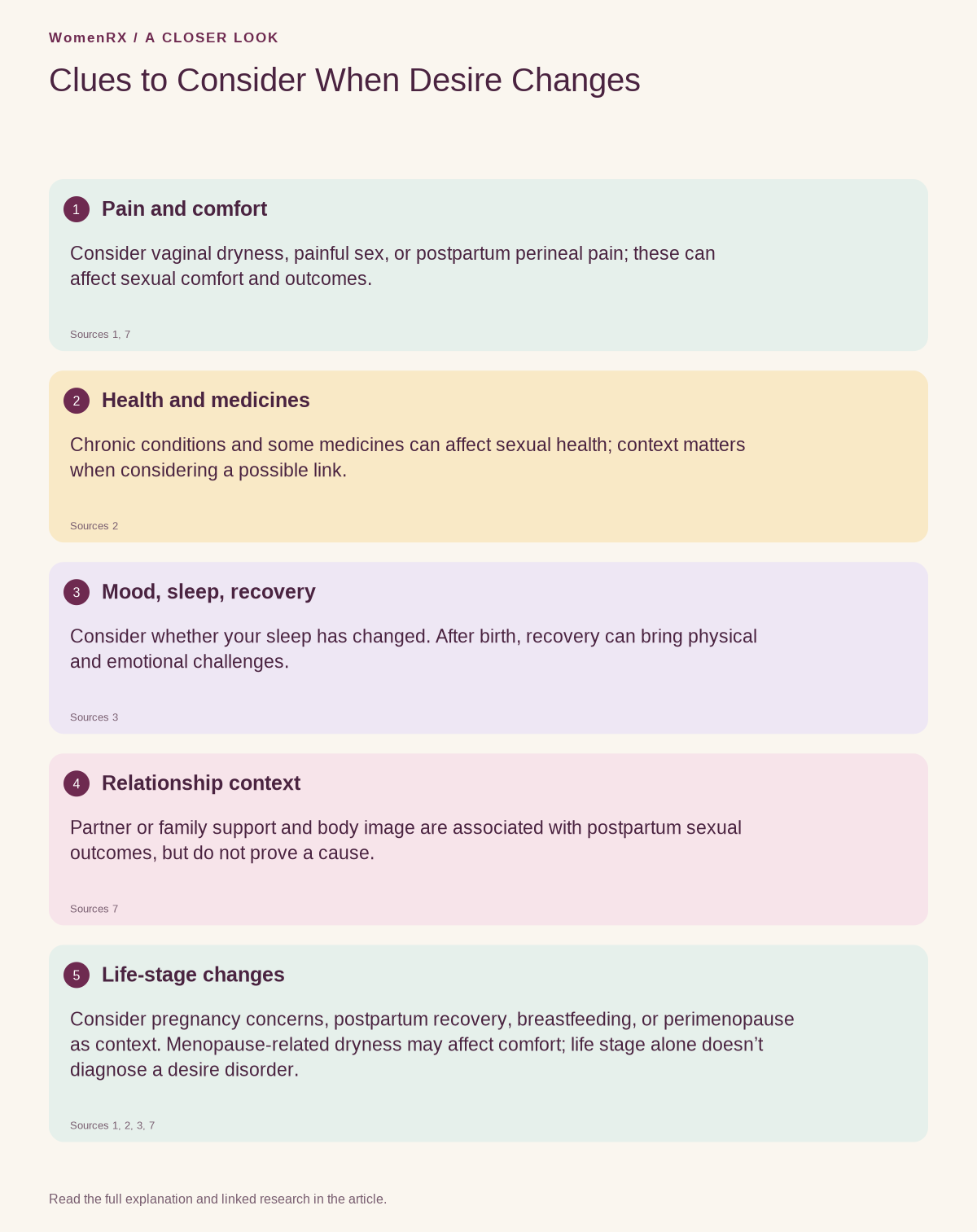
Clues to Consider When Desire Changes
Pain and comfort: Consider vaginal dryness, painful sex, or postpartum perineal pain; these can affect sexual comfort and outcomes.17
Health and medicines: Chronic conditions and some medicines can affect sexual health; context matters when considering a possible link.2
Mood, sleep, recovery: Consider whether your sleep has changed. After birth, recovery can bring physical and emotional challenges.3
Relationship context: Partner or family support and body image are associated with postpartum sexual outcomes, but do not prove a cause.7
Life-stage changes: Consider pregnancy concerns, postpartum recovery, breastfeeding, or perimenopause as context. Menopause-related dryness may affect comfort; life stage alone doesn’t diagnose a desire disorder.1237
Read the figure as text
Use these areas to organize what has changed. They are prompts for reflection, not a diagnostic checklist or score.- Pain and comfort: Consider vaginal dryness, painful sex, or postpartum perineal pain; these can affect sexual comfort and outcomes.17
- Health and medicines: Chronic conditions and some medicines can affect sexual health; context matters when considering a possible link.2
- Mood, sleep, recovery: Consider whether your sleep has changed. After birth, recovery can bring physical and emotional challenges.3
- Relationship context: Partner or family support and body image are associated with postpartum sexual outcomes, but do not prove a cause.7
- Life-stage changes: Consider pregnancy concerns, postpartum recovery, breastfeeding, or perimenopause as context. Menopause-related dryness may affect comfort; life stage alone doesn’t diagnose a desire disorder.1237
More questions, answered
Could a medicine be affecting my desire?
Possibly. Medicines are among the factors that can affect sexual health, but the timing and your health context matter. Ask the clinician managing your medicine whether it could be contributing and what alternatives, if any, are appropriate. 2
What if sex is painful or dryness is part of the change?
Pain and dryness are worth discussing as issues in their own right. Water-based lubricants or vaginal moisturizers may help dryness; seek assessment if it persists for weeks, affects daily life, or comes with unusual discharge or bleeding. 1
Sources you can check
- Vaginal dryness - NHSAccessed 2026-09-25Return to first citation
- Sexual Health | MedlinePlusAccessed 2026-09-25Return to first citation
- Postpartum Care: MedlinePlusAccessed 2026-09-25Return to first citation
- VYLEESI (BREMELANOTIDE) INJECTION [COSETTE PHARMACEUTICALS, INC.] | US prescribing information and patient instructionsAccessed 2026-09-25Return to first citation
- International Society for the Study of Women's Sexual Health Clinical Practice Guideline for the Use of Systemic Testosterone for Hypoactive Sexual Desire Disorder in Women.Parish SJ, Simon JA, Davis SR, Giraldi A, Goldstein I, Goldstein SW, Kim NN, Kingsberg SA, Morgentaler A, Nappi RE, Park K, Stuenkel CA, Traish AM, Vignozzi L. · The journal of sexual medicine · 2021Return to first citation
- International Society for the Study of Women's Sexual Health Clinical Practice Guideline for the Use of Systemic Testosterone for Hypoactive Sexual Desire Disorder in Women.Parish SJ, Simon JA, Davis SR, Giraldi A, Goldstein I, Goldstein SW, Kim NN, Kingsberg SA, Morgentaler A, Nappi RE, Park K, Stuenkel CA, Traish AM, Vignozzi L. · Journal of women's health (2002) · 2021Return to first citation
- Determinants of Postpartum Sexual Dysfunction in the First Year: A Systematic Review.Boarta A, Gluhovschi A, Craina ML, Marta CI, Dumitriu B, Socol ID, Sorop MI, Sorop B. · Healthcare (Basel, Switzerland) · 2025Return to first citation