Bremelanotide, Flibanserin, and Testosterone for Low Desire
The most useful comparison starts with why desire changed, then looks at who was studied, how each treatment is used, and what follow-up it needs.
These aren’t interchangeable treatments. In the US, bremelanotide is an as-needed injection indicated for qualifying premenopausal women; flibanserin is a daily bedtime tablet indicated for qualifying women under 65, including after menopause. Transdermal testosterone has its strongest evidence in postmenopausal women with distressing low desire. Clinical guidance calls for a discussion of off-label use and hormone-level monitoring. 236
First, what kind of low desire are you trying to treat?
Desire can change without anything being wrong. The question behind these treatments is more specific: Has your interest dropped from what’s usual for you, does it trouble you, and is the change present across situations rather than mainly with one partner or in one circumstance? That pattern is called acquired, generalized hypoactive sexual desire disorder, or HSDD. The US indications for bremelanotide and flibanserin also exclude low desire explained by a medical or mental health condition, a relationship problem, or a medication or other substance. 23
That distinction changes the next move. For example, if sex has become painful, if a medicine coincided with the change, or if desire is different only in a particular relationship, choosing among these three treatments may miss what needs attention. Sexual difficulties can have overlapping physical, emotional, and relationship factors; treatment can include nonmedication approaches as well as medication. 145
Bremelanotide: an injection used as needed
Bremelanotide, sold as Vyleesi, is a self-administered injection under the skin. Its US indication is for premenopausal women with acquired, generalized HSDD. It isn’t indicated after menopause or as a way to improve sexual performance. Unlike a daily treatment, its use is planned around anticipated sexual activity, though its label says the duration of effect after an injection isn’t fully characterized. 2
Two placebo-controlled trials in premenopausal women found greater improvements in desire scores and in how bothered participants felt by low desire. They did not find a significant difference in the change in number of satisfying sexual events. That’s a useful distinction if your goal is less distress about desire rather than a particular number of sexual experiences. 2
The practical tradeoff is the injection and its side effects. Nausea was common in the trials. Bremelanotide can temporarily raise blood pressure and lower heart rate, so the label calls for blood-pressure and cardiovascular-risk assessment; it rules out use with uncontrolled high blood pressure or known cardiovascular disease. Focal skin darkening can also occur and may not fully resolve. The label calls for stopping treatment if symptoms haven’t improved after eight weeks. 2
Flibanserin: a bedtime tablet taken daily
Flibanserin, sold as Addyi, has a different US indication from bremelanotide’s: women under 65 with acquired, generalized HSDD. That includes women after menopause. It’s taken as a daily bedtime tablet, not just when sex is anticipated. 3
Its trial results also deserve a careful read. Across three placebo-controlled trials in premenopausal women, flibanserin improved the number of satisfying sexual events compared with placebo. One trial found an improvement on its primary desire measure; the other two did not find a significant difference on the daily-diary desire measure used as a primary endpoint, although a separate desire scale showed consistent improvements. A placebo-controlled trial in naturally postmenopausal women under 65 found improvements in satisfying sexual events, desire, and desire-related bother. These are group averages, not a promise of how any one woman will feel. 3
The daily routine comes with different safety questions. Flibanserin can cause sleepiness, low blood pressure, and fainting. Alcohol close to a bedtime dose raises the risk of severe low blood pressure and fainting. Certain medicines that increase flibanserin levels, including the antifungal fluconazole, the antibiotic ciprofloxacin, and the heart medicine diltiazem, are listed among medicines that must not be combined with it. Liver impairment also rules it out. Its label calls for stopping if HSDD symptoms haven’t improved after eight weeks. 3
Testosterone: a monitored treatment discussion
Testosterone isn’t simply a stronger version of either prescription treatment. Clinical guidance supports systemic transdermal testosterone for appropriately assessed women with HSDD, with the clearest evidence and consensus recommendation applying after menopause. The International Society for the Study of Women’s Sexual Health (ISSWSH) guideline describes a moderate therapeutic benefit. It says evidence for women in the late reproductive years is limited, and long-term safety hasn’t been established. 6
The ISSWSH guideline calls for a discussion of off-label use, not a comparison that treats testosterone as a third equivalently labeled product. It discusses cautious use of an approved transdermal formulation intended for men, rather than recommending compounded testosterone products, whose efficacy and safety data are lacking. 6
Monitoring is part of that decision. A testosterone blood level does not diagnose HSDD or show by itself that testosterone will help. The guideline uses a baseline level and follow-up levels to help keep treatment within the physiologic premenopausal range, alongside assessment for signs of androgen excess. That oversight, and the uncertainty about long-term safety, matter as much as the route of treatment. 6
How to make the comparison useful for you
Start with the change you want to notice. Is the main problem that desire feels absent and distressing, that satisfying experiences have become less frequent, or that pain or another obstacle has made sex unappealing? The trials didn’t measure identical outcomes, and bremelanotide’s trials did not show an increase in satisfying sexual events. Comparing the treatments as if they had won the same test would be misleading. 23
Then consider fit. Before menopause, the choice between an as-needed injection and a daily tablet may turn on your preference for planning, blood-pressure or nausea concerns, alcohol use, and possible medicine interactions. After menopause, bremelanotide’s indication doesn’t apply; flibanserin is indicated for qualifying women under 65, while testosterone raises a guideline-directed discussion about off-label use and monitoring. None of those distinctions replaces looking for a more direct cause of the change in desire. 236
A useful way to frame the conversation is: What explains my change in desire, what improvement would matter to me, and which treatment’s evidence and tradeoffs actually match my situation?
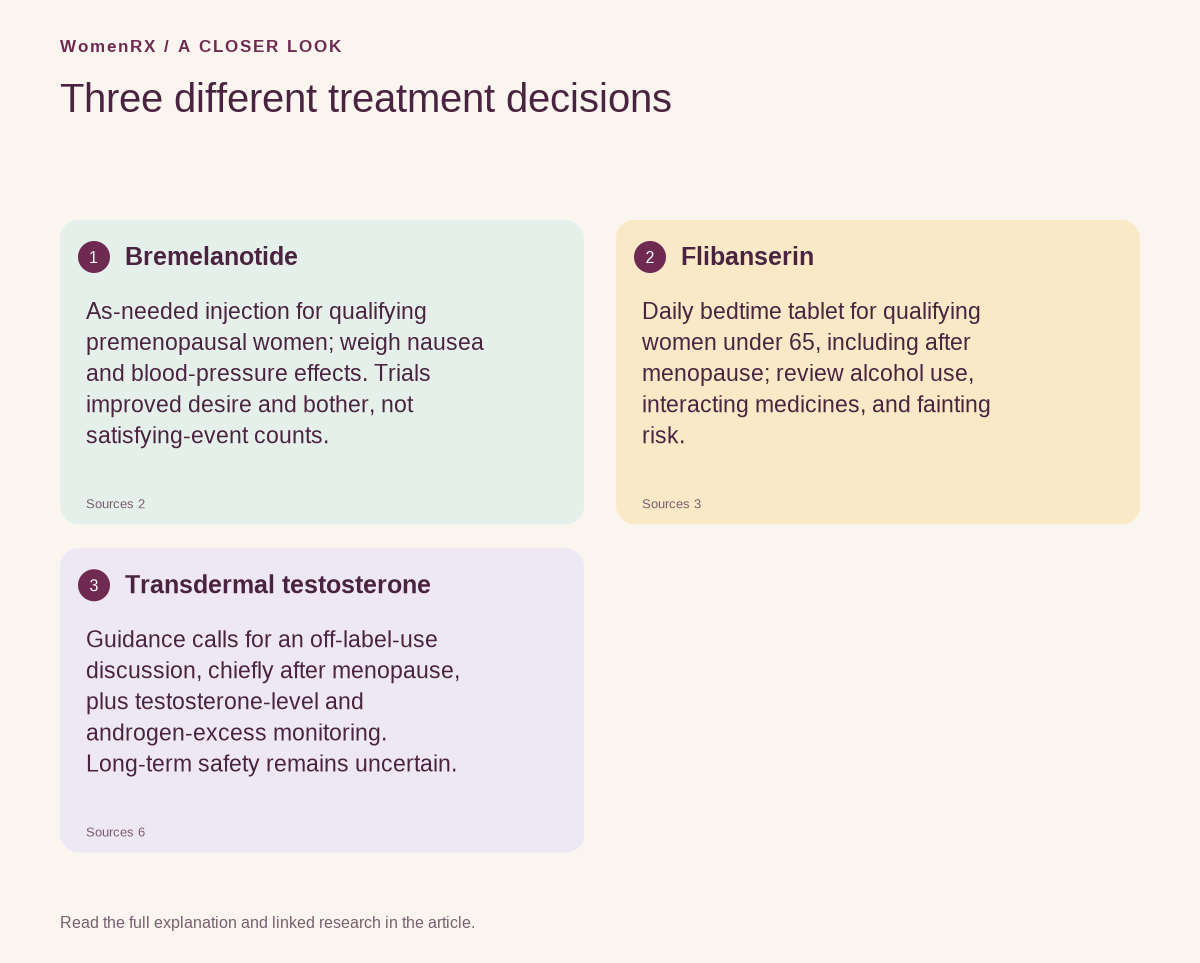
Three different treatment decisions
Bremelanotide: As-needed injection for qualifying premenopausal women; weigh nausea and blood-pressure effects. Trials improved desire and bother, not satisfying-event counts.2
Flibanserin: Daily bedtime tablet for qualifying women under 65, including after menopause; review alcohol use, interacting medicines, and fainting risk.3
Transdermal testosterone: Guidance calls for an off-label-use discussion, chiefly after menopause, plus testosterone-level and androgen-excess monitoring. Long-term safety remains uncertain.6
Read the figure as text
Compare the population, routine, and main oversight question before comparing benefits.- Bremelanotide: As-needed injection for qualifying premenopausal women; weigh nausea and blood-pressure effects. Trials improved desire and bother, not satisfying-event counts.2
- Flibanserin: Daily bedtime tablet for qualifying women under 65, including after menopause; review alcohol use, interacting medicines, and fainting risk.3
- Transdermal testosterone: Guidance calls for an off-label-use discussion, chiefly after menopause, plus testosterone-level and androgen-excess monitoring. Long-term safety remains uncertain.6
More questions, answered
Can a testosterone blood test tell me whether I have HSDD?
No. The ISSWSH guideline says a total testosterone level shouldn’t be used to diagnose HSDD. If testosterone treatment is being considered, the level serves as a baseline for monitoring, alongside an assessment of the factors affecting desire. 6
Sources you can check
- Sexual Health | MedlinePlusAccessed 2026-09-25Return to first citation
- VYLEESI (BREMELANOTIDE) INJECTION [COSETTE PHARMACEUTICALS, INC.] | US prescribing information and patient instructionsAccessed 2026-09-25Return to first citation
- ADDYI (FLIBANSERIN) TABLET, FILM COATED [SPROUT PHARMACEUTICALS, INC.] | US prescribing information and patient instructionsAccessed 2026-09-25Return to first citation
- Medical Treatment of Female Sexual Dysfunction.Nappi RE, Tiranini L, Martini E, Bosoni D, Righi A, Cucinella L. · The Urologic clinics of North America · 2022Return to first citation
- Female sexual dysfunctions: an overview on the available therapeutic interventions.da Silva Lara LA, Rufino AC, Oliveira FF, Rossato S, Borges CS, Reis RM. · Minerva obstetrics and gynecology · 2022Return to first citation
- International Society for the Study of Women's Sexual Health Clinical Practice Guideline for the Use of Systemic Testosterone for Hypoactive Sexual Desire Disorder in Women.Parish SJ, Simon JA, Davis SR, Giraldi A, Goldstein I, Goldstein SW, Kim NN, Kingsberg SA, Morgentaler A, Nappi RE, Park K, Stuenkel CA, Traish AM, Vignozzi L. · The journal of sexual medicine · 2021Return to first citation