Testosterone for Low Desire: What Safety Evidence Shows
Testosterone has its clearest evidence for distressing low desire after menopause, but the product, dose, side effects, and limits of long-term safety all matter.
Testosterone may modestly improve distressing low sexual desire in some postmenopausal women, with the strongest evidence for transdermal treatment. Evidence in premenopausal women is much more limited. It isn’t an established treatment for every change in desire, and long-term safety remains uncertain. Before considering it, discuss other possible contributors, the formulation, side effects, and how treatment would be monitored. 1 3 4
Testosterone is sometimes considered when low sexual desire is persistent and distressing, but it isn’t a routine treatment for every woman whose interest in sex has changed. The evidence is strongest for selected postmenopausal women with hypoactive sexual desire disorder (HSDD). Even in that group, benefit is generally described as modest, and long-term safety is not settled. 1 4
Who has the clearest evidence?
Postmenopausal women with HSDD are the group best represented in treatment research. Reviews of randomized trials report improvement in sexual desire and related aspects of sexual function with systemic transdermal testosterone. That evidence supports considering treatment in carefully selected cases, not using it for general wellbeing or as a default response to low libido. 1 4
For premenopausal women, the evidence is thinner and less consistent. A recent systematic review found only two randomized trials in premenopausal women, compared with seven in postmenopausal women. The review described promising results in the smaller premenopausal evidence base, but concluded that stronger studies are needed to establish who might benefit and what the safety profile is. Earlier reviews reported no demonstrated benefit in women of reproductive age. Taken together, the evidence for this group remains uncertain, not established. 2 3
For perimenopause and later reproductive years, evidence is also limited. Don’t assume that findings in postmenopausal trial participants apply equally across every stage of the transition. 1
Low desire isn’t diagnosed by a testosterone number
There isn’t an established diagnosis of “androgen deficiency” in women, and a testosterone blood level alone can’t establish HSDD or show how severe low desire is. Desire is affected by more than hormones. A biopsychosocial assessment considers whether the change is distressing and looks at possible contributors such as relationship or mental health concerns, other medicines, vaginal or urinary symptoms around menopause, and other health conditions. 1 5 7
A baseline testosterone measurement may still be part of a treatment discussion for a different reason: one position statement recommends checking it before treatment to identify an already elevated level. That is not the same as using a low result to diagnose HSDD. 7
Product choice changes the risk discussion
Transdermal formulations are the route with the strongest supporting evidence and are preferred in the cited position statement. In the United States, there is no FDA-approved testosterone formulation for women, so treatment for this purpose is off-label. Ask what specific product is being considered and how its use relates to evidence from studies, rather than assuming products or routes are interchangeable. 1 4 7
Pellets deserve a separate conversation. A recent review found that studies of pellets reported high early testosterone levels and wide variation between individuals. Much of the reported benefit and safety information came from observational studies, which can’t establish cause and effect as reliably as randomized trials. The review concluded that evidence was insufficient to confirm pellet safety. 6
The same caution applies to compounded testosterone: the cited position statement does not recommend compounded products because evidence is insufficient. Ask how the formulation and monitoring plan will help avoid levels above the usual premenopausal range. 7
What to cover before and during treatment
A useful discussion can focus on four questions:
- What is the goal? Clarify whether the concern is low desire that causes distress, rather than a change in sexual interest by itself. Consider other contributors that may be addressed instead of, or alongside, testosterone. 5 7
- Which formulation is proposed, and why? Ask whether it is transdermal or a pellet, and how the choice fits the evidence. The evidence and dosing uncertainty aren’t the same for every route. 4 6
- How will levels be checked? One position statement recommends checking a baseline level and monitoring within three to six weeks, with treatment kept within the premenopausal physiological range. This is guidance from a Latin American position statement, not a universal US protocol; agree on a plan with the prescriber. 7
- What side effects and unknowns are acceptable? Acne and increased hair growth are among the more commonly reported androgen-related effects. Long-term safety remains unsettled. Cardiovascular data are limited, especially for women at elevated cardiovascular risk. Pellet studies have reported observational signals about breast-cancer incidence, but those findings cannot establish whether pellets change risk. 2 4 5 6
A reasonable decision weighs a possible, usually modest improvement in desire against the uncertainty that remains, especially about longer-term risks and less-studied formulations. A treatment conversation should leave you knowing what outcome would count as helpful, how levels and side effects will be followed, and what will happen if the plan isn’t working.
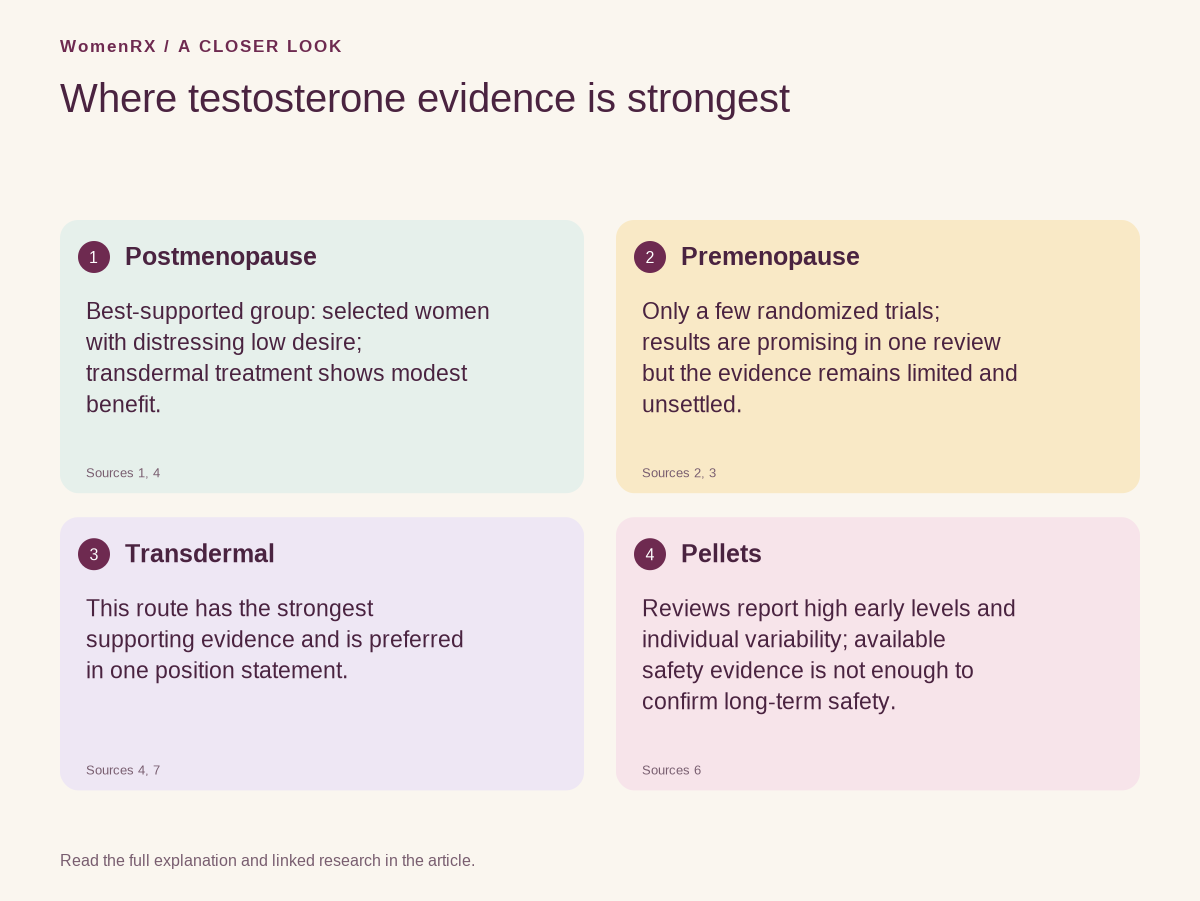
Where testosterone evidence is strongest
Postmenopause: Best-supported group: selected women with distressing low desire; transdermal treatment shows modest benefit.14
Premenopause: Only a few randomized trials; results are promising in one review but the evidence remains limited and unsettled.23
Transdermal: This route has the strongest supporting evidence and is preferred in one position statement.47
Pellets: Reviews report high early levels and individual variability; available safety evidence is not enough to confirm long-term safety.6
Read the figure as text
Compare the populations and formulations studied with the questions that remain open.- Postmenopause: Best-supported group: selected women with distressing low desire; transdermal treatment shows modest benefit.14
- Premenopause: Only a few randomized trials; results are promising in one review but the evidence remains limited and unsettled.23
- Transdermal: This route has the strongest supporting evidence and is preferred in one position statement.47
- Pellets: Reviews report high early levels and individual variability; available safety evidence is not enough to confirm long-term safety.6
More questions, answered
Can a testosterone test show whether I need treatment?
No. A testosterone level doesn’t diagnose HSDD or measure its severity. A baseline test may be used before treatment to check that the level isn’t already elevated, and monitoring may be used to help avoid levels above the usual premenopausal range. 5 7
Is a pellet equivalent to transdermal testosterone?
No. Transdermal formulations have the strongest supporting evidence in the cited guidance. Pellet studies report high early levels and wide variation, and much of their evidence is observational. Ask why a particular route is being proposed and how its risks and monitoring differ. 4 6 7
Sources you can check
- Testosterone for the Treatment of Hypoactive Sexual Desire Disorder in Perimenopausal and Postmenopausal Women.Kling JM. · Obstetrics and gynecology · 2025Return to first citation
- [Efficacy and safety of testosterone in the treatment of hypoactive sexual desire in women: what does the evidence say?]Espitia De La Hoz FJ. · Revista internacional de andrologia · 2023Return to first citation
- Testosterone therapy for female sexual dysfunction: a systematic review of the literature demonstrating outcomes in premenopausal and postmenopausal women.Furlan VA, Hammad MAM, Quesada S, Nguyen S, Yih J. · The journal of sexual medicine · 2026Return to first citation
- Systemic testosterone for the treatment of female sexual interest and arousal disorder (FSIAD) in the postmenopause.Ribera Torres L, Anglès-Acedo S, López Chardi L, Mension Coll E, Castelo-Branco C. · Gynecological endocrinology : the official journal of the International Society of Gynecological Endocrinology · 2024Return to first citation
- Testosterone Therapy in Women: A Literature Review of Clinical Indications, Dosing, Routes of Administration, and Safety.Montero Bernaldez J, Burgess ER, Martinez R, Peñalver M. · Cureus · 2026Return to first citation
- Testosterone Pellets in Women: Revisiting Safety and Clinical Outcomes.Pinto da Costa Viana D, Jacobsen L, Gabriel LH, Lobo de Souza Correia E, da Maia Fernandes D, Nagel ML, Comin A. · Cureus · 2025Return to first citation
- Androgen therapy in midlife and older women: a position statement of the Latin American Association of Gynecological Endocrinology (ALEG).Pilnik S, Belardo A, Marchesan LB, Camero-Lascano A, Acuña-San Martín M, Elizalde-Cremonte A, Ojeda E, Manzur A, Chedraui P. · Climacteric : the journal of the International Menopause Society · 2025Return to first citation