Testosterone for Low Desire: What the Evidence Supports
Testosterone has its strongest evidence for distressing low desire after menopause, but questions about formulation, monitoring, and long-term safety still matter.
Testosterone may modestly improve distressing low sexual desire in appropriately selected postmenopausal women; this is the group with the strongest evidence. Evidence for premenopausal women is much more limited, and a testosterone blood level does not diagnose the cause of low desire. In the U.S., there is no FDA-approved testosterone product for women, so formulation and monitoring deserve careful discussion. 2 3 4
Who the evidence is about
Testosterone treatment is not a general remedy for low desire. The clearest evidence is for appropriately selected postmenopausal women with distressing low desire, often described in research as hypoactive sexual desire disorder. A 2026 systematic review found the strongest support in postmenopausal women, drawing on randomized trials of transdermal treatment. A review focused on perimenopausal and postmenopausal women likewise describes the benefit in selected postmenopausal patients as modest. 2 3
That distinction matters if you’re still having periods or are in the menopause transition. The systematic review included only two randomized trials in premenopausal women, compared with seven in postmenopausal women, and characterized the younger group’s evidence as preliminary. Another review says research in women of late reproductive age is limited. These findings don’t establish that testosterone is an appropriate or proven option for every life stage. 2 3
A lab result can’t explain desire by itself
There is no accepted diagnosis of androgen deficiency in women based on a testosterone level, and low desire can’t be diagnosed from a blood test alone. In a large cross-sectional study of midlife women, measured sex hormones were not associated with sexual desire or desire difficulty after the researchers adjusted for other factors. Because that study was observational, it cannot test whether treatment helps. It does, however, underline why a lab value shouldn’t stand in for understanding the concern itself. 3 4
This is not a contradiction with trials in which some postmenopausal participants’ desire improved with treatment. One question is whether a hormone level identifies who has low desire; another is whether treatment helps a selected group. The studies answer different questions. Treatment results do not make a low level a diagnostic test. 2 4
Formulation changes what the evidence can tell you
Most of the strongest evidence described in the review is for transdermal testosterone, meaning treatment absorbed through the skin. In the United States, a review reports that no testosterone formulation is FDA-approved for women. Use for this purpose is therefore off-label, and the product and approach matter when weighing how closely a treatment resembles the research. 2 3
A small placebo-controlled trial illustrates one uncertainty: 47 postmenopausal women using hormone therapy received either compounded transdermal testosterone or placebo. The testosterone group had improvements in some sexual-function areas, including desire and satisfaction, but the researchers also reported variability in hormone concentrations that made the compounded medication difficult to evaluate. This trial is one piece of evidence, not proof that compounded products as a category have established safety or consistent effects. 1
What monitoring and safety can, and can’t, settle
Reviews describe monitoring testosterone levels to keep them within the normal range for women. That can help identify levels that are too high, but it does not guarantee a benefit or answer every safety question. Long-term safety data remain limited. A recent review says serious adverse events appear uncommon when levels stay within the normal female range, while also acknowledging the limits of long-term evidence. 5 6
Before deciding, it can help to ask: What specific problem are we treating, and what would count as a meaningful improvement for me? Which formulation is being considered, and how does its evidence compare with transdermal treatment? How will levels be monitored and kept in the normal female range? What side effects should prompt a call? When will we check whether it is helping, and how will we decide whether to continue? The evidence supports asking about a plan for reassessment; it does not establish one universal treatment duration. 1 2 5 6
The clearest takeaway is not that a hormone number explains low desire, or that testosterone works for every woman. It is that a possible modest benefit is best supported in selected postmenopausal women, while the decision still depends on the person, the formulation, and a realistic conversation about monitoring and what remains uncertain. 2 3
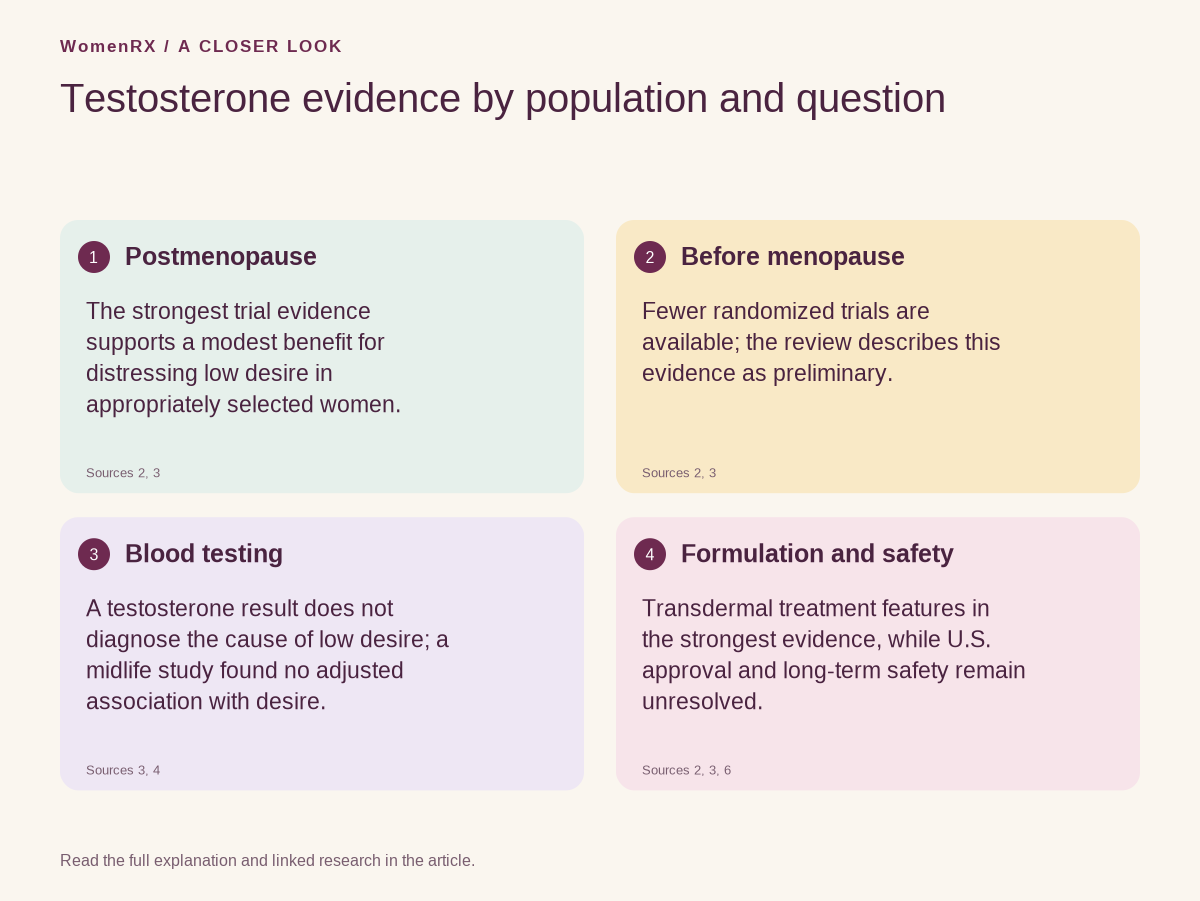
Testosterone evidence by population and question
Postmenopause: The strongest trial evidence supports a modest benefit for distressing low desire in appropriately selected women.23
Before menopause: Fewer randomized trials are available; the review describes this evidence as preliminary.23
Blood testing: A testosterone result does not diagnose the cause of low desire; a midlife study found no adjusted association with desire.34
Formulation and safety: Transdermal treatment features in the strongest evidence, while U.S. approval and long-term safety remain unresolved.236
Read the figure as text
The evidence is clearest for selected postmenopausal women, but a treatment response, a lab result, and a particular formulation answer different questions.- Postmenopause: The strongest trial evidence supports a modest benefit for distressing low desire in appropriately selected women.23
- Before menopause: Fewer randomized trials are available; the review describes this evidence as preliminary.23
- Blood testing: A testosterone result does not diagnose the cause of low desire; a midlife study found no adjusted association with desire.34
- Formulation and safety: Transdermal treatment features in the strongest evidence, while U.S. approval and long-term safety remain unresolved.236
More questions, answered
Does a low testosterone result mean I need treatment?
No. A testosterone level does not diagnose the cause of low desire in women, and measured levels were not associated with desire or desire difficulty in a large cross-sectional midlife study. Treatment evidence in selected postmenopausal women answers a different question from whether a blood test can identify the cause. 3 4
Is there an FDA-approved testosterone product for women in the U.S.?
A 2025 review reports that there is no FDA-approved testosterone formulation for women in the United States. The strongest evidence summarized in a 2026 systematic review is for transdermal treatment, but the lack of an approved product and limited long-term safety data are relevant to the discussion. 2 3
Sources you can check
- Effect of transdermal testosterone on postmenopausal sexual desire: placebo-controlled randomized clinical trial.Ceccatto Andrade VP, Araujo Júnior E, Callado GY, Ceccatto Andrade G, Kulak Junior J. · European journal of obstetrics, gynecology, and reproductive biology · 2026Return to first citation
- Testosterone therapy for female sexual dysfunction: a systematic review of the literature demonstrating outcomes in premenopausal and postmenopausal women.Furlan VA, Hammad MAM, Quesada S, Nguyen S, Yih J. · The journal of sexual medicine · 2026Return to first citation
- Testosterone for the Treatment of Hypoactive Sexual Desire Disorder in Perimenopausal and Postmenopausal Women.Kling JM. · Obstetrics and gynecology · 2025Return to first citation
- Associations between testosterone and pre-androgens and sexual function; findings from the Australian Women's Midlife Years Study.Wang Y, Islam RM, Hodge A, Handelsman DJ, Karim MN, Bond M, Davis SR. · Fertility and sterility · 2026Return to first citation
- The Intersection of Androgens and Cardiovascular Disease in Postmenopausal Women.Dew ML, Olubi OM, Wang-Crocker C, Prince EL, Lowe A, Le DE. · Current cardiology reports · 2026Return to first citation
- Testosterone in Women: Clinical Evidence and Practice Guidelines.Lanoff J, Simon JA. · Obstetrics and gynecology clinics of North America · 2026Return to first citation