What Should You Know Before Considering Testosterone Cream After Menopause?
Testosterone may help some postmenopausal women with distressing low desire, but the product and follow-up plan matter.
Testosterone is an evidence-supported option to discuss for some postmenopausal women with persistent, distressing low sexual desire, called hypoactive sexual desire disorder (HSDD). A small trial found benefit with a testosterone cream, but it doesn’t show that every cream or compounded product works the same way. Ask about the exact formulation, application and transfer directions, and how you’ll review benefits and safety. 2 4
Start with the concern, not the cream
Testosterone isn’t a general treatment for feeling less like yourself after menopause. The clinical context where research supports considering it is HSDD: a long-term decrease in sexual desire that causes personal distress. There isn’t an androgen-deficiency diagnosis for women, so a testosterone blood-test result alone doesn’t establish that treatment is appropriate. 3 4
A review describes testosterone as modestly beneficial for appropriately selected postmenopausal women with HSDD. A systematic review also found the strongest evidence in postmenopausal women, including randomized trials of transdermal treatment. That supports a focused discussion about distressing low desire, not promises of better energy, cognition, or general wellbeing. 4 6
Desire can have more than one contributor. Medicines and chronic health conditions, for example, can affect sexual desire or enjoyment. That’s a reason to consider what else may be going on rather than treating a hormone number as the whole explanation. 1
What a cream trial can tell you
One randomized, placebo-controlled crossover trial studied testosterone cream in 36 postmenopausal women who had undergone hysterectomy, were already using transdermal estrogen, and met the study’s criteria for low sexual desire. Each treatment period lasted three months. The study reported improved sexual-function scores during testosterone treatment. Its small, selected group and short treatment periods limit how confidently the result applies to other women or other products. 2
Evidence from other skin-applied products adds context, but it doesn’t prove that all creams and gels are interchangeable. In an exploratory study, 24 postmenopausal women who had already been using testosterone gel and estrogen therapy had substantial variation in measured testosterone concentrations. Because they were established users, that study describes levels in that group; it doesn’t show what a new user should expect from a different product. 3
A separate randomized trial in 47 postmenopausal women compared compounded transdermal testosterone with placebo. The abstract reports variability in hormone concentrations, which complicated evaluation of the compounded medication. This is a reason to ask about the specific product and how it is prepared, not proof that every compounded product has the same characteristics. 5
A 2025 review reported that no FDA-approved testosterone formulation for women was available in the United States at that time. If treatment is offered, ask whether the exact product is being prescribed off-label or is compounded, and why that formulation is being chosen. A product’s name, strength, and instructions matter; the word “cream” alone doesn’t tell you how it should be used. 4
Make the practical details part of the decision
Application instructions depend on the product. This research doesn’t establish one application or transfer rule for every testosterone cream or gel. Before starting, ask for directions specific to the product you’ll receive: where to apply it, what to do after application, and what precautions to take around a partner, children, or anyone else who might touch the application site. Don’t assume instructions for another person’s product apply to yours.
If the product is compounded, ask how the prescribed amount is measured and what the pharmacy’s process is for preparing that formulation consistently. The study of one compounded product found variable hormone concentrations, but that finding doesn’t establish how any particular product will perform. 5
Agree on what follow-up means
Before treatment, decide what change would matter to you. For example, you might want to discuss whether desire or the distress associated with low desire has changed. Ask when you’ll review that goal and what will happen if the treatment isn’t helping. This keeps the decision centered on the reason for treatment rather than a lab result alone.
Ask whether blood tests are part of your plan, what they’re intended to assess, and how their timing relates to your product’s instructions. In one small gel study, measured levels varied widely between participants. A review notes that clinical guidelines provide monitoring guidance, but the sources here don’t establish one monitoring schedule or target for every cream. 3 4
Also ask what changes or side effects should prompt you to contact the prescriber, and when you’ll review whether continued use makes sense. Short studies can’t establish long-term safety: the cream trial’s treatment periods lasted three months, and the 2025 review identifies a lack of long-term safety data. 2 4
Questions worth asking before you start
- Does my concern fit the context of persistent, distressing low desire, and could something else be contributing?
- What exact product will I use, and is it off-label or compounded?
- What are the product-specific application and transfer precautions?
- What change are we looking for, what monitoring is planned, and when will we review the results?
- What is known, and still uncertain, about safety if treatment continues?
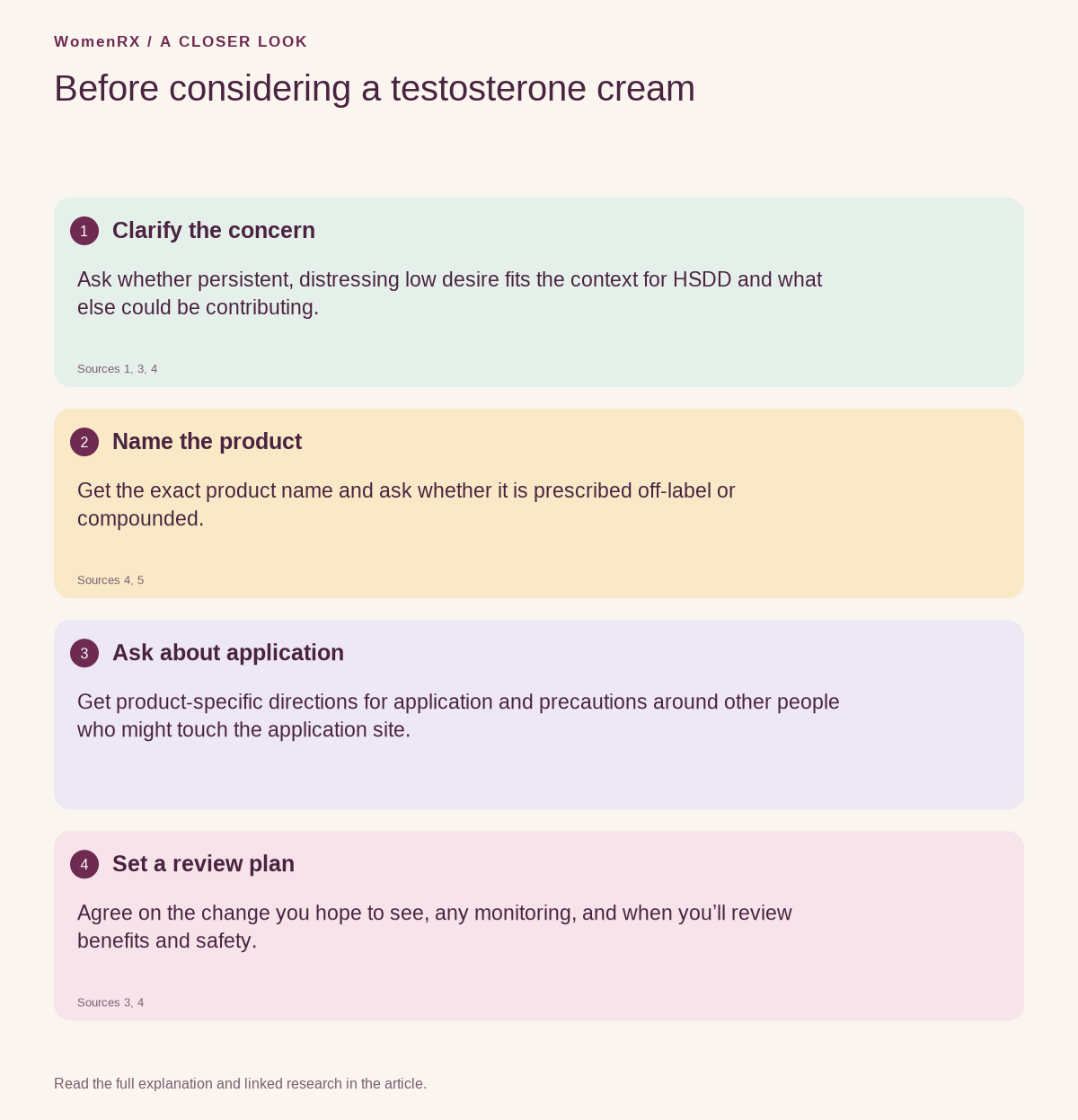
Before considering a testosterone cream
Clarify the concern: Ask whether persistent, distressing low desire fits the context for HSDD and what else could be contributing.134
Name the product: Get the exact product name and ask whether it is prescribed off-label or compounded.45
Ask about application: Get product-specific directions for application and precautions around other people who might touch the application site.
Set a review plan: Agree on the change you hope to see, any monitoring, and when you’ll review benefits and safety.34
Read the figure as text
These questions separate the reason for treatment from the product-specific details and follow-up plan.- Clarify the concern: Ask whether persistent, distressing low desire fits the context for HSDD and what else could be contributing.134
- Name the product: Get the exact product name and ask whether it is prescribed off-label or compounded.45
- Ask about application: Get product-specific directions for application and precautions around other people who might touch the application site.
- Set a review plan: Agree on the change you hope to see, any monitoring, and when you’ll review benefits and safety.34
Sources you can check
- Sexual Health | MedlinePlusAccessed 2026-09-25Return to first citation
- A double-blind, randomized, placebo-controlled trial of the effect of testosterone cream on the sexual motivation of menopausal hysterectomized women with hypoactive sexual desire disorder.El-Hage G, Eden JA, Manga RZ. · Climacteric : the journal of the International Menopause Society · 2007Return to first citation
- A Single Centre Study to Describe the Changes in Serum Testosterone Concentration Following Application of Testosterone Gel in Post-Menopausal Women With Hypoactive Sexual Desire Disorder (HSSD) Already Receiving This as Part of Usual Care in Conjunction With Oestrogen-Containing Hormone Replacement Treatment (HRT).Heald A, Illangasekera Y, Rehman H, Livingston M, Keen A, Kochhar R, Panay N, Borzomato J, Mordaunt M, Taylor P, Hackett G. · Clinical endocrinology · 2026Return to first citation
- Testosterone for the Treatment of Hypoactive Sexual Desire Disorder in Perimenopausal and Postmenopausal Women.Kling JM. · Obstetrics and gynecology · 2025Return to first citation
- Effect of transdermal testosterone on postmenopausal sexual desire: placebo-controlled randomized clinical trial.Ceccatto Andrade VP, Araujo Júnior E, Callado GY, Ceccatto Andrade G, Kulak Junior J. · European journal of obstetrics, gynecology, and reproductive biology · 2026Return to first citation
- Testosterone therapy for female sexual dysfunction: a systematic review of the literature demonstrating outcomes in premenopausal and postmenopausal women.Furlan VA, Hammad MAM, Quesada S, Nguyen S, Yih J. · The journal of sexual medicine · 2026Return to first citation