What should you know before using progesterone cream for menopause symptoms?
A cream can be absorbed through your skin, but that doesn’t make it a proven treatment for hot flashes or a substitute for a prescribed hormone regimen.
Progesterone cream hasn’t been established as a treatment for menopause symptoms such as hot flashes. Skin absorption can happen, but the amount reaching your bloodstream may vary, and evidence that a cream provides the same benefit or protection as a prescribed progesterone regimen is lacking. Before using one, be clear about your treatment goal, especially if you also take estrogen. 2 3
Start with the goal, not the hormone
A hot flash, disrupted sleep, or a mood change doesn’t by itself show that progesterone cream is the right treatment. The key question is what you want the treatment to do. A cream promoted for menopause symptoms is not automatically equivalent to menopausal hormone therapy prescribed for a specific symptom or as part of an estrogen regimen.
For hot flashes, a North American Menopause Society position statement found few data supporting topical progesterone cream. A later review describes progesterone cream’s use in postmenopausal treatment as unproven. By contrast, menopausal hormone therapy that includes systemic estrogen is a separate treatment category described as highly effective for vasomotor symptoms; when a progestogen is needed as part of that regimen, the formulation matters. 2 3 4
“Topical” doesn’t mean “only on the skin”
Progesterone can pass through the skin, but absorption isn’t necessarily predictable. A 2026 review describes the outer skin layer as a barrier that affects absorption and notes that local metabolism can limit how much progesterone becomes available systemically. 3
One small randomized study tested 2% progesterone cream for skin changes, not menopause symptoms. It included 40 peri- and postmenopausal women followed for 16 weeks. Researchers reported a small rise in average blood progesterone levels, but this study doesn’t show that the cream relieves hot flashes or protects the uterine lining during estrogen treatment. Nor does this short skin study establish long-term safety. 1
If you take estrogen, don’t swap products on your own
If you’ve been told to use a progestogen with systemic estrogen for endometrial protection, ask whether the exact cream you’re considering has evidence for that purpose. A review identifies oral micronized progesterone as an option when endometrial protection is required, while describing progesterone cream as unproven in postmenopausal treatment. That difference is a reason not to assume a cream can replace a prescribed regimen. 3 4
This question is separate from whether you need progesterone at all. Ask what the intended role is in your particular treatment plan: symptom relief, endometrial protection alongside estrogen, or something else. The answer should identify the product and route, not just the hormone name.
Questions that make the decision clearer
Before starting a cream, ask:
- Which symptom or treatment goal is this meant to address?
- What evidence supports this specific product and route for that goal?
- If I use systemic estrogen, is this product intended to provide endometrial protection, and what evidence supports that?
- How will we tell whether it’s helping, and what’s the plan if it isn’t?
If your main concern is hot flashes, ask about treatments with evidence for that symptom rather than assuming progesterone cream is interchangeable with other hormone therapy. If the proposed reason is skin firmness or wrinkles, that’s a different goal: one small trial found skin changes, but it did not test menopause symptom relief. 1 2
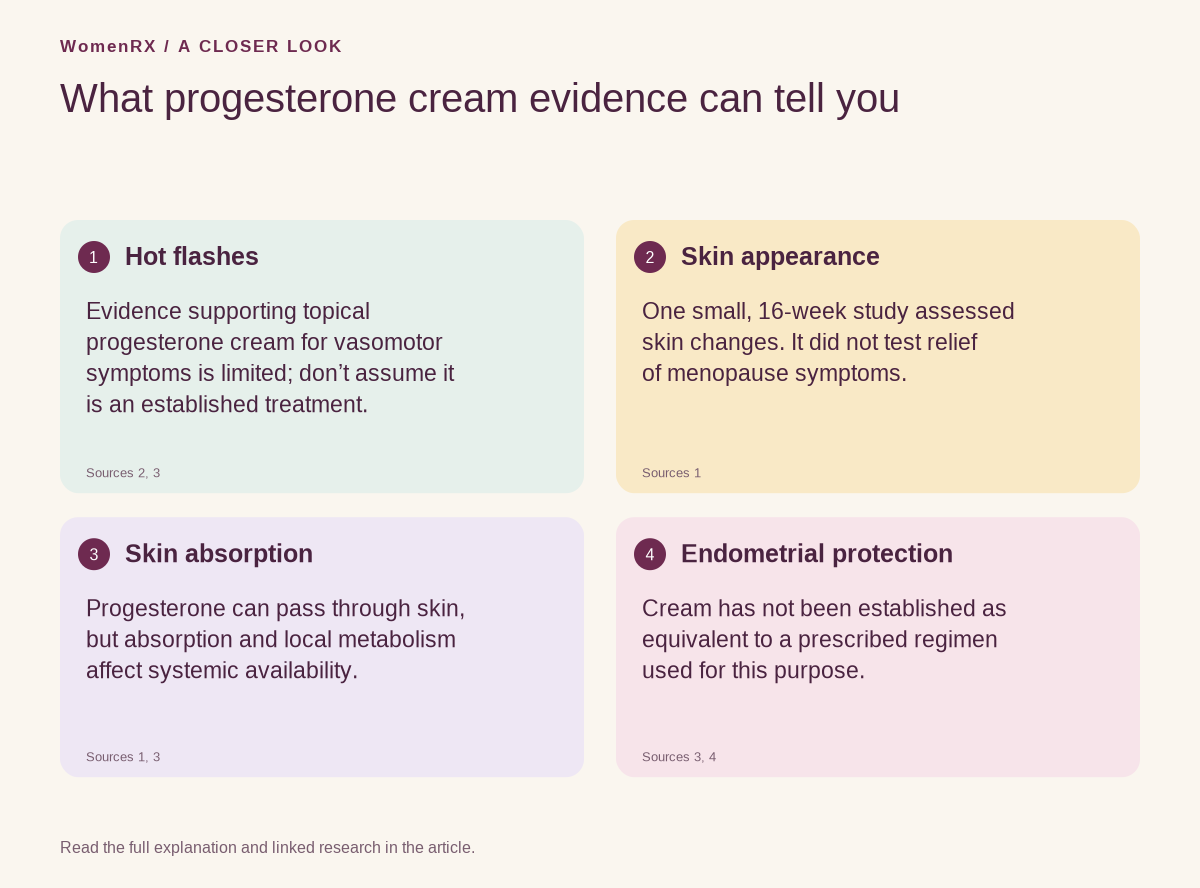
What progesterone cream evidence can tell you
Hot flashes: Evidence supporting topical progesterone cream for vasomotor symptoms is limited; don’t assume it is an established treatment.23
Skin appearance: One small, 16-week study assessed skin changes. It did not test relief of menopause symptoms.1
Skin absorption: Progesterone can pass through skin, but absorption and local metabolism affect systemic availability.13
Endometrial protection: Cream has not been established as equivalent to a prescribed regimen used for this purpose.34
Read the figure as text
These are different goals, and evidence for one does not establish benefit for another.- Hot flashes: Evidence supporting topical progesterone cream for vasomotor symptoms is limited; don’t assume it is an established treatment.23
- Skin appearance: One small, 16-week study assessed skin changes. It did not test relief of menopause symptoms.1
- Skin absorption: Progesterone can pass through skin, but absorption and local metabolism affect systemic availability.13
- Endometrial protection: Cream has not been established as equivalent to a prescribed regimen used for this purpose.34
Sources you can check
- Effects and side-effects of 2% progesterone cream on the skin of peri- and postmenopausal women: results from a double-blind, vehicle-controlled, randomized study.Holzer G, Riegler E, Hönigsmann H, Farokhnia S, Schmidt JB. · The British journal of dermatology · 2005Return to first citation
- Treatment of menopause-associated vasomotor symptoms: position statement of The North American Menopause Society.North American Menopause Society. · Menopause (New York, N.Y.) · 2004Return to first citation
- Transdermal Hormonal Therapy in Menopause: Current Evidence and Personalized Approaches.Mihai MM, Toma AM, Toma CV, Copilău AI, Naum CI, Timofte MA, Văcăroiu IA, Stroescu AB, Sima RM, Poenaru MO. · Pharmaceutics · 2026Return to first citation
- Menopausal Hormone Therapy: A Narrative Review of Contemporary Evidence.Finks SW, Cieri-Hutcherson NE, Vernon V, McBane SE. · Pharmacotherapy · 2026Return to first citation