Is Progesterone Available Without a Prescription for Menopause Use?
A product described as “progesterone” isn’t necessarily the same as a prescribed progesterone medicine, especially when estrogen is part of the plan.
Oral micronized progesterone used in menopause care is a prescription medicine. A cream described as “progesterone” or a supplement making hormone-related claims isn’t automatically an equivalent treatment. The ingredient, route, and intended outcome all matter. If you use systemic estrogen and have a uterus, don’t count on a cream or supplement to protect the uterine lining without evidence for that specific product and use. 2 4
First, find out what the product actually is
A familiar hormone word on the front of a package doesn’t tell you what’s inside or what the product has been shown to do. For menopause use, these are different categories:
- A progesterone medicine: Prometrium capsules contain micronized progesterone taken by mouth. Bijuva is a prescription capsule that combines estradiol and progesterone. Each is a defined formulation; neither is a blanket name for products described as “natural progesterone.” 1 2
- A topical progesterone cream: This describes a route of use, not a proven menopause benefit. A North American Menopause Society position statement found few data supporting topical progesterone cream for hot flashes. That statement, published in 2004, doesn’t establish the current availability or effectiveness of any particular cream sold today. 4
- A supplement with hormone-related claims: An ingredient such as soy isoflavones or black cohosh is not progesterone simply because it’s promoted for menopause. The same position statement found clinical trial evidence insufficient to support or refute those remedies for hot flashes. It didn’t establish that they protect the uterine lining. 4
The practical way to read a label is to separate ingredient, formulation, and claim. Does the ingredient list name progesterone, a different substance, or a blend of plant ingredients? Is it an oral medicine, a cream, or a dietary supplement? And is the claim about hot flashes, another symptom, or protecting the uterus during estrogen therapy? Evidence for one of those outcomes doesn’t prove another.
Why estrogen changes the question
If you have a uterus and use systemic estrogen, protection of the uterine lining is a different goal from feeling fewer hot flashes. Estrogen can stimulate the lining; progesterone can oppose that effect. In a randomized trial described in the Prometrium prescribing information, 358 postmenopausal women with a uterus received one of three treatments for up to 36 months. Endometrial hyperplasia occurred in 6% of those assigned the studied combination of oral micronized progesterone and estrogen, compared with 64% assigned estrogen alone. Those results concern that specific prescription regimen, not progesterone cream or a supplement. 1 2
Route matters, but a different route isn’t automatically ineffective. A systematic review of studies in peri- and postmenopausal women using estrogen found that a levonorgestrel intrauterine device protected against endometrial hyperplasia at least as effectively as oral or vaginal progesterone in the included studies. That’s evidence about a specific hormone-releasing device, not evidence that every product applied to the skin can do the same job. 3
If you’re already using estrogen, the useful question is: What evidence shows that this exact product, used this way, protects the uterine lining? Bring its ingredient list to the person prescribing your estrogen rather than substituting it for the progestogen in your treatment plan. Unusual vaginal bleeding, including any bleeding after menopause, needs evaluation rather than a change of products based on package claims. 1 2
One other label distinction: an over-the-counter norgestrel birth-control pill is intended to prevent pregnancy. Its nonprescription status doesn’t make it a menopause progesterone treatment. 5
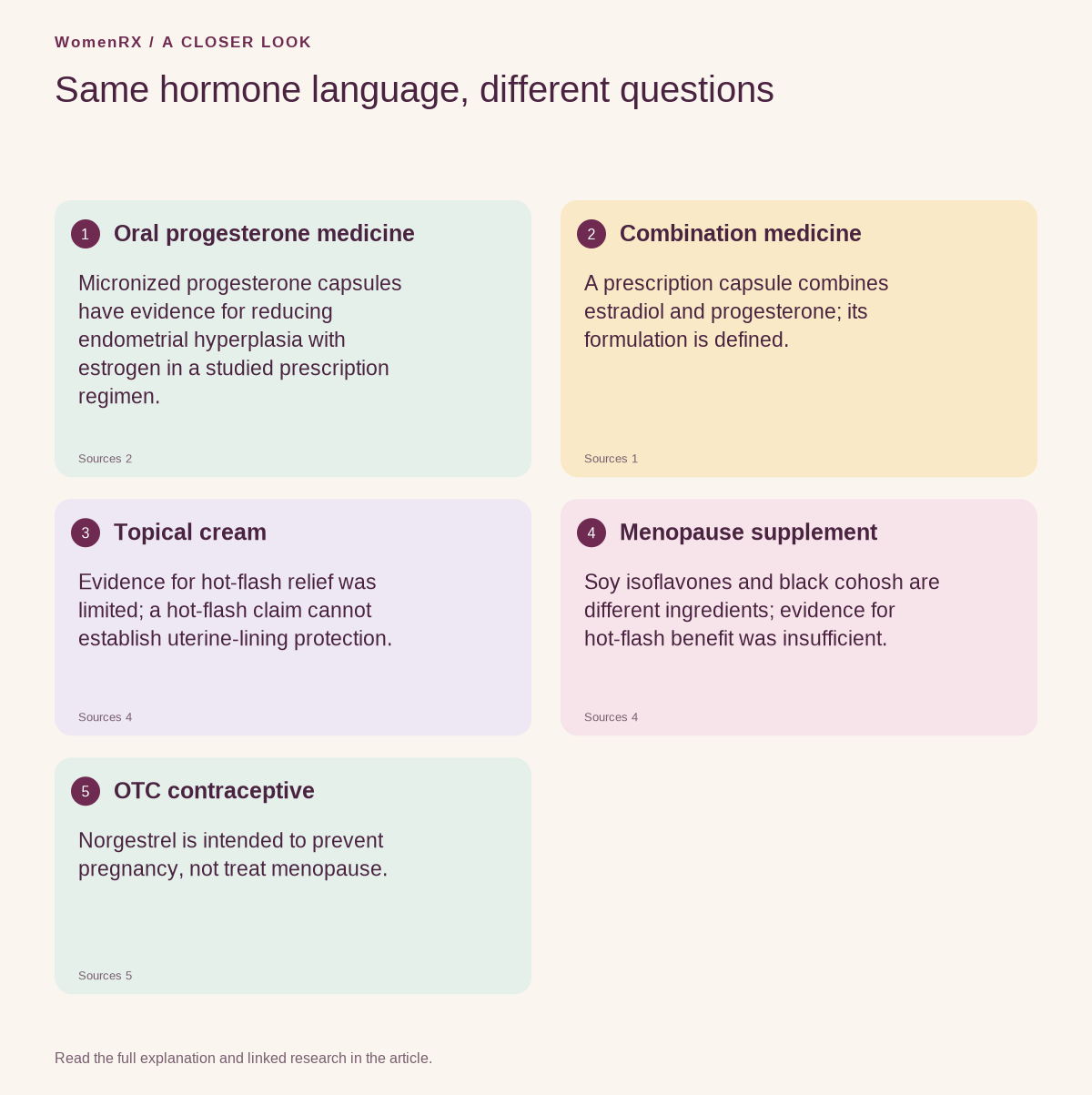
Same hormone language, different questions
Oral progesterone medicine: Micronized progesterone capsules have evidence for reducing endometrial hyperplasia with estrogen in a studied prescription regimen.2
Combination medicine: A prescription capsule combines estradiol and progesterone; its formulation is defined.1
Topical cream: Evidence for hot-flash relief was limited; a hot-flash claim cannot establish uterine-lining protection.4
Menopause supplement: Soy isoflavones and black cohosh are different ingredients; evidence for hot-flash benefit was insufficient.4
OTC contraceptive: Norgestrel is intended to prevent pregnancy, not treat menopause.5
Read the figure as text
Compare the ingredient and route with the specific outcome each product claim would need to support.- Oral progesterone medicine: Micronized progesterone capsules have evidence for reducing endometrial hyperplasia with estrogen in a studied prescription regimen.2
- Combination medicine: A prescription capsule combines estradiol and progesterone; its formulation is defined.1
- Topical cream: Evidence for hot-flash relief was limited; a hot-flash claim cannot establish uterine-lining protection.4
- Menopause supplement: Soy isoflavones and black cohosh are different ingredients; evidence for hot-flash benefit was insufficient.4
- OTC contraceptive: Norgestrel is intended to prevent pregnancy, not treat menopause.5
More questions, answered
If a supplement says it supports hormone balance, does it contain progesterone?
Not necessarily. Check the ingredient list rather than treating a hormone-related claim as an ingredient statement. Remedies such as soy isoflavones and black cohosh have been discussed for hot flashes, but that isn’t evidence that they contain progesterone or protect the uterine lining during estrogen therapy. 4
Sources you can check
- BIJUVA (ESTRADIOL AND PROGESTERONE) CAPSULE [MAYNE PHARMA] | US prescribing information and patient instructionsAccessed 2026-09-25Return to first citation
- PROMETRIUM (PROGESTERONE) CAPSULE [ACERTIS PHARMACEUTICALS, LLC] | US prescribing information and patient instructionsAccessed 2026-09-25Return to first citation
- Benefits of Levonorgestrel Intrauterine Device Use vs. Oral or Transdermal Progesterone for Postmenopausal Women Using Estrogen Containing Hormone Therapy.Clark K, Westberg SM. · Innovations in pharmacy · 2019Return to first citation
- Treatment of menopause-associated vasomotor symptoms: position statement of The North American Menopause Society.North American Menopause Society. · Menopause (New York, N.Y.) · 2004Return to first citation
- Norgestrel (Opill) Is the First Over-the-Counter Oral Contraceptive Pill Approved in the United States.Shiroff J. · Nursing for women's health · 2024Return to first citation