Hot Flashes in Perimenopause: What Helps and When to Discuss Treatment
A short record of how hot flashes affect your days can help you compare hormone therapy, nonhormonal options, and practical comfort measures.
Hot flashes can happen during perimenopause, and treatment choices depend on how much they affect you, your health history, and your preferences. Hormone therapy is the most effective treatment for hot flashes, while evidence-supported nonhormonal options include cognitive behavioral therapy, clinical hypnosis, and several prescription medicines. Simple cooling measures may bring comfort, but they aren’t established treatments for reducing hot flashes. 12
Hot flashes during perimenopause can range from occasional warmth to episodes that interrupt sleep or make work and daily activities harder. You don’t have to wait until symptoms feel unbearable to bring them up. The useful question is what you want relief from, and which options fit your health and preferences.
Start with the effect, not just the count
For a week or two, jot down when an episode happens, how disruptive it feels, whether it wakes you, and what you were doing beforehand. You can also note where you are in your menstrual cycle if that seems useful. This is a personal record, not a diagnostic test or a required score.
The pattern helps make “I’m having hot flashes” more specific: perhaps they’re mostly a sleep problem, or perhaps the main issue is feeling suddenly overheated during meetings. That distinction can shape which tradeoffs matter most to you.
Compare the options by what they can offer
Comfort measures: useful for comfort, not proven symptom treatment
A fan, lighter layers, or a cooler bedroom may make an episode easier to tolerate. But the North American Menopause Society’s evidence review did not recommend cooling techniques or avoiding triggers as treatments for reducing vasomotor symptoms. So it’s reasonable to use what feels comfortable, while keeping expectations realistic. 2
Hormone therapy: the most effective option for hot flashes
The North American Menopause Society identifies hormone therapy as the most effective treatment for vasomotor symptoms. Whether it’s a suitable choice for you depends on your health history and personal circumstances. The balance of benefits and risks varies with factors including the type of hormone therapy, dose, route, duration, timing of starting it, and whether a progestogen is used. 1
In its 2022 position statement, the Society described the benefit-risk balance as generally favorable for women younger than 60 or within 10 years of menopause onset who have no contraindications. That’s a general evidence statement, not a personal clearance: your own history still matters. 1
Nonhormonal options: several approaches have evidence
The Society’s 2023 position statement recommends cognitive behavioral therapy (CBT), clinical hypnosis, and certain prescription medicines for vasomotor symptoms. The medicines it lists include SSRIs or SNRIs, gabapentin, fezolinetant, and, with somewhat less certain evidence, oxybutynin. A clinician can help you compare whether a behavioral approach or a medicine makes sense for your symptoms and health history. 2
CBT deserves a realistic explanation. In one randomized study of 53 perimenopausal women, CBT and a psychoeducation group both improved some measures, but there was no difference between groups in hot-flash frequency or rating after six weeks. This small study doesn’t settle the broader evidence, but it’s a reason to ask what outcome CBT is most likely to help with for you rather than assuming it will stop episodes. 4
Supplements: “natural” doesn’t mean established
The Society’s evidence review did not recommend supplements or herbal remedies for vasomotor symptoms. That doesn’t establish that every product has been studied equally; it does mean supplements aren’t among the options this review supports as treatments. If you’re considering one, bring the exact product name into the discussion rather than assuming it’s a proven substitute for other care. 2
Make the discussion personal
You might tell your clinician how often episodes happen, what they interrupt, and what you’ve already tried for comfort. Then ask:
- Which options have evidence for the outcome I care about, such as fewer episodes or less disruption?
- How does my health history affect the benefits and risks of hormone therapy or nonhormonal medicines?
- If we consider hormone therapy, what type is being discussed, and how do route and progestogen use affect the decision?
- If I’d rather avoid hormones, which evidence-supported nonhormonal options fit my circumstances?
- When should we revisit whether the approach is helping?
There isn’t one best answer for everyone. A useful plan matches the burden of your symptoms with the evidence for each option and the tradeoffs that matter to you.
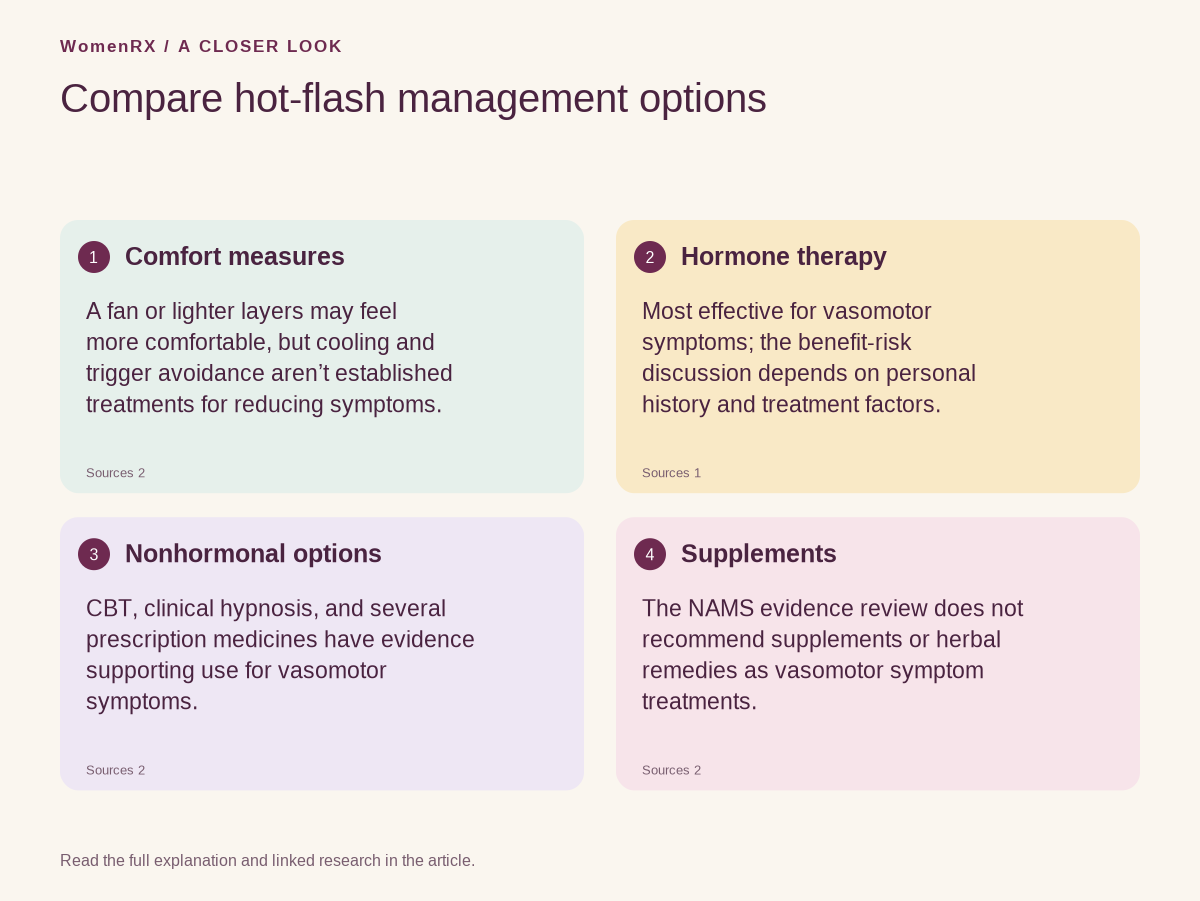
Compare hot-flash management options
Comfort measures: A fan or lighter layers may feel more comfortable, but cooling and trigger avoidance aren’t established treatments for reducing symptoms.2
Hormone therapy: Most effective for vasomotor symptoms; the benefit-risk discussion depends on personal history and treatment factors.1
Nonhormonal options: CBT, clinical hypnosis, and several prescription medicines have evidence supporting use for vasomotor symptoms.2
Supplements: The NAMS evidence review does not recommend supplements or herbal remedies as vasomotor symptom treatments.2
Read the figure as text
Different approaches serve different needs. Use this comparison to connect symptom impact and personal priorities with a discussion of what each option can offer.- Comfort measures: A fan or lighter layers may feel more comfortable, but cooling and trigger avoidance aren’t established treatments for reducing symptoms.2
- Hormone therapy: Most effective for vasomotor symptoms; the benefit-risk discussion depends on personal history and treatment factors.1
- Nonhormonal options: CBT, clinical hypnosis, and several prescription medicines have evidence supporting use for vasomotor symptoms.2
- Supplements: The NAMS evidence review does not recommend supplements or herbal remedies as vasomotor symptom treatments.2
More questions, answered
Are hot flashes during perimenopause unusual?
No. Hot flashes can occur during the menopause transition, which includes perimenopause. Their impact varies, so it’s reasonable to discuss them if they disrupt sleep or daily life. 3
Does CBT always reduce how often hot flashes happen?
Not necessarily. A small randomized study in perimenopausal women found no difference in hot-flash frequency or rating between CBT and psychoeducation after six weeks, even though some other measures improved. The broader menopause position statement recommends CBT as a nonhormonal option, so it’s worth discussing what benefit to expect in your situation. 24
Sources you can check
- The 2022 hormone therapy position statement of The North American Menopause Society.“The 2022 Hormone Therapy Position Statement of The North American Menopause Society” Advisory Panel. · Menopause (New York, N.Y.) · 2022Return to first citation
- The 2023 nonhormone therapy position statement of The North American Menopause Society.Menopause (New York, N.Y.) · 2023Return to first citation
- Aesthetically relevant symptoms of menopause transition: Impact and approach to management.Gröne D, Fida M, de Oliveira GV, Kroumpouzos G. · Clinics in dermatology · 2026Return to first citation
- Effectiveness of Cognitive Behavioral Therapy in Managing Physical and Psychological Distress in Women during the Perimenopausal Phase.Bassi R, Bajaj MK, Goel B. · Journal of mid-life health · 2025Return to first citation