What Fezolinetant Can Change About Hot Flashes
In trials, fezolinetant reduced moderate-to-severe hot flashes compared with placebo, but the average difference is not a promise about your own response.
In a 12-week trial, women taking fezolinetant 45 mg had an average reduction of about two more moderate-to-severe hot flashes per day than women taking placebo at week 4, and about two and a half more per day at week 12. Those are differences between groups, not a prediction that your flashes will stop or fall by that exact amount. 3
Fezolinetant (Veozah) is a nonhormonal prescription treatment for moderate-to-severe hot flashes and night sweats related to menopause. In clinical trials, it reduced how often these symptoms occurred and how severe they were, on average, compared with placebo. The useful question for you is not whether your experience matches a trial average exactly, but whether your symptoms are changing enough to matter in daily life. 13
What the trial numbers mean
The phase 3 SKYLIGHT 1 trial included women ages 40 to 65 who averaged at least seven moderate-to-severe hot flashes a day. At week 4, the 45 mg group had a reduction in symptom frequency that was, on average, 2.07 episodes per day greater than the placebo group’s reduction. At week 12, the difference was 2.55 episodes per day. These figures compare changes between groups; they are not the total number of flashes each participant lost, nor do they tell you how many women became symptom-free. 3
The US prescribing information reports statistically significant reductions in frequency and severity at weeks 4 and 12 in each of two phase 3 trials. It describes the frequency reduction compared with placebo as clinically meaningful at those time points. The trial population started with frequent, moderate-to-severe symptoms, so the results may not translate neatly to someone whose starting pattern is different. 1
Researchers also observed improvement in symptom frequency and severity after one week in SKYLIGHT 1. That is a group-level trial finding, not a guaranteed start date for relief. Individual response can differ, and a difficult day or week doesn’t by itself tell you whether treatment is helping overall. 3
Track relief that matters to you
A brief, consistent note can make a follow-up conversation more useful. Record how many moderate-to-severe flashes you have, how intense they feel, and whether they wake you or interrupt work, sleep, or other routines. If night sweats are a main concern, note those separately. The trial’s primary symptom measures were frequency and severity; recording the effect on your day adds personal context rather than reproducing a trial measure. 13
If you’re comparing your experience over time, use the same kind of note each day. Look at the overall pattern rather than expecting every day to improve. Bring both the symptom pattern and what has changed in your sleep or daily activities to your next treatment discussion. This can help distinguish fewer symptoms from symptoms that still occur but feel less disruptive.
Sleep is worth mentioning separately. In a pooled analysis of women considered unsuitable for hormone therapy, sleep-disturbance scores improved more with fezolinetant than placebo by week 12. That is a reported average on a questionnaire, not a guarantee of better sleep for every person or proof that every sleep problem is caused by hot flashes. 2
Weigh benefit alongside tolerability
In SKYLIGHT 1, at least one treatment-emergent adverse event during the first 12 weeks was reported by 75 of 173 women receiving 45 mg (43%) and 78 of 175 receiving placebo (45%). This broad measure includes reported events and doesn’t mean the treatments have identical risks or that a particular person will tolerate fezolinetant well. 3
Liver testing is also part of the decision: the US prescribing information calls for liver laboratory tests before starting treatment. Ask the prescriber what testing and follow-up plan applies to you, as well as what symptoms or side effects should prompt you to get in touch. 1
A practical review weighs more than a daily count: Are flashes less frequent or less intense? Are nights or daytime routines easier? Are any unwanted effects making the tradeoff feel less worthwhile? Your answers help put the trial averages in context without turning them into a pass-or-fail target.
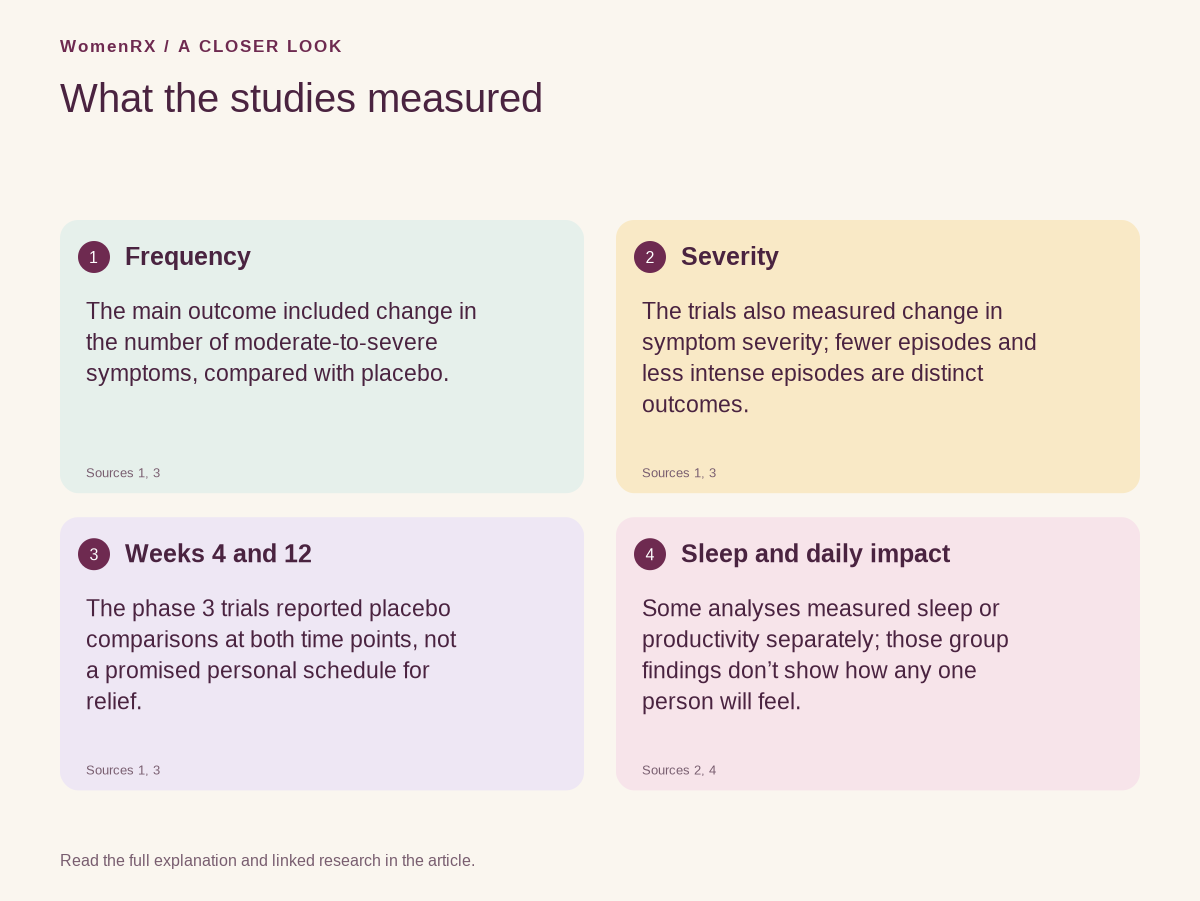
What the studies measured
Frequency: The main outcome included change in the number of moderate-to-severe symptoms, compared with placebo.13
Severity: The trials also measured change in symptom severity; fewer episodes and less intense episodes are distinct outcomes.13
Weeks 4 and 12: The phase 3 trials reported placebo comparisons at both time points, not a promised personal schedule for relief.13
Sleep and daily impact: Some analyses measured sleep or productivity separately; those group findings don’t show how any one person will feel.24
Read the figure as text
Trial outcomes show group-level changes at set time points. They can guide a personal review, but they don’t predict an individual result.- Frequency: The main outcome included change in the number of moderate-to-severe symptoms, compared with placebo.13
- Severity: The trials also measured change in symptom severity; fewer episodes and less intense episodes are distinct outcomes.13
- Weeks 4 and 12: The phase 3 trials reported placebo comparisons at both time points, not a promised personal schedule for relief.13
- Sleep and daily impact: Some analyses measured sleep or productivity separately; those group findings don’t show how any one person will feel.24
More questions, answered
Does fezolinetant usually eliminate hot flashes?
The trials showed average reductions in frequency and severity compared with placebo. The reported results don’t establish that everyone becomes symptom-free, so it’s more useful to assess your own symptom pattern and day-to-day impact. 13
Could sleep improve too?
A pooled analysis in women unsuitable for hormone therapy found a greater average improvement in a sleep-disturbance questionnaire score with fezolinetant than placebo at week 12. That result doesn’t guarantee better sleep for you, and it doesn’t show that every sleep problem is caused by hot flashes. 2
Sources you can check
- VEOZAH (FEZOLINETANT) TABLET, FILM COATED [ASTELLAS PHARMA US, INC.] | US prescribing information and patient instructionsAccessed 2026-09-25Return to first citation
- Fezolinetant effect on vasomotor symptoms due to menopause in women unsuitable for hormone therapy.Santoro N, Neal-Perry G, Stute P, Blogg M, Mancuso S, Morga A, Ottery FD, Siddiqui E. · Current medical research and opinion · 2025Return to first citation
- Fezolinetant for treatment of moderate-to-severe vasomotor symptoms associated with menopause (SKYLIGHT 1): a phase 3 randomised controlled study.Lederman S, Ottery FD, Cano A, Santoro N, Shapiro M, Stute P, Thurston RC, English M, Franklin C, Lee M, Neal-Perry G. · Lancet (London, England) · 2023Return to first citation
- Effect of fezolinetant on sleep, health-related quality of life and work productivity.Cano A, Neal Perry G, Martins K, Morga A, Schild A, Nappi RE, Shapiro M, Santoro N. · Climacteric : the journal of the International Menopause Society · 2026Return to first citation