Estrogen and Hot Flashes: Why Symptoms Change and What Treatments Do
Changing estrogen can affect the brain’s temperature regulation, but treatment choices depend on more than a hormone result.
As ovarian activity changes during perimenopause and menopause, falling estradiol can narrow the body’s temperature-regulation zone, making ordinary temperature shifts more likely to trigger a hot flash. Symptoms don’t follow one pattern, and a single estrogen result isn’t enough to explain them. Hormone therapy is the most effective treatment for hot flashes; several nonhormonal options also have evidence behind them. 1 2 3 4
Why a small temperature shift can feel so sudden
A hot flash is a vasomotor symptom: a sudden wave of heat, often with sweating or flushing. Estradiol, the main form of estrogen made by the ovaries, influences brain pathways involved in keeping body temperature within a comfortable range. Research suggests that when estradiol declines, this temperature-regulation zone can become narrower. A change that might otherwise go unnoticed can then set off a stronger response. The exact biology is still not fully understood. 1
This helps explain why hot flashes can feel abrupt and out of proportion to the room temperature. It also explains why the relationship isn’t as simple as “lower estrogen means more symptoms.” In a long-running study of 1,455 women, researchers identified several distinct symptom patterns across the menopause transition, from persistently low frequency to symptoms that started early or remained frequent. Estradiol patterns were associated with those different trajectories, but the study doesn’t make one hormone reading a reliable guide to what one person will experience. 2
What estrogen treatment can do
Systemic menopausal hormone therapy, which includes estrogen, is the most effective treatment for vasomotor symptoms, according to the North American Menopause Society. Its benefit-risk balance depends on factors including age, time since menopause, health history, treatment type, route, duration, and whether a progestogen is used. For women younger than 60 or within 10 years of menopause onset who have no contraindications, the Society says the balance is generally favorable for bothersome symptoms. It becomes less favorable when treatment is started later, in part because certain health risks increase with age and time since menopause. 3
That isn’t a blanket recommendation for every woman. A history such as an estrogen-dependent cancer or cardiovascular disease may make systemic hormone therapy unsuitable, and individual circumstances matter. The useful comparison is not simply “hormones or no hormones”: it’s whether the likely symptom relief is worth the risks for you, given your health history and preferences. 4
Hormone therapy’s risks also vary by formulation and other treatment details, so a general statement about estrogen can’t settle which option is appropriate. A clinician can help weigh those specifics alongside how disruptive the hot flashes are and how long they’ve been happening. 3
Evidence-based options without systemic hormones
If you don’t want hormone therapy or aren’t a suitable candidate, there are evidence-based alternatives. The North American Menopause Society recommends cognitive behavioral therapy and clinical hypnosis, as well as several prescription treatments: certain antidepressants in the SSRI or SNRI groups, gabapentin, and fezolinetant. Oxybutynin is also listed as an option, with a somewhat less certain evidence rating. These treatments differ in how they work and in their potential downsides, so the best fit depends on your health and priorities. 4
The same statement does not recommend supplements or herbal remedies for hot flashes, and it finds insufficient support for several commonly suggested approaches, including exercise, yoga, cooling techniques, and avoiding triggers as symptom treatments. That doesn’t mean you have to stop an activity you enjoy. It does mean these approaches shouldn’t be treated as proven substitutes for options with stronger evidence. 4
A practical way to compare choices
When you’re deciding what to try, focus on three things: how much the symptoms affect your daily life, whether hormone therapy’s potential benefits and risks fit your health history, and whether you prefer a hormonal or nonhormonal approach. You don’t need an estrogen blood result to make that conversation meaningful. Symptom patterns vary, and the available evidence doesn’t establish that one reading can predict how bothersome hot flashes will be or which treatment will work best for you. 2 3 4
If you’re considering a nonhormonal option, ask which treatments have evidence for hot flashes specifically and what tradeoffs apply to your situation. That can help separate options with guideline support from products or routines that may sound appealing but haven’t shown the same level of evidence. 4
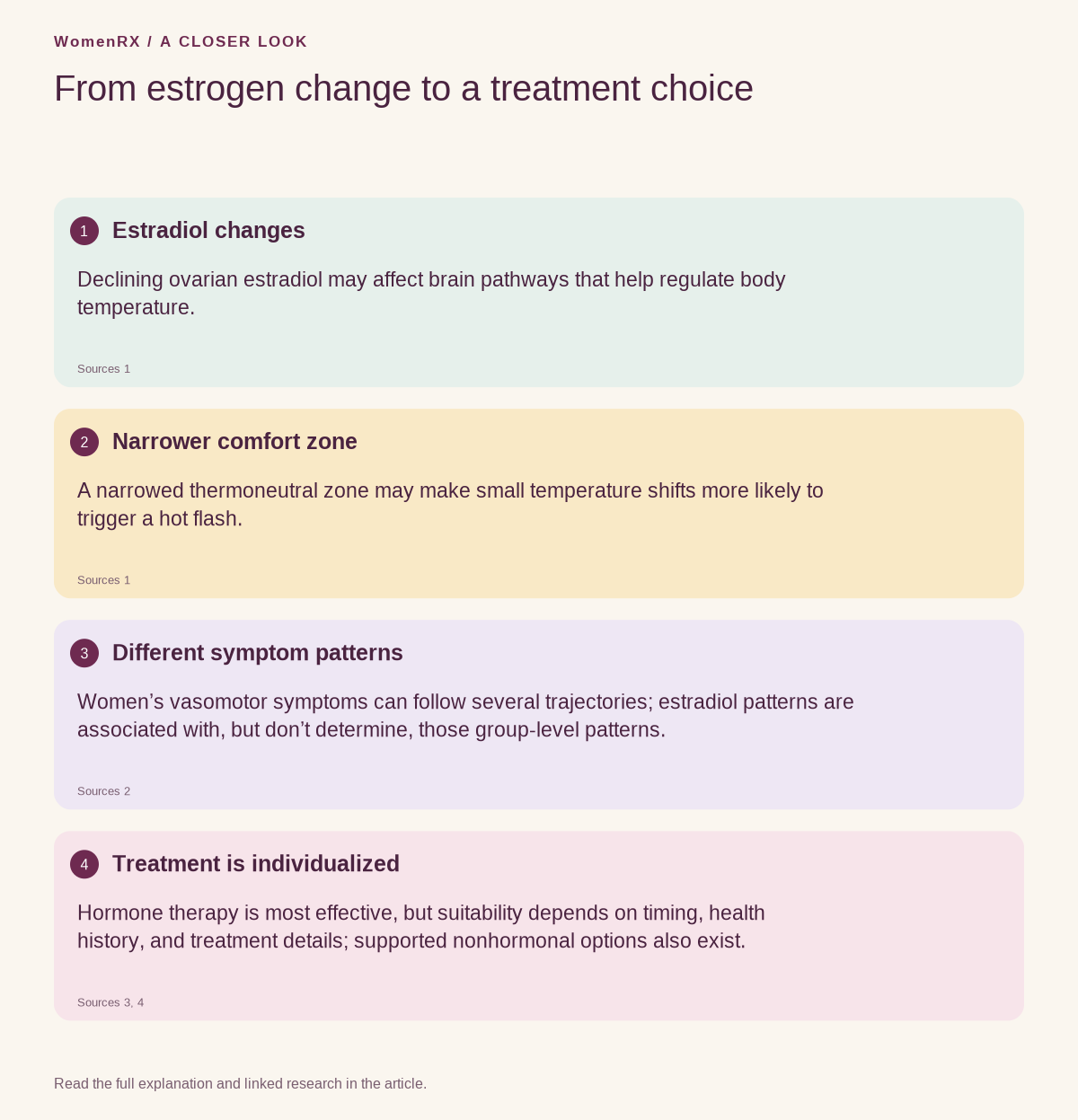
From estrogen change to a treatment choice
Estradiol changes: Declining ovarian estradiol may affect brain pathways that help regulate body temperature.1
Narrower comfort zone: A narrowed thermoneutral zone may make small temperature shifts more likely to trigger a hot flash.1
Different symptom patterns: Women’s vasomotor symptoms can follow several trajectories; estradiol patterns are associated with, but don’t determine, those group-level patterns.2
Treatment is individualized: Hormone therapy is most effective, but suitability depends on timing, health history, and treatment details; supported nonhormonal options also exist.34
Read the figure as text
A simple map of the proposed temperature-regulation link, symptom variation, and why hormone results alone don’t select a treatment.- Estradiol changes: Declining ovarian estradiol may affect brain pathways that help regulate body temperature.1
- Narrower comfort zone: A narrowed thermoneutral zone may make small temperature shifts more likely to trigger a hot flash.1
- Different symptom patterns: Women’s vasomotor symptoms can follow several trajectories; estradiol patterns are associated with, but don’t determine, those group-level patterns.2
- Treatment is individualized: Hormone therapy is most effective, but suitability depends on timing, health history, and treatment details; supported nonhormonal options also exist.34
More questions, answered
Can an estrogen blood test explain my hot flashes?
Not on its own. Estradiol patterns have been associated with different symptom trajectories across the menopause transition, but that finding doesn’t establish that one result predicts an individual woman’s symptoms or treatment response. 2
Sources you can check
- [Understanding menopause. Pathophysiology of hot flashes].Trémollières F. · Medecine sciences : M/S · 2025Return to first citation
- Characterizing the trajectories of vasomotor symptoms across the menopausal transition.Tepper PG, Brooks MM, Randolph JF, Crawford SL, El Khoudary SR, Gold EB, Lasley BL, Jones B, Joffe H, Hess R, Avis NE, Harlow S, McConnell DS, Bromberger JT, Zheng H, Ruppert K, Th... · Menopause (New York, N.Y.) · 2016Return to first citation
- The 2022 hormone therapy position statement of The North American Menopause Society.“The 2022 Hormone Therapy Position Statement of The North American Menopause Society” Advisory Panel. · Menopause (New York, N.Y.) · 2022Return to first citation
- The 2023 nonhormone therapy position statement of The North American Menopause Society.Menopause (New York, N.Y.) · 2023Return to first citation