Do Hot Flashes Change After Menopause?
Hot flashes can begin while you still have periods and continue well after your final one, but their course varies from person to person.
Yes, the pattern can change, but menopause isn’t a switch that turns hot flashes off. Bothersome hot flashes become more common by late perimenopause, and they can continue into postmenopause. Studies describe what happens across groups, not how long yours will last. If flashes or night sweats are disrupting your sleep or daily life, you don’t have to wait for them to pass before considering treatment. 451
Before periods stop: flashes can already be part of the picture
Perimenopause is the transition during which periods often change in timing or flow before they stop. Hot flashes can start during this stage, while you’re still having periods. A flash may bring sudden heat around your face, neck, or chest, sometimes with sweating or a racing-heart feeling. When it happens at night, it’s often called a night sweat. 5
The shift is visible in a large Australian study that asked women about symptoms during the previous four weeks. Among women classified as premenopausal, 8.8% reported moderately to severely bothersome hot flashes; among those in late perimenopause, 37.3% did. Those figures describe different groups surveyed at one time, not the chance that any one woman’s flashes will worsen or how long they’ll last. The study’s four-week question measured recent symptoms, not symptom duration. 4
The final period isn’t a finish line for symptoms
Menopause is identified after 12 months without a period; postmenopause is the time afterward. That date helps name a stage, but it doesn’t set an end date for hot flashes. They may ease, continue, or become bothersome later. Reports from surveys discussed in a study of postmenopausal symptoms found that hot flashes were most common soon after menopause, yet were also reported more than 10 years later. 57
Following the same people can tell us more about change than comparing stages in a single survey, though the details of the group matter. In an Estonian postmenopausal hormone-therapy trial, participants answered repeated questions about hot flashes or sweating in the preceding two weeks. Reports changed across follow-ups rather than following one tidy downward line. The trial involved a selected group, some receiving hormone therapy, and far fewer women answered at the later follow-ups. It’s evidence that symptoms can persist and vary, not a timetable for untreated hot flashes in everyone. 7
You may see an estimate that menopause and perimenopause symptoms usually last 7 to 9 years, sometimes longer. That guidance refers to symptoms overall, which can change over time. It shouldn’t be read as a countdown for hot flashes specifically, or as a prediction based on the date of your last period. 5
What matters more than the stage label
Consider two possible patterns: flashes that began before your periods stopped and now wake you most nights, or occasional daytime flashes that first became bothersome after menopause. Both fit within the range described above. The useful distinction isn’t whether either pattern is “on schedule.” It’s how much the symptoms are affecting your sleep, concentration, and day-to-day comfort. Night sweats can be one contributor to sleep disruption, but sleep problems around menopause can have other causes too. 53
If symptoms are getting in your way, treatment is a reasonable conversation now, whether you still have periods or not. Hormone therapy is the most effective treatment for vasomotor symptoms, the clinical term for hot flashes and night sweats. Its benefits and risks depend on factors including age, time since menopause, health history, and the type of therapy. For someone who doesn’t want or isn’t a good candidate for hormone therapy, evidence-supported nonhormone options include cognitive behavioral therapy, clinical hypnosis, and several prescription medicines. These are choices to weigh against your symptoms and preferences, not treatments you must postpone until a particular stage. 12
One practical way to describe what you need help with is the effect, not just the count: “I’m waking up sweaty and can’t get back to sleep,” for example, gives a clearer picture than “I still get hot flashes.” A final period can tell you where you are in the transition. It cannot tell you when you should stop asking for relief.
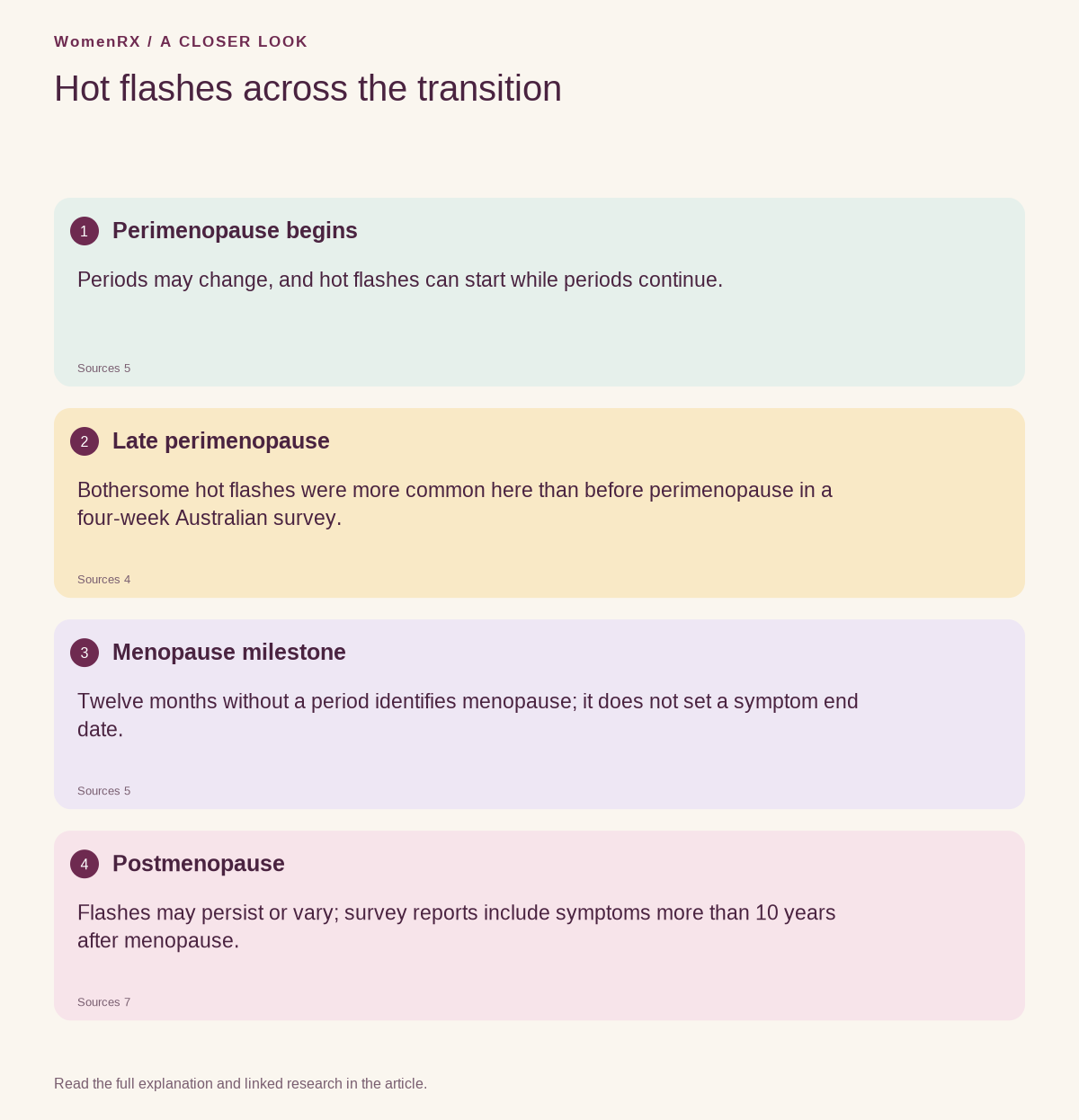
Hot flashes across the transition
Perimenopause begins: Periods may change, and hot flashes can start while periods continue.5
Late perimenopause: Bothersome hot flashes were more common here than before perimenopause in a four-week Australian survey.4
Menopause milestone: Twelve months without a period identifies menopause; it does not set a symptom end date.5
Postmenopause: Flashes may persist or vary; survey reports include symptoms more than 10 years after menopause.7
Read the figure as text
Stage names mark changes in periods, not guaranteed changes in hot flashes.- Perimenopause begins: Periods may change, and hot flashes can start while periods continue.5
- Late perimenopause: Bothersome hot flashes were more common here than before perimenopause in a four-week Australian survey.4
- Menopause milestone: Twelve months without a period identifies menopause; it does not set a symptom end date.5
- Postmenopause: Flashes may persist or vary; survey reports include symptoms more than 10 years after menopause.7
More questions, answered
Can hormonal contraception make it harder to tell which stage I’m in?
Yes. Hormonal contraception can change bleeding patterns, so periods may be less useful for identifying perimenopause or the final period. That uncertainty about the stage doesn’t make bothersome hot flashes any less worth discussing. 56
Sources you can check
- The 2022 hormone therapy position statement of The North American Menopause Society.“The 2022 Hormone Therapy Position Statement of The North American Menopause Society” Advisory Panel. · Menopause (New York, N.Y.) · 2022Return to first citation
- The 2023 nonhormone therapy position statement of The North American Menopause Society.Menopause (New York, N.Y.) · 2023Return to first citation
- Sleep Disruption in the Menopausal Transition and Postmenopause: A Narrative Review.Lyu AC, Kravitz HM. · Obstetrics and gynecology · 2026Return to first citation
- Prevalence and severity of symptoms across the menopause transition: cross-sectional findings from the Australian Women's Midlife Years (AMY) Study.Islam RM, Bond M, Ghalebeigi A, Wang Y, Walker-Bone K, Davis SR. · The lancet. Diabetes & endocrinology · 2025Return to first citation
- Symptoms of menopause and perimenopause - NHSAccessed 2026-09-25Return to first citation
- Treatment for menopause and perimenopause - NHSAccessed 2026-09-25Return to first citation
- Variability of bothersome menopausal symptoms over time--a longitudinal analysis using the Estonian postmenopausal hormone therapy trial (EPHT).Hemminki E, Regushevskaya E, Luoto R, Veerus P. · BMC women's health · 2012Return to first citation