When Does Menopause End? The Date and Symptom Timeline
Menopause is dated by the last period, but hot flashes and night sweats can continue for years afterward.
For women over 45, menopause is generally identified after 12 months without a period. That date marks the end of the transition; it doesn’t promise that symptoms will stop then. A meta-analysis found that hot flashes and night sweats often continued after the final menstrual period, with wide variation in how long they lasted. Any bleeding after menopause should be assessed, even if it happens once. 1 2
Two different timelines
Menopause is a point in time, not a symptom-free stretch. For women over 45, it’s usually identified retrospectively: once 12 months have passed without a period, the final menstrual period can be recognized as the menopause marker. The years of changing periods and symptoms leading up to that point are the transition; afterward, a woman is postmenopausal. 1
Symptoms don’t follow that same calendar. Across population studies, hot flashes and night sweats became more common before the final period, peaked afterward, and persisted for some women for years. So if you’re still having them after a year without periods, that alone doesn’t mean menopause hasn’t happened. The date and the symptom course are separate things. 2
What the symptom research suggests
A meta-analysis combining 10 population-based studies, with 35,445 participants, found that vasomotor symptoms, hot flashes and night sweats, increased sharply in the two years before the final menstrual period and were most common about a year afterward. Nearly half of all women in the analysis reported symptoms four years after that period; about one in 10 reported them as far as 12 years afterward. 2
The researchers estimated a median duration of about four years among women who had symptoms. That is a group-level estimate, not a countdown for an individual. The analysis included two longitudinal studies and eight cross-sectional studies, so it combined different ways of measuring symptom patterns. It can describe a broad range, but it can’t tell you when your own symptoms will end. 2
Symptoms that linger don’t move the menopause date or mean that your body is still having periods. If they’re disrupting sleep or daily life, their effect is worth addressing in its own right rather than waiting for them to prove that the transition is over.
If periods aren’t a clear marker
The usual 12-month rule describes women over 45 whose menstrual history shows an identifiable period-free interval. If yours doesn’t, that rule may not give you a reliable date. Hot flashes and night sweats can’t settle the question either, because they may continue after the final period. 1 2
Bleeding after menopause is different
Once you’ve reached menopause, don’t assume new vaginal bleeding is a normal part of the transition winding down. It can have several causes, and it isn’t usually cancer, but it can sometimes signal a serious problem. Get it assessed even if it’s light, happens only once, or you aren’t sure it’s blood. 1
An evaluation helps identify the cause; bleeding alone can’t tell you what it is. The key distinction is simple: symptoms can carry on after menopause, but bleeding after the 12-month marker should not be assumed to be a normal part of that symptom timeline. 1 2
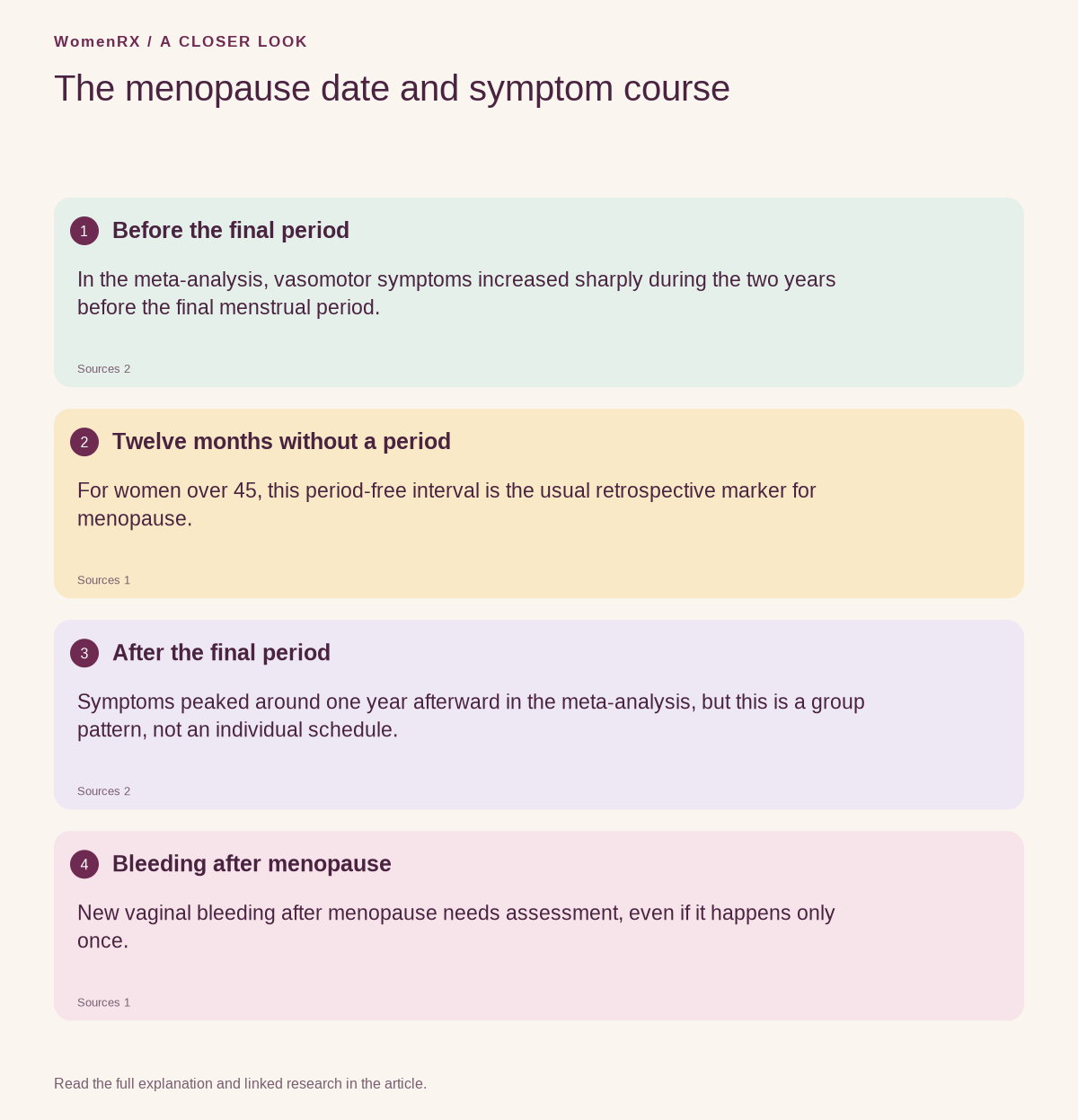
The menopause date and symptom course
Before the final period: In the meta-analysis, vasomotor symptoms increased sharply during the two years before the final menstrual period.2
Twelve months without a period: For women over 45, this period-free interval is the usual retrospective marker for menopause.1
After the final period: Symptoms peaked around one year afterward in the meta-analysis, but this is a group pattern, not an individual schedule.2
Bleeding after menopause: New vaginal bleeding after menopause needs assessment, even if it happens only once.1
Read the figure as text
The final menstrual period sets a retrospective marker; vasomotor symptoms may follow a different timeline.- Before the final period: In the meta-analysis, vasomotor symptoms increased sharply during the two years before the final menstrual period.2
- Twelve months without a period: For women over 45, this period-free interval is the usual retrospective marker for menopause.1
- After the final period: Symptoms peaked around one year afterward in the meta-analysis, but this is a group pattern, not an individual schedule.2
- Bleeding after menopause: New vaginal bleeding after menopause needs assessment, even if it happens only once.1
More questions, answered
Do hot flashes mean I haven’t reached menopause?
No. Menopause is identified by the time since your final period, while hot flashes and night sweats can continue afterward. 1 2
Should I wait to see whether bleeding happens again?
No. Bleeding after menopause should be assessed even if it happens only once or is very light. 1
Sources you can check
- Postmenopausal bleeding - NHSAccessed 2026-09-25Return to first citation
- Revisiting the duration of vasomotor symptoms of menopause: a meta-analysis.Politi MC, Schleinitz MD, Col NF. · Journal of general internal medicine · 2008Return to first citation