How Is Menopause Identified, and What Care Can Help?
A clear menstrual history often identifies menopause, but some health circumstances make periods harder to interpret and call for a different assessment.
In a typical situation after age 45, menopause is identified retrospectively after 12 consecutive months without a period; routine hormone testing or imaging usually isn’t needed when that pattern is clear. Hormonal contraception, hysterectomy, or cancer treatment can complicate the assessment. Treatment is a separate choice: care can be matched to bothersome hot flashes or genitourinary symptoms. 32
Menopause isn’t something you have to qualify for
Menopause is a normal life stage, not a condition that automatically needs treatment. Some people have mild symptoms that ease on their own; others have symptoms that disrupt daily life. You can seek care because something is bothering you, even if the exact timing of menopause is difficult to establish. 1
When your menstrual history gives a clear answer
In a typical situation after age 45, menopause is identified retrospectively after 12 consecutive months without a period. When this pattern is clear, diagnosis is generally clinical: routine hormone testing or imaging isn’t needed. 3
A blood test isn’t a universal menopause confirmation. Hormone levels can vary during the transition, and a test may not resolve the question when another factor has changed your bleeding pattern. The key is whether your periods can be interpreted in the context of your health history. 3
When the calendar rule doesn’t fit
Hormonal contraception: Some hormonal methods change or stop bleeding, so not having a period while using one doesn’t establish that menopause has occurred. A clinical guideline specifically advises against using hormone assays or pelvic ultrasound to diagnose menopause in people using several methods, including pills, implants, and hormonal IUDs. Whether menopause has occurred and when contraception can be stopped are related, but separate, questions. 3
Hysterectomy: If your uterus has been removed, periods can’t mark the 12-month point. The assessment may depend on your surgical history and symptoms; hormone measurements are not a universal answer. 3
Cancer treatment: Treatments that affect the ovaries can also make the usual period-based rule unreliable. In this situation, the guideline says the 12-month rule can’t establish menopause with certainty and does not identify a test that definitively settles the question. If menopausal status matters to another treatment decision, make that connection explicit when discussing your care. 3
These situations call for an individualized assessment, not an assumption that a particular test will provide certainty. The cited guideline is not a US-specific protocol, so decisions about your care should reflect your medical history and treatment context. 3
Choose care for the symptom you want to change
If symptoms aren’t bothering you, treatment isn’t automatic. If they are, the useful starting point is what you want help with and what fits your health history and preferences.
For bothersome hot flashes and other vasomotor symptoms, menopausal hormone therapy is the most effective treatment. The North American Menopause Society’s 2022 position statement describes the benefit-risk balance as favorable for people younger than 60 or within 10 years of menopause onset who have no contraindications. It describes a less favorable balance when treatment starts later, including after age 60 or more than 10 years after menopause begins. The risks also depend on treatment type, route, duration, and whether a progestogen is used, so the decision is individual and should be revisited over time. 2
Hormone therapy isn’t the only option for hot flashes. Evidence-supported nonhormonal options include cognitive behavioral therapy, clinical hypnosis, and certain prescription medicines, such as SSRIs or SNRIs, gabapentin, and fezolinetant. These are options to discuss in light of your needs and medical history. The 2023 position statement did not recommend supplements or herbal remedies for vasomotor symptoms. 4
For bothersome genitourinary symptoms that haven’t improved with over-the-counter therapies, low-dose vaginal estrogen or other therapies may be options when systemic hormone therapy isn’t indicated. These treatments address genitourinary symptoms, not hot flashes. 2
If you’re deciding what to ask about, try naming the symptom you most want help with and whether contraception, surgery, or cancer treatment affects how you interpret your periods. That helps keep two questions distinct: how menopause is assessed in your circumstances, and what care might ease the symptoms you’re actually experiencing.
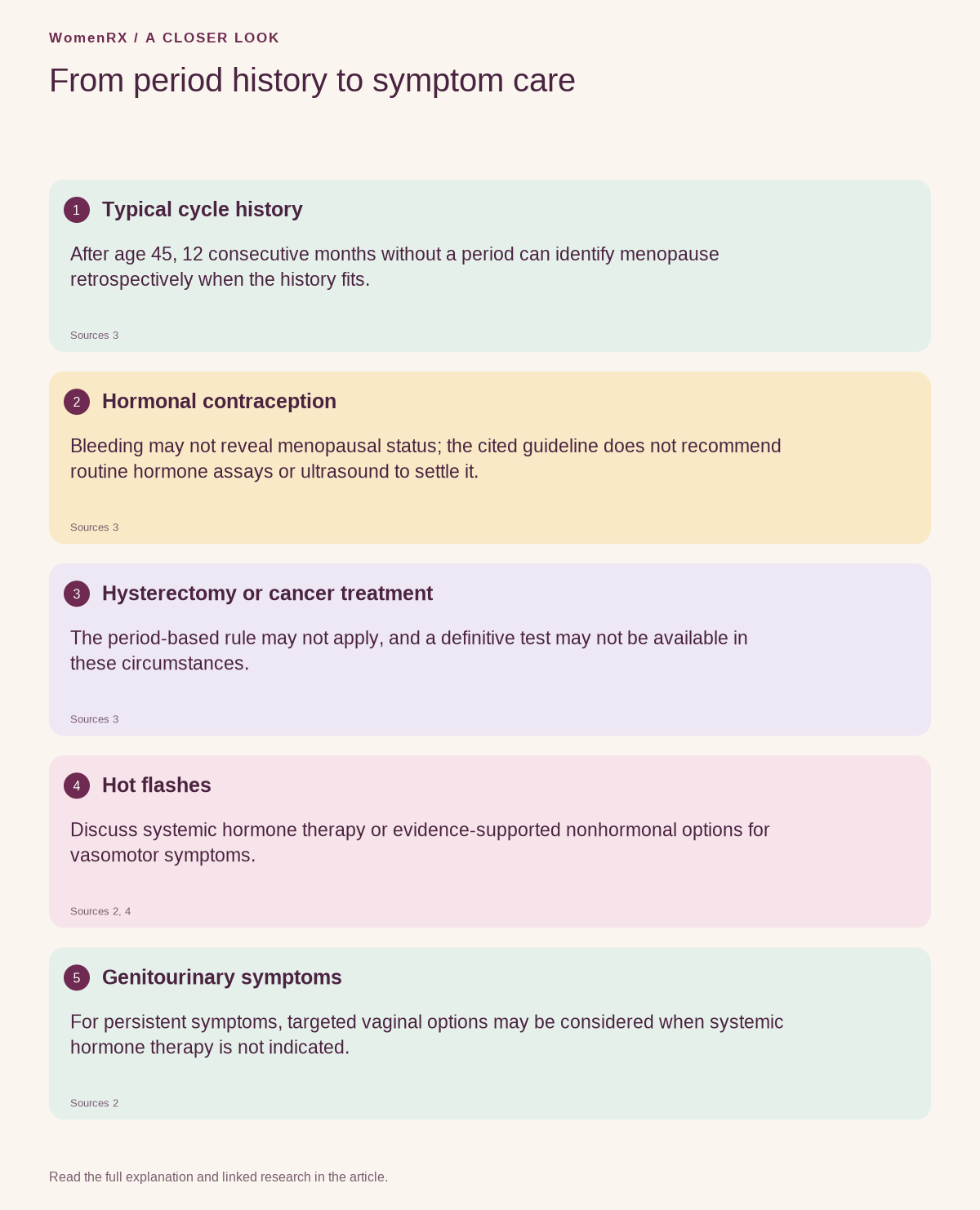
From period history to symptom care
Typical cycle history: After age 45, 12 consecutive months without a period can identify menopause retrospectively when the history fits.3
Hormonal contraception: Bleeding may not reveal menopausal status; the cited guideline does not recommend routine hormone assays or ultrasound to settle it.3
Hysterectomy or cancer treatment: The period-based rule may not apply, and a definitive test may not be available in these circumstances.3
Hot flashes: Discuss systemic hormone therapy or evidence-supported nonhormonal options for vasomotor symptoms.24
Genitourinary symptoms: For persistent symptoms, targeted vaginal options may be considered when systemic hormone therapy is not indicated.2
Read the figure as text
This flow separates a typical menstrual-history assessment from circumstances that can make it unreliable, then shows why symptom care is a separate decision.- Typical cycle history: After age 45, 12 consecutive months without a period can identify menopause retrospectively when the history fits.3
- Hormonal contraception: Bleeding may not reveal menopausal status; the cited guideline does not recommend routine hormone assays or ultrasound to settle it.3
- Hysterectomy or cancer treatment: The period-based rule may not apply, and a definitive test may not be available in these circumstances.3
- Hot flashes: Discuss systemic hormone therapy or evidence-supported nonhormonal options for vasomotor symptoms.24
- Genitourinary symptoms: For persistent symptoms, targeted vaginal options may be considered when systemic hormone therapy is not indicated.2
Sources you can check
- Hormone Therapy for Menopause | MedlinePlusAccessed 2026-09-25Return to first citation
- The 2022 hormone therapy position statement of The North American Menopause Society.“The 2022 Hormone Therapy Position Statement of The North American Menopause Society” Advisory Panel. · Menopause (New York, N.Y.) · 2022Return to first citation
- [How to diagnose menopause? Postmenopausal women management: CNGOF and GEMVi clinical practice guidelines].Rousset-Jablonski C. · Gynecologie, obstetrique, fertilite & senologie · 2021Return to first citation
- The 2023 nonhormone therapy position statement of The North American Menopause Society.Menopause (New York, N.Y.) · 2023Return to first citation