How Menopause Is Diagnosed When Periods Are Hard to Read
After 45, menstrual history often tells more than a hormone test, but contraception and surgery can change which clues are useful.
In a typical transition after 45, menopause is identified retrospectively after 12 consecutive months without a period, with age and symptoms providing context. Routine hormone tests or imaging aren’t needed in that situation. If contraception changes bleeding, a hysterectomy removes the period marker, or cancer treatment affects the ovaries, the assessment has to account for those circumstances rather than rely on the usual rule. 2 3
When period history gives a clear answer
If you’re over 45 and your periods have stopped in a typical midlife pattern, a clinician can usually identify menopause after 12 consecutive months without a period. It’s a diagnosis made by looking back at your menstrual history, alongside your age and symptoms. Hormone tests and imaging aren’t needed to establish it in this typical situation. 2 3
That’s why a follicle-stimulating hormone (FSH) test isn’t a routine shortcut to an answer. Guidance on reducing unnecessary testing says FSH testing may be inappropriate for diagnosing menopause or perimenopause in people 45 and over when age, menstrual history, and symptoms can guide the assessment. 3
The key question is whether those 12 months without bleeding reflect your natural menstrual pattern. Sometimes they don’t.
When contraception changes what bleeding can tell you
If you use a combined oral contraceptive, a progestin-only pill, an implant, or a levonorgestrel IUD, your bleeding pattern may not provide the usual menopause clue. For these specified methods, a clinical guideline does not recommend hormone assays or pelvic ultrasound either to diagnose menopause or to decide when to stop contraception. An absent period while using one of them isn’t the same clue as 12 months without periods in the typical situation. 2
For example, if you haven’t bled while using a levonorgestrel IUD, tell your clinician when bleeding changed and which method you use. That context is more useful than treating the date of your last bleed as proof of menopause. The guideline discusses clinical follow-up after stopping or removing certain methods, but that is an individualized decision, not a reason to stop contraception simply to check for menopause. 2
After hysterectomy, the period marker is gone
A hysterectomy removes the menstrual history used in the usual 12-month approach. It also matters whether your ovaries were removed: removal of both ovaries before natural menopause causes a sudden drop in estrogen and surgical menopause. A hysterectomy alone does not tell a clinician when ovarian function has changed. 2 1
Because there’s no usable period history after hysterectomy, the guideline describes a limited role for testing: repeat FSH together with low estradiol, measured at least three months after the procedure, may point toward menopausal status. It calls this a diagnostic orientation, not a single definitive result or a test everyone needs. 2
If you’re younger or have had cancer treatment
The straightforward 12-month clinical criterion described above applies to a typical situation after 45. If your periods change or stop before 45, that criterion alone doesn’t establish what’s happening. Your age, symptoms, contraception, and any surgery or treatment affecting the ovaries all matter to the assessment. The diagnostic guidance cited here does not set out one testing pathway for everyone under 45. 2
Cancer treatment can create a different uncertainty. After treatment that can affect ovarian function, 12 months without periods cannot establish menopause with certainty. The guideline also does not identify another examination that can make the diagnosis definite in that situation. 2
If a test is suggested, a useful question is: “What would this result clarify or change for me?” The answer should depend on why your period history is hard to interpret. Contraception, hysterectomy, and cancer treatment complicate that history in different ways; no single hormone result replaces those details. 2 3
Which menopause clue can you use?
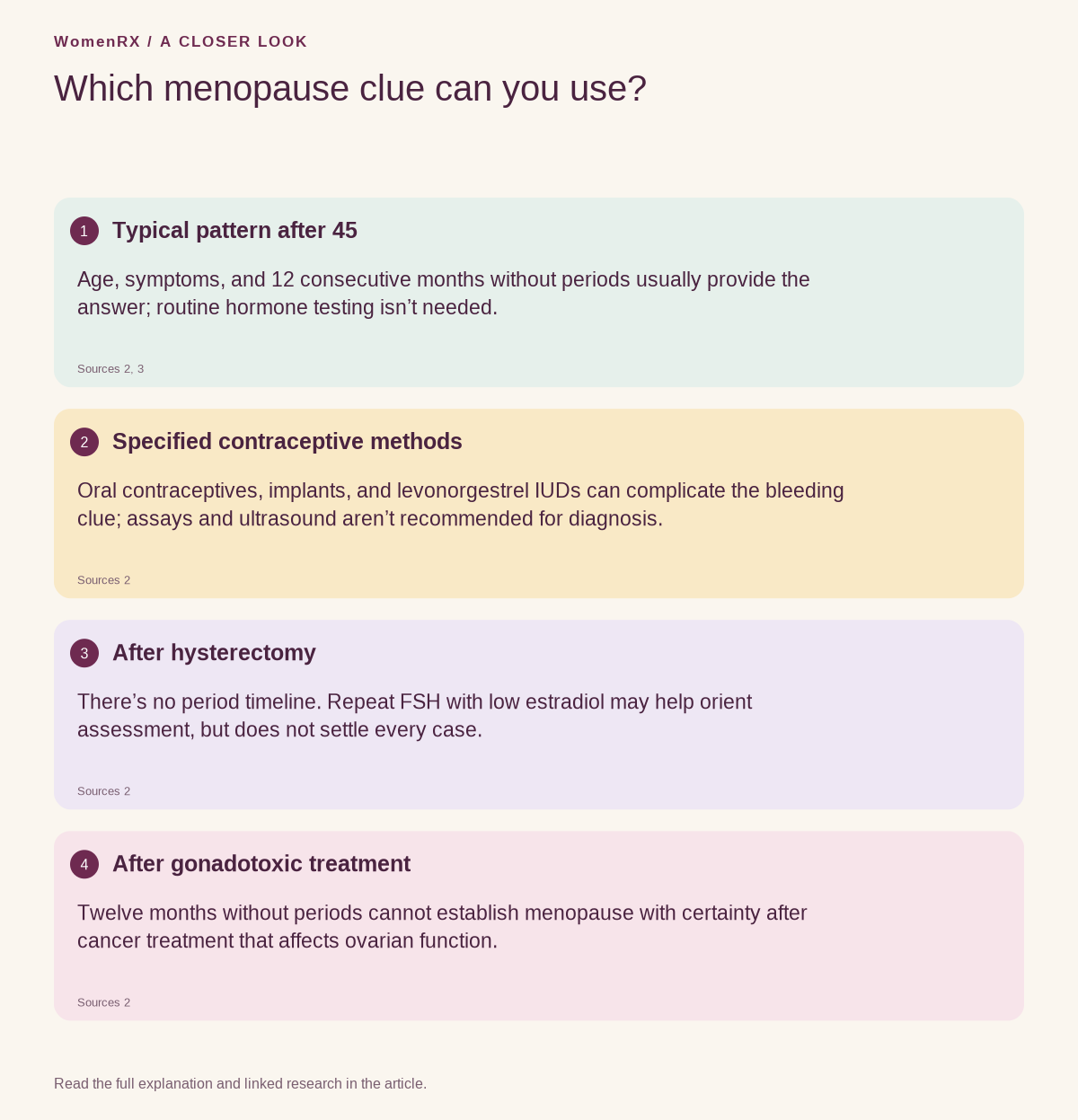
Typical pattern after 45: Age, symptoms, and 12 consecutive months without periods usually provide the answer; routine hormone testing isn’t needed.23
Specified contraceptive methods: Oral contraceptives, implants, and levonorgestrel IUDs can complicate the bleeding clue; assays and ultrasound aren’t recommended for diagnosis.2
After hysterectomy: There’s no period timeline. Repeat FSH with low estradiol may help orient assessment, but does not settle every case.2
After gonadotoxic treatment: Twelve months without periods cannot establish menopause with certainty after cancer treatment that affects ovarian function.2
Read the figure as text
Start with whether your menstrual history reflects a natural pattern, then consider what might change its meaning.- Typical pattern after 45: Age, symptoms, and 12 consecutive months without periods usually provide the answer; routine hormone testing isn’t needed.23
- Specified contraceptive methods: Oral contraceptives, implants, and levonorgestrel IUDs can complicate the bleeding clue; assays and ultrasound aren’t recommended for diagnosis.2
- After hysterectomy: There’s no period timeline. Repeat FSH with low estradiol may help orient assessment, but does not settle every case.2
- After gonadotoxic treatment: Twelve months without periods cannot establish menopause with certainty after cancer treatment that affects ovarian function.2
More questions, answered
Can an FSH test confirm menopause?
It isn’t routinely needed for a typical transition after 45. After hysterectomy, repeat FSH together with low estradiol may help point toward menopausal status because periods can no longer provide a timeline, but the guideline does not present it as a definitive test for everyone. 2 3
Sources you can check
- CLIMARA PRO (ESTRADIOL AND LEVONORGESTREL) PATCH [BAYER HEALTHCARE PHARMACEUTICALS INC.] | US prescribing information and patient instructionsAccessed 2026-09-25Return to first citation
- [How to diagnose menopause? Postmenopausal women management: CNGOF and GEMVi clinical practice guidelines].Rousset-Jablonski C. · Gynecologie, obstetrique, fertilite & senologie · 2021Return to first citation
- Reducing inappropriate testing in the diagnosis of the menopause and peri-menopause.Williams J, Currie H, Foster A, Anderson J. · Post reproductive health · 2016Return to first citation