Changing Periods in Your 40s: What Needs Checking
Changing periods alongside new hot flashes or night sweats can fit perimenopause, and there are ways to ease symptoms while you work out what’s happening.
If you’re in your 40s or older, changing periods alongside new hot flashes or night sweats can fit perimenopause. Sleep, mood, memory, vaginal or urinary changes may occur too, but no single symptom establishes the cause. Track how symptoms relate to your cycle. You can try practical relief, and you don’t need to put up with disruptive symptoms. Heavy or unexpected bleeding, including any bleeding after menopause, needs assessment. 71021
When cycle changes could fit perimenopause
Perimenopause is the transition during which periods change before they eventually stop. It most often happens between ages 45 and 55, though it can begin earlier. Clinical guidance considers recently started vasomotor symptoms alongside changes in the menstrual cycle when identifying perimenopause. Menopause-related symptoms can range from minor to severe and last for shorter or longer periods, so someone else’s experience isn’t a reliable timetable for yours. 67
Recently started vasomotor symptoms, such as hot flashes or night sweats, are particularly relevant when they appear alongside cycle changes. Sleep disturbance, mood changes and trouble with memory or focus may occur too. Vaginal dryness or discomfort can start or worsen around menopause as estrogen levels fall. Urinary urgency, frequency and waking to urinate may emerge in midlife, but they aren’t proof that menopause is the cause. If you’re waking often, notice whether it’s a need to urinate or something else that wakes you. That detail describes your experience more clearly than writing down only “poor sleep.” The timing of these symptoms helps put them in context, but none establishes the cause on its own. 7103
These changes can matter even when they’re not dangerous. A symptom that repeatedly interrupts your sleep or daily life is worth discussing; you don’t have to wait until your periods have stopped. The question is both could this fit the transition? and is there something else that needs attention? 710
Three stages, with different bleeding rules
Perimenopause: Your cycle may change while you’re still having periods. Notice changes in when bleeding starts, how long it lasts and how heavy it is, alongside any new vasomotor symptoms or sleep disturbance. A changing cycle can fit perimenopause, but it doesn’t explain every kind of bleeding. 672
Menopause: If you’re not using hormonal contraception, menopause is identified after 12 months without a period. It’s a point identified by looking back at the last period, not a date you can predict from symptoms or a missed cycle. 8
Postmenopause: Once you’ve gone 12 months without a period, vaginal bleeding is a different matter. Even one episode of spotting or pink or brown discharge should be checked. Many causes aren’t cancer, but cancer is one reason not to dismiss it. 14
Which bleeding changes need a closer look?
Heavier bleeding can happen as menopause approaches, but “it’s probably hormones” isn’t enough to explain bleeding that affects your life. For example, needing to change a pad or tampon every one to two hours, using two types of period product together, or feeling tired or short of breath with heavy periods are useful details to report. Arrange an assessment if heavy periods are affecting daily life or you’ve had them for some time. Severe period pain, bleeding between periods and bleeding after sex also warrant evaluation. 2
The distinction matters because hormonal changes and another condition can coexist. Fibroids and adenomyosis are among the possible causes of heavy bleeding, and some medicines, including anticoagulants, can contribute. In perimenopause, structural conditions and changes in the uterine lining may occur alongside hormonal disturbance. Recording the pattern helps describe the problem; it cannot rule out those causes. A missed period isn’t necessarily perimenopause either: pregnancy is another possible explanation. 2510
After menopause, don’t wait to see whether spotting becomes a full period. Make an appointment even if it happened once, there’s only a small amount, or you’re unsure whether the discharge contains blood. 1
What can help with symptoms now?
Match the approach to the symptom rather than trying to fix everything at once. For hot flashes, layers you can remove and a fan can make an episode easier to manage. Noting when flashes happen may also help you spot possible triggers, such as a hot room or alcohol, without assuming that every flash has one. If night sweats are disrupting sleep, relief for the hot flashes themselves may help you sleep better. 10
For vaginal dryness or discomfort during sex, an over-the-counter vaginal moisturizer or a water-based lubricant may help. They serve different purposes: a moisturizer addresses ongoing dryness, while a lubricant reduces friction during sex. Prescription vaginal treatments are another option if those measures aren’t enough. Urinary leakage is also treatable; it isn’t something you have to accept as a normal part of aging. 910
If symptoms are still getting in the way, treatment choices depend on what bothers you most and your health history. Hormonal and nonhormonal medicines can help with certain symptoms, while treatment directed at vaginal dryness differs from treatment for hot flashes. That’s a more useful conversation than asking for one remedy for “menopause symptoms” as a whole. 9
Make a short record that answers a useful question
For each episode of bleeding, note the start and end dates, whether it was spotting or a period, how heavy it was for you, and any bleeding between periods or after sex. Alongside that, record when vasomotor symptoms, sleep disruption, mood or memory changes, vaginal discomfort or urinary symptoms occur and which ones affect your day. For example, “woke to urinate three nights this week” says more than “sleep bad.” This isn’t a home diagnosis. It helps you see whether symptoms appeared alongside cycle changes and makes unusual bleeding harder to overlook. 7210
You don’t need one hormone number to make that record meaningful. Clinical guidance considers recent vasomotor symptoms together with menstrual changes when identifying perimenopause. The testing question is different for someone under 40 being assessed for premature ovarian insufficiency: that guidance calls for elevated follicle-stimulating hormone (FSH) on two blood samples taken four to six weeks apart, not one result. 7
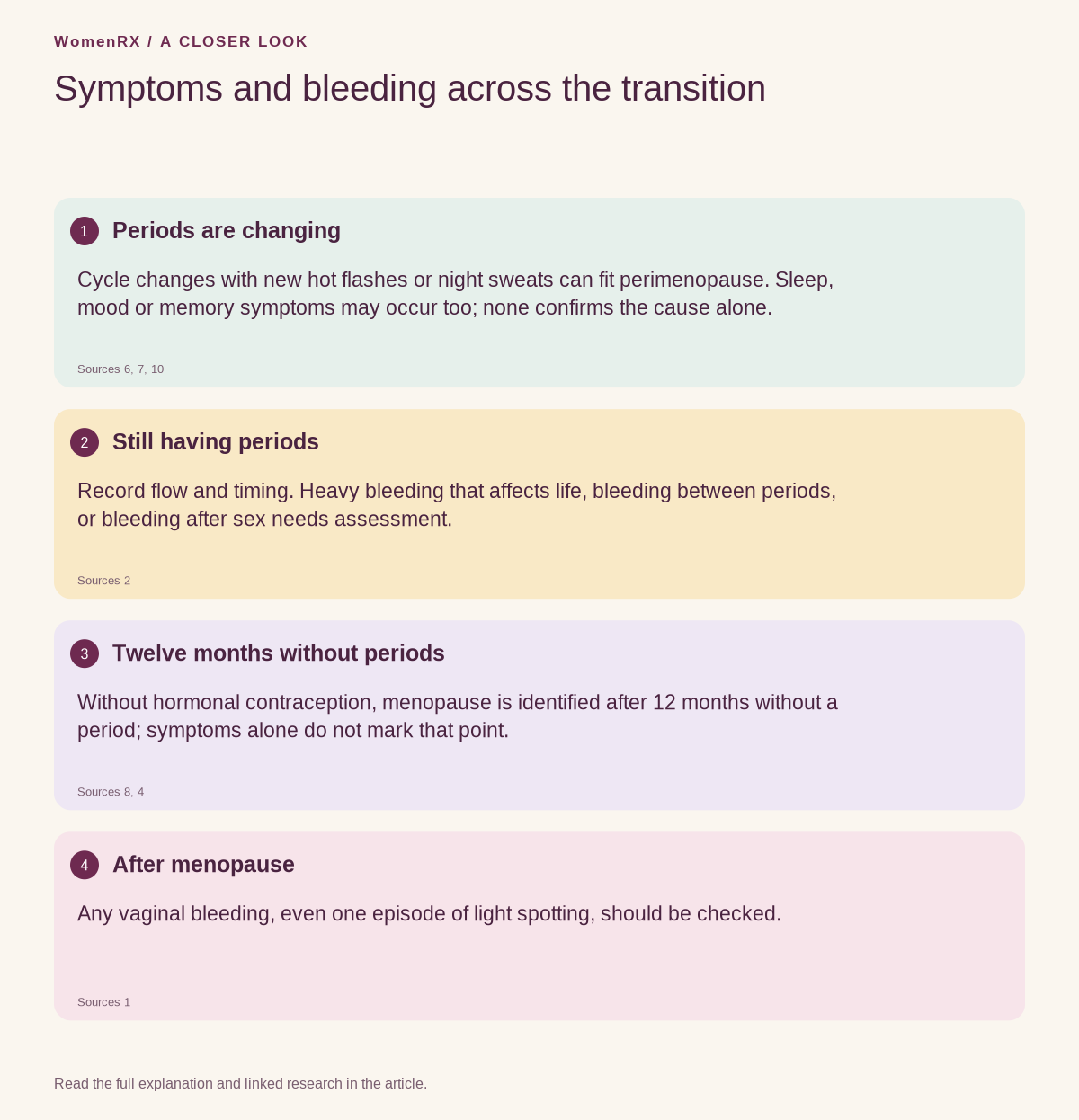
Symptoms and bleeding across the transition
Periods are changing: Cycle changes with new hot flashes or night sweats can fit perimenopause. Sleep, mood or memory symptoms may occur too; none confirms the cause alone.6710
Still having periods: Record flow and timing. Heavy bleeding that affects life, bleeding between periods, or bleeding after sex needs assessment.2
Twelve months without periods: Without hormonal contraception, menopause is identified after 12 months without a period; symptoms alone do not mark that point.84
After menopause: Any vaginal bleeding, even one episode of light spotting, should be checked.1
Read the figure as text
Use menstrual stage to put symptoms in context, while treating unusual bleeding as a separate signal.- Periods are changing: Cycle changes with new hot flashes or night sweats can fit perimenopause. Sleep, mood or memory symptoms may occur too; none confirms the cause alone.6710
- Still having periods: Record flow and timing. Heavy bleeding that affects life, bleeding between periods, or bleeding after sex needs assessment.2
- Twelve months without periods: Without hormonal contraception, menopause is identified after 12 months without a period; symptoms alone do not mark that point.84
- After menopause: Any vaginal bleeding, even one episode of light spotting, should be checked.1
More questions, answered
Can heavy bleeding still be part of perimenopause?
Yes, periods can become heavy as menopause approaches. But heavy bleeding that affects your life, or bleeding between periods or after sex, still merits assessment because other causes can coexist with hormonal change. 25
Does spotting count as bleeding after menopause?
Yes. Once you’ve gone 12 months without a period, even one episode of light spotting or pink or brown discharge should be checked. 41
Sources you can check
- Postmenopausal bleeding - NHSAccessed 2026-09-25Return to first citation
- Heavy periods - NHSAccessed 2026-09-25Return to first citation
- Dietary Caffeine, Cold Exposure, and the Estrogen-TRPM8 Axis: A Nutri-Environmental Model for Lower Urinary Tract Symptoms in the Menopause Transition: A Narrative Review.Lee DH, Park JJ. · Nutrients · 2026Return to first citation
- Visually directed hysteroscopic biopsy in the evaluation of abnormal uterine bleeding and postmenopausal bleeding: a Joint Society Practice Guideline. Joint Society Practice Guideline from AAGL-ESGE-GCH. · Facts, views & vision in ObGyn · 2026Return to first citation
- Complex benign gynecology in perimenopause: current evidence and future directions.Goren R, Shats M, Ciesielski K, Siedhoff M, Meyer R. · Current opinion in obstetrics & gynecology · 2026Return to first citation
- Menopause and perimenopause - NHSAccessed 2026-09-25Return to first citation
- Recommendations | Menopause: identification and management | Guidance | NICEAccessed 2026-09-25Return to first citation
- What are menopause and perimenopause? - NHSAccessed 2026-09-25Return to first citation
- Menopause treatment | Office on Women's HealthAccessed 2026-09-26Return to first citation
- Menopause symptoms and relief | Office on Women's HealthAccessed 2026-09-26Return to first citation