How to Recognize Menopause and Know When to Seek Care
Changing periods and new symptoms can signal perimenopause, but the usual menopause definition depends on having a usable menstrual history.
Changing periods alongside recently started vasomotor symptoms can point to perimenopause. If your menstrual history is usable and you’re not using hormonal contraception, menopause is identified after 12 months without a period. If you no longer have periods after a hysterectomy, the 12-month period rule can’t be used. 34
The difference between the transition and menopause
Perimenopause is the transition leading up to menopause. Your periods may become irregular, and symptoms such as hot flashes may begin. NICE guidance uses the combination of recently started vasomotor symptoms and menstrual-cycle changes to help identify perimenopause. The transition can last several years, so a changing cycle doesn’t tell you exactly when your final period will arrive. 345
Menopause is a milestone recognized afterward. When menstrual history is usable and you aren’t using hormonal contraception, it’s identified after at least 12 months without a period. Menopause most commonly occurs between ages 45 and 55, though it can happen earlier. 345
That distinction is useful if, for example, you’ve skipped periods and then had another one. You may still be in the transition; a stretch without bleeding that is shorter than 12 months does not, by itself, establish menopause. 34
Symptoms are clues, not a diagnosis on their own
Hot flashes are a recognizable clue, but they aren’t universal. Sleep problems, low mood and memory difficulties can also occur around perimenopause and menopause. The pattern matters more than checking off every symptom: consider what has changed for you, whether your cycle has changed too, and whether symptoms are disrupting daily life. 4
There’s no routine test that diagnoses perimenopause or menopause for everyone. A clinician may identify it from your age and symptoms. A blood test for anti-Müllerian hormone, or AMH, can’t reliably tell an individual woman when menopause will happen. A systematic review found no study assessing whether AMH could shorten the usual 12-month period without menstruation required to identify menopause. 42
You don’t need to wait for that 12-month milestone to talk about symptoms that are affecting your sleep or day-to-day life. A discussion can focus on what’s happening now, even when the exact stage isn’t settled. 5
When the period rule doesn’t fit
If you use hormonal contraception: Bleeding may no longer give a clear picture of where you are in the transition. NICE notes that hormonal treatment can make menopause difficult to identify and advises against using a follicle-stimulating hormone, or FSH, blood test to identify menopause while someone uses combined estrogen-progestogen contraception or high-dose progestogen. Tell the clinician what you use rather than interpreting a missed period or a single FSH result on its own. 3
If you’ve had a hysterectomy: If you no longer have periods, you can’t use 12 months without one to identify the menopause milestone. Make sure the clinician knows whether your ovaries were removed too: ovary removal can cause menopause earlier than it would otherwise occur. The period-based rule alone can’t settle your stage in this situation. 34
If you’re younger than 45: Don’t assume the usual midlife transition explains a new loss of periods. Menopause before 45 is considered early; before 40, changes in ovarian function may instead be assessed as primary ovarian insufficiency, or POI. POI is not identical to having completed menopause: periods may still occur irregularly, and pregnancy may still be possible. For suspected POI under 40, NICE recommends assessment that includes elevated FSH results from two blood samples taken 4 to 6 weeks apart, rather than relying on one result. 53
When a closer look makes sense
Arrange a conversation if symptoms are troubling you, if your periods stop or become irregular at a younger age than expected, or if contraception or hysterectomy means your menstrual history can’t clarify what’s happening. These situations call for an assessment of your circumstances, not a diagnosis based on a symptom checklist. 345
If you’ve reached menopause after 12 months without a period, get any new vaginal bleeding checked, even if it’s light or happens only once. This applies whether or not you use menopausal hormone therapy. Bleeding often has a cause other than cancer, but it can be a sign of cancer and shouldn’t be dismissed as another period. 6
If you use systemic menopausal hormone therapy, bleeding has its own assessment rules. NICE advises seeking medical help promptly for unscheduled vaginal bleeding that continues beyond the first six months of treatment or occurs more than three months after a change in dose or preparation. 3
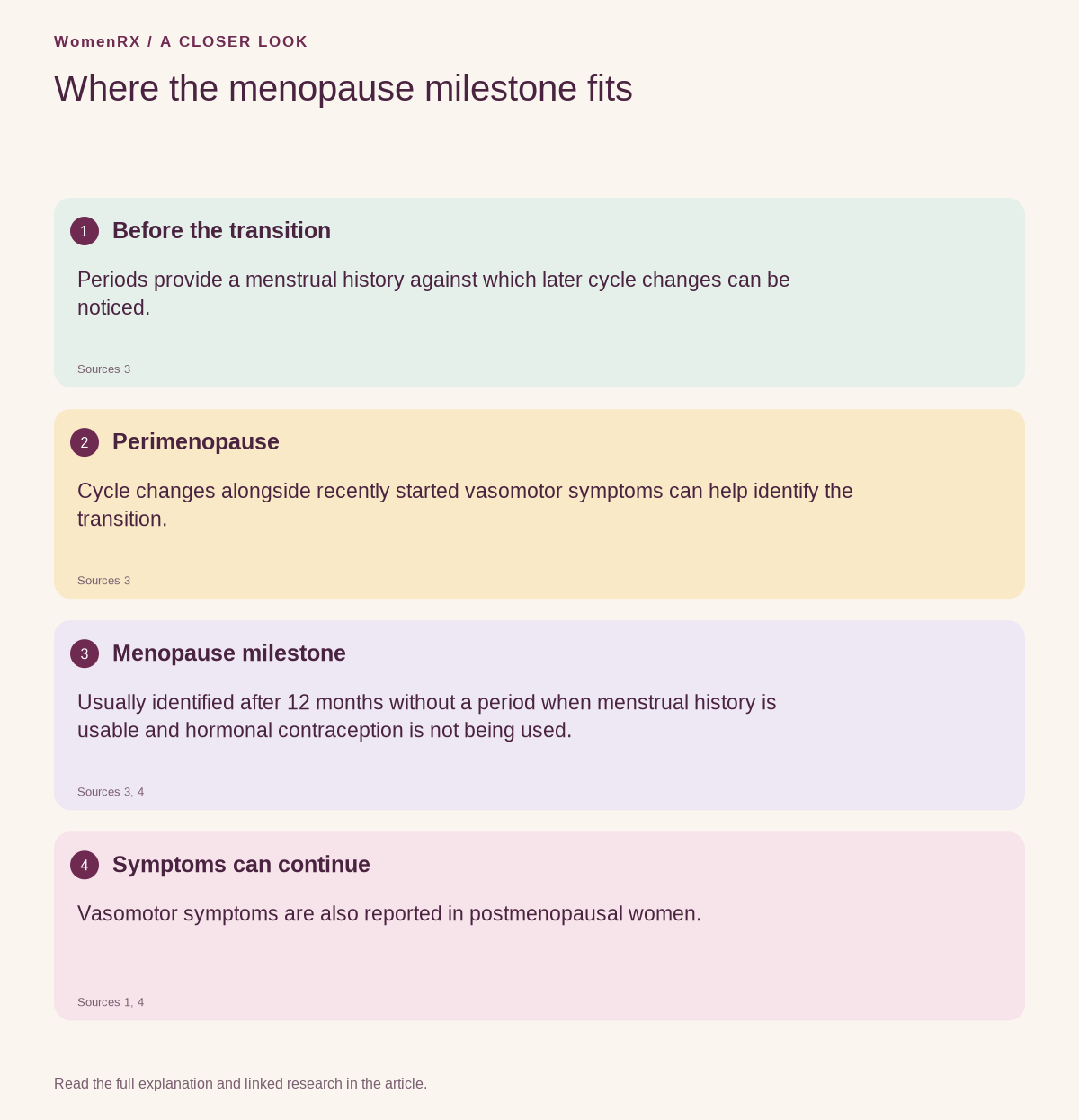
Where the menopause milestone fits
Before the transition: Periods provide a menstrual history against which later cycle changes can be noticed.3
Perimenopause: Cycle changes alongside recently started vasomotor symptoms can help identify the transition.3
Menopause milestone: Usually identified after 12 months without a period when menstrual history is usable and hormonal contraception is not being used.34
Symptoms can continue: Vasomotor symptoms are also reported in postmenopausal women.14
Read the figure as text
This timeline describes a sequence, not a fixed schedule. The period-based milestone works only when menstrual history is usable.- Before the transition: Periods provide a menstrual history against which later cycle changes can be noticed.3
- Perimenopause: Cycle changes alongside recently started vasomotor symptoms can help identify the transition.3
- Menopause milestone: Usually identified after 12 months without a period when menstrual history is usable and hormonal contraception is not being used.34
- Symptoms can continue: Vasomotor symptoms are also reported in postmenopausal women.14
More questions, answered
Can a blood test tell me exactly when menopause will happen?
No single AMH result can predict your age at menopause precisely. FSH testing also has limits, including when you use combined hormonal contraception or high-dose progestogen. Testing may have a different role when primary ovarian insufficiency is suspected before age 40. 23
Sources you can check
- Global prevalence of vasomotor symptoms in the menopause transition: systematic review and meta-analysis.Ellahi SA, Spector A, Talaulikar V, Faulkner A, Desai R. · Climacteric : the journal of the International Menopause Society · 2026Return to first citation
- Anti-Müllerian hormone for the diagnosis and prediction of menopause: a systematic review.Nelson SM, Davis SR, Kalantaridou S, Lumsden MA, Panay N, Anderson RA. · Human reproduction update · 2023Return to first citation
- Recommendations | Menopause: identification and management | Guidance | NICEAccessed 2026-09-25Return to first citation
- What are menopause and perimenopause? - NHSAccessed 2026-09-25Return to first citation
- Menopause | Menopause Symptoms | MedlinePlusAccessed 2026-09-25Return to first citation
- Postmenopausal bleeding - NHSAccessed 2026-09-25Return to first citation