How Should You Compare Online Menopause Care Services?
Compare what each service actually provides, who provides it, and what you’ll pay beyond the advertised visit fee.
Start by sorting each service into education, clinician care, or ongoing support; some offer only one. For clinical care, check who you’ll meet, whether follow-up is included, how prescriptions are handled, and the full cost over time. Menopause treatment should be tailored to your symptoms and health history, and hormone therapy is one option, not an automatic part of care. 1
Online menopause services can make it easier to ask questions or arrange a visit, but the label “menopause care” doesn’t tell you what you’re buying. A service might provide educational material, a one-time clinician appointment, prescription management, or continuing support. Compare those pieces separately before you enroll.
First, identify the kind of service
Education may help you understand symptoms and prepare questions, but it isn’t the same as an individual medical assessment. Find out whether the service offers general information only or an appointment with a clinician who can discuss your specific health history.
Clinician care means you can speak with a healthcare provider about symptoms and possible next steps. Check the clinician’s credentials, relevant menopause experience, and whether you’ll see the same person at future visits. Ask what concerns the service can assess virtually and when it would direct you to in-person care.
Ongoing support can mean follow-up visits, messaging, or help managing a treatment plan. Ask what “support” includes, who responds, and whether those contacts cost extra. A study based on interviews with 19 menopausal women and 15 providers in Isfahan, Iran, identified telemedicine as one potential way to expand access to sexual-health services. It explored views and service strategies, not whether online services improve outcomes or how they compare with one another. 3
Compare the clinical conversation, not just the menu
If you’re considering treatment for hot flashes or night sweats, ask whether the clinician will review your symptoms, health history, preferences, and relevant risks before discussing options. Menopausal hormone therapy can be effective for bothersome vasomotor symptoms, but its benefits and risks vary with factors including treatment type, route, duration, timing, and whether a progestogen is used. The North American Menopause Society recommends individualizing treatment and periodically reevaluating it. 1
Hormone therapy isn’t the only possible plan, and an appointment shouldn’t assume you want it. Evidence-based nonhormonal options for vasomotor symptoms include some prescription medicines as well as cognitive-behavioral therapy and clinical hypnosis. Which options are appropriate depends on your circumstances and preferences. 2
If your main concern is vaginal, vulvar, or urinary discomfort, ask whether the service addresses those symptoms or focuses mainly on hot flashes. The 2022 position statement describes treatment options for bothersome genitourinary symptoms and distinguishes some local treatments from systemic hormone therapy. 1 If a service’s scope doesn’t match the reason you’re seeking help, its low initial price may not make it the right fit.
Work out the full cost
Compare the likely cost of the care you expect to use, not just the first appointment. Ask for a written explanation of:
- The initial visit fee and any recurring membership charge.
- Whether follow-up visits or messages are included, and what additional contacts cost.
- Whether recommended tests or in-person appointments are billed separately.
- Whether prescriptions are included in the service fee or paid for separately at a pharmacy.
- The cancellation policy and what happens if you stop the membership.
For example, if one service advertises a lower first-visit price but charges separately for follow-ups, while another includes a follow-up in its fee, compare the expected total for the care you think you’ll need. Don’t assume a prescription, pharmacy cost, or continuing access is included unless the service says so clearly.
A short question list before enrolling
- Is this education, medical care, ongoing support, or a combination?
- Who will I meet, and what are their credentials and menopause-care experience?
- What symptoms and treatment questions can the service address virtually?
- What is included after the first visit, and what costs extra?
- If medication is discussed, who handles the prescription, and are medication and pharmacy costs separate?
- How will I get care if my needs require an in-person assessment or a different specialist?
A useful answer should be specific about what’s included and what isn’t. If the service can’t explain who provides care, how follow-up works, or how charges add up, keep comparing. The goal isn’t to find the biggest menu; it’s to find a service whose scope, access, and costs fit the help you’re looking for.
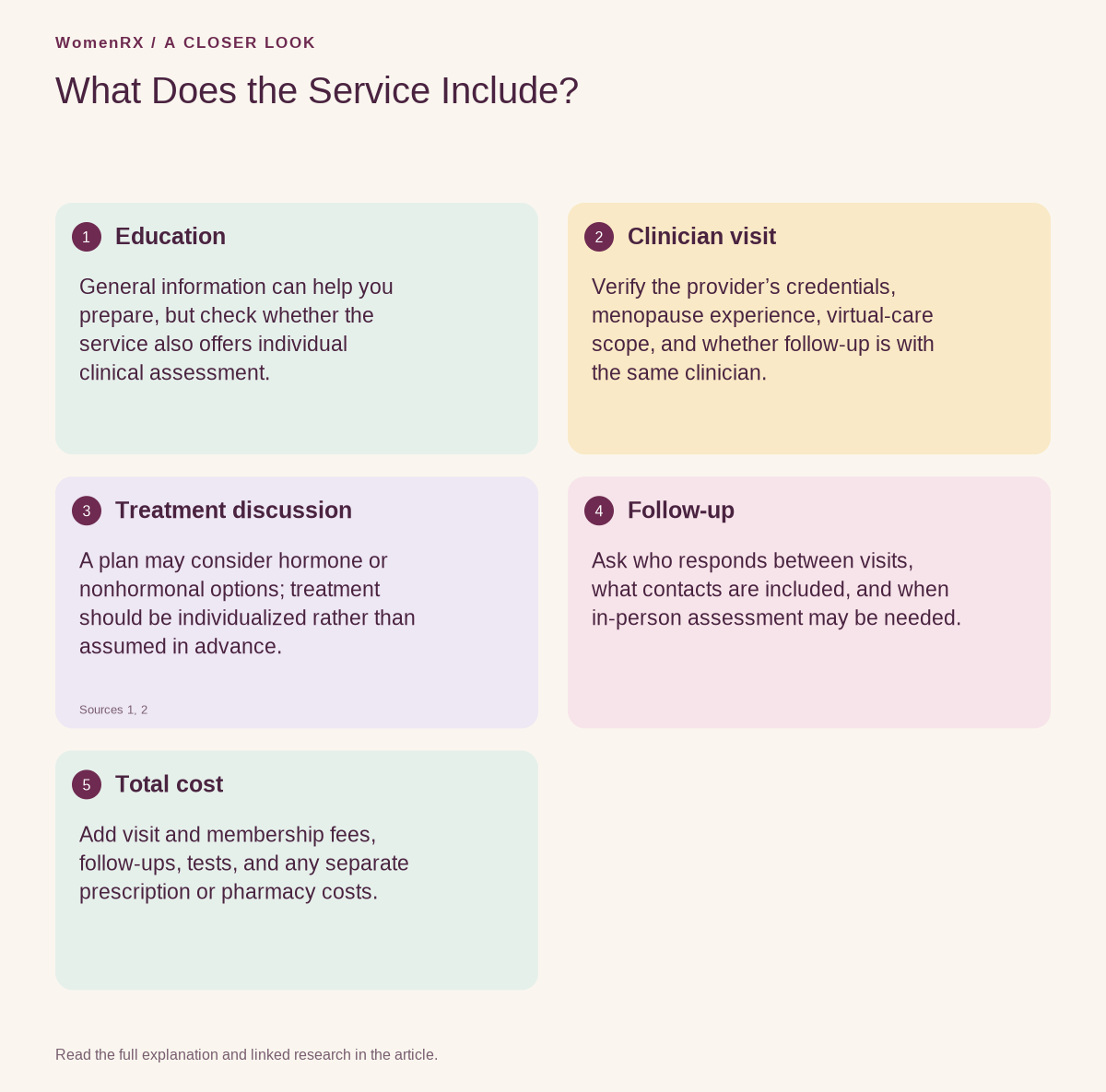
What Does the Service Include?
Education: General information can help you prepare, but check whether the service also offers individual clinical assessment.
Clinician visit: Verify the provider’s credentials, menopause experience, virtual-care scope, and whether follow-up is with the same clinician.
Treatment discussion: A plan may consider hormone or nonhormonal options; treatment should be individualized rather than assumed in advance.12
Follow-up: Ask who responds between visits, what contacts are included, and when in-person assessment may be needed.
Total cost: Add visit and membership fees, follow-ups, tests, and any separate prescription or pharmacy costs.
Read the figure as text
Compare the parts of care separately, then confirm the details and charges directly with each service.- Education: General information can help you prepare, but check whether the service also offers individual clinical assessment.
- Clinician visit: Verify the provider’s credentials, menopause experience, virtual-care scope, and whether follow-up is with the same clinician.
- Treatment discussion: A plan may consider hormone or nonhormonal options; treatment should be individualized rather than assumed in advance.12
- Follow-up: Ask who responds between visits, what contacts are included, and when in-person assessment may be needed.
- Total cost: Add visit and membership fees, follow-ups, tests, and any separate prescription or pharmacy costs.
More questions, answered
Does online menopause care always include hormone therapy?
No. A service may provide education, discuss hormone or nonhormonal options, or offer support without prescribing. Hormone therapy is one possible treatment, and whether it fits depends on your symptoms, health history, and preferences. 12
What should I ask about follow-up?
Ask whether follow-up visits or messages are included, who will respond, and what happens if your needs change or require in-person care. These details help you compare both continuity and likely total cost.
Sources you can check
- The 2022 hormone therapy position statement of The North American Menopause Society.“The 2022 Hormone Therapy Position Statement of The North American Menopause Society” Advisory Panel. · Menopause (New York, N.Y.) · 2022Return to first citation
- The 2023 nonhormone therapy position statement of The North American Menopause Society.Menopause (New York, N.Y.) · 2023Return to first citation
- Strategies to promote the provision of sexual health services during menopause: a qualitative study from the perspective of menopausal women and healthcare providers in Isfahan city, Iran.Moradi M, Noroozi M, Mostafavi F, Beigi M. · BMC health services research · 2025Return to first citation