Online Menopause Care: Five Checks Before You Book
A good online service should make clear who is treating you, how decisions are made, and what happens if you need care beyond a virtual visit.
Before booking, find out whether you’re getting general information or a visit with a clinician, who that clinician is, and how they’ll consider your symptoms and health history. If treatment is discussed, ask how benefits, risks, alternatives, and follow-up are handled. Also clarify total costs, privacy practices, and how the service connects you with in-person or coordinated care if needed. Menopause hormone therapy should be individualized and periodically reevaluated. 1
Online menopause care can make it easier to discuss hot flashes, sleep changes, vaginal or urinary symptoms, and treatment options. But “online care” can mean anything from educational content to an actual clinical visit. Before sharing personal information or paying, check what kind of care you’re booking and what happens after the appointment.
1. Find out who is providing care
Ask whether you’ll speak with a clinician or use a service that mainly provides information, screening, or referrals. If there is a clinician, ask who they are, what their role and credentials are, and whether they’re authorized to provide care where you’ll be during the visit. You can verify credentials with the relevant licensing body if you’re unsure.
Also ask who reviews your information and makes treatment decisions. A form or automated questionnaire may be part of intake, but it’s reasonable to know whether a clinician will assess your situation and how you can contact them with questions.
2. Check whether the evaluation is personal
A useful visit should leave room for your specific symptoms, priorities, and health history, rather than treating menopause as one standard problem. Before booking, ask what information the clinician will review and whether there’s time to discuss your existing conditions and treatments.
That matters especially if hormone therapy comes up. Its benefits and risks vary with factors including the type of therapy, route, duration, timing, and whether a progestogen is used. The North American Menopause Society recommends individualizing treatment and periodically reevaluating its benefits and risks. 1
You might ask: “If hormone therapy isn’t a good fit for me, will we discuss other evidence-based options?” Nonhormonal treatments are available for bothersome hot flashes and night sweats, although which option fits depends on the person and the treatment’s tradeoffs. 2
3. Ask how prescriptions and follow-up work
A prescription shouldn’t be the only thing the service promises. Ask how the clinician explains the reason for a recommendation, its potential benefits and risks, and what alternatives you can consider. If medication is started or changed, find out who answers questions afterward and how the service decides when to check in again.
For hormone therapy, follow-up is part of care, not an optional extra: recommendations call for periodic reevaluation. 1 Ask whether follow-up visits have a separate fee, whether you’ll see the same clinician, and how to reach the service between visits.
4. Understand when online care may not be enough
A virtual visit can be convenient, but it doesn’t guarantee that every concern can be assessed or managed remotely. Ask what happens if your symptoms or medical history call for an examination, testing, or care from another clinician. Will the service help arrange that next step, coordinate with your usual clinician, or explain where to go?
This is a practical question, not a reason to rule out online care. In one Canadian menopause clinic during the first wave of the pandemic, patients reported high satisfaction with telephone visits, though some preferred in-person care. That study measured satisfaction in one clinic, not whether online visits are as clinically effective as in-person care for every situation. 3
5. Get the full cost and privacy picture
Before you book, ask for the total expected cost: the first visit, follow-ups, and any separate charges for tests or other services. If you plan to use insurance, confirm what the service will bill and what you may owe. Don’t assume a quoted visit price covers later care or prescriptions.
Read the privacy information before submitting sensitive details. Ask what health information the service collects, who can access it, whether it is shared with other companies or clinicians, and how to request a copy or ask about deletion. If anything is unclear, get an explanation before you continue.
A simple way to compare services
You don’t need a service to promise a particular treatment. Look for clear answers about clinician involvement, individualized decision-making, follow-up, costs, privacy, and a route to in-person care when needed. If a service can’t explain those basics before you book, keep looking.
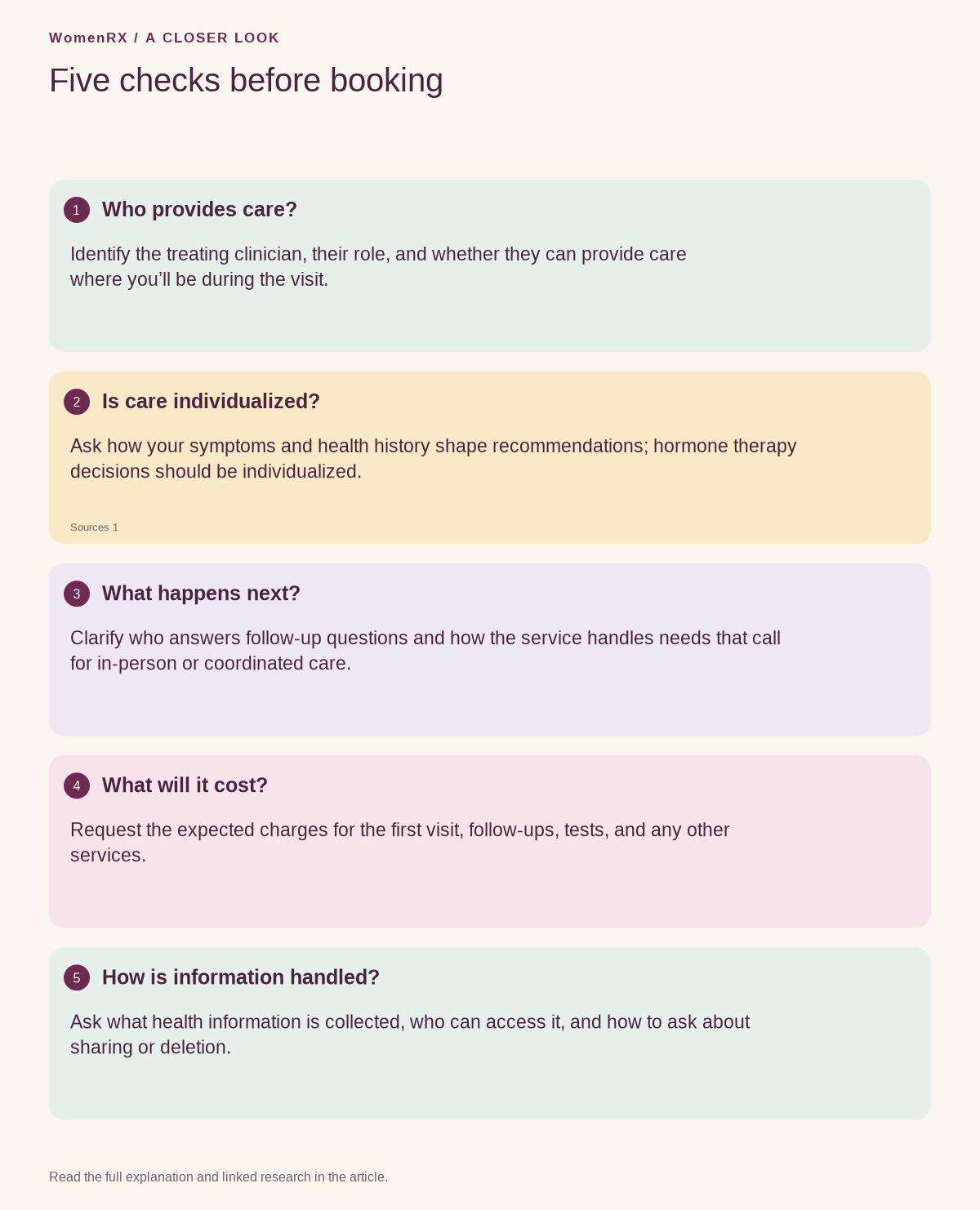
Five checks before booking
Who provides care?: Identify the treating clinician, their role, and whether they can provide care where you’ll be during the visit.
Is care individualized?: Ask how your symptoms and health history shape recommendations; hormone therapy decisions should be individualized.1
What happens next?: Clarify who answers follow-up questions and how the service handles needs that call for in-person or coordinated care.
What will it cost?: Request the expected charges for the first visit, follow-ups, tests, and any other services.
How is information handled?: Ask what health information is collected, who can access it, and how to ask about sharing or deletion.
Read the figure as text
Use these questions to compare what an online menopause service actually offers before sharing health information or paying.- Who provides care?: Identify the treating clinician, their role, and whether they can provide care where you’ll be during the visit.
- Is care individualized?: Ask how your symptoms and health history shape recommendations; hormone therapy decisions should be individualized.1
- What happens next?: Clarify who answers follow-up questions and how the service handles needs that call for in-person or coordinated care.
- What will it cost?: Request the expected charges for the first visit, follow-ups, tests, and any other services.
- How is information handled?: Ask what health information is collected, who can access it, and how to ask about sharing or deletion.
More questions, answered
Does an online menopause visit mean I’ll be prescribed hormone therapy?
No. A visit is a chance to discuss symptoms and options, not a guarantee of a prescription. Hormone therapy decisions should be individualized, and nonhormonal options may also be appropriate depending on your situation. 1 2
Is online menopause care proven to be as effective as in-person care?
The cited patient-satisfaction study does not establish that. It surveyed patients at one Toronto clinic during the pandemic and measured satisfaction with telephone visits, not comparative clinical outcomes across online and in-person care. 3
Sources you can check
- The 2022 hormone therapy position statement of The North American Menopause Society.“The 2022 Hormone Therapy Position Statement of The North American Menopause Society” Advisory Panel. · Menopause (New York, N.Y.) · 2022Return to first citation
- The 2023 nonhormone therapy position statement of The North American Menopause Society.Menopause (New York, N.Y.) · 2023Return to first citation
- Delivery of menopause care during a pandemic: an evaluation of patient satisfaction with telephone visits.Wright E, Shaltout O, Zokvic MA, Shirreff L. · Menopause (New York, N.Y.) · 2021Return to first citation