Menopause Supplements: Safety Checks Before You Start
A useful safety check starts with the exact ingredients, your medicines, and the symptom you’re hoping to relieve.
Before starting a menopause supplement, show a pharmacist or clinician the full label and share your medicines, other supplements, and health conditions. Include the exact hormone therapy you use, if any. Some herbs may affect how medicines are processed, though a possible interaction isn’t necessarily a proven problem with your particular product. Ask about likely benefit, too. 134
Check the product, not just its promise
“Menopause support” tells you what a product is marketed for, not what’s in it. Take a photo of the complete label or bring the bottle when you ask a pharmacist or clinician to review it. Point out every ingredient and the amount per serving, especially in a combination product. Herbal preparations can vary, so checking only the product name or its headline ingredient may miss part of the picture. 1
Bring your full list of prescription medicines, over-the-counter medicines, and other supplements. Some herbs can affect enzymes that process drugs, potentially changing how much medicine is in the body. But evidence about particular herbs can be conflicting, and an effect seen in a laboratory does not automatically mean a meaningful interaction will occur in you. 1
Try asking: “Is there a known interaction between this exact product and anything I take, or is the concern still theoretical?” If the answer is uncertain, ask what would make another option a better choice. Don’t change a prescribed medicine just to accommodate a supplement without discussing the change with its prescriber.
Name your hormone therapy precisely
If you use menopausal hormone therapy, include the product name and whether it’s a pill, patch, gel, or vaginal treatment. Hormone therapy’s benefits and risks differ by factors including its type, route, and whether a progestogen is used. “I take hormones” may not give someone enough detail to review your situation. 3
That doesn’t mean every supplement interacts with hormone therapy. For example, a review found that black cohosh may affect certain drug-processing enzymes, but clinically relevant drug interactions with black cohosh remain unproven. The question to ask is about your ingredients and regimen, rather than assuming either that the combination is safe or that it’s harmful. 1
Connect your health history to the ingredients
Tell the person reviewing the product about conditions that could change the decision. Black cohosh offers a concrete example: sporadic reports of liver injury have raised concern. If you have a liver condition or a history of liver problems, ask specifically whether a product containing black cohosh makes sense for you. Those reports do not establish your individual likelihood of liver injury. 12
A small cross-sectional study compared 23 women who had used black-cohosh-only supplements for at least three months with 28 women who had not used them. It found no increased micronucleus frequencies and no hematological abnormalities among users. Those findings are reassuring for the measures reported, but the study cannot establish the safety of every black cohosh product or its use by people with different health conditions. 2
If you have a procedure planned, mention the supplement you’re considering and ask whether your care team needs to know about it before the procedure. This is a way to keep everyone working from the same medicine list, not a claim that every menopause supplement poses a surgical risk.
Ask whether it’s worth taking in the first place
Safety is only half the decision. If you’re trying to ease hot flashes or night sweats, ask what evidence supports this product for that symptom. The Menopause Society’s 2023 evidence review does not recommend supplements or herbal remedies for these symptoms. That’s a judgment about their use as treatments, not a universal declaration that every product is unsafe. 4
This matters whether you’re in perimenopause or past your final period: a product with no identified interaction may still offer uncertain benefit. Before you decide, ask what changes you should watch for, when to follow up, and what other options have evidence for the symptom that’s bothering you. If a new symptom appears after you start a product, share the exact product and when you began taking it when you seek advice.
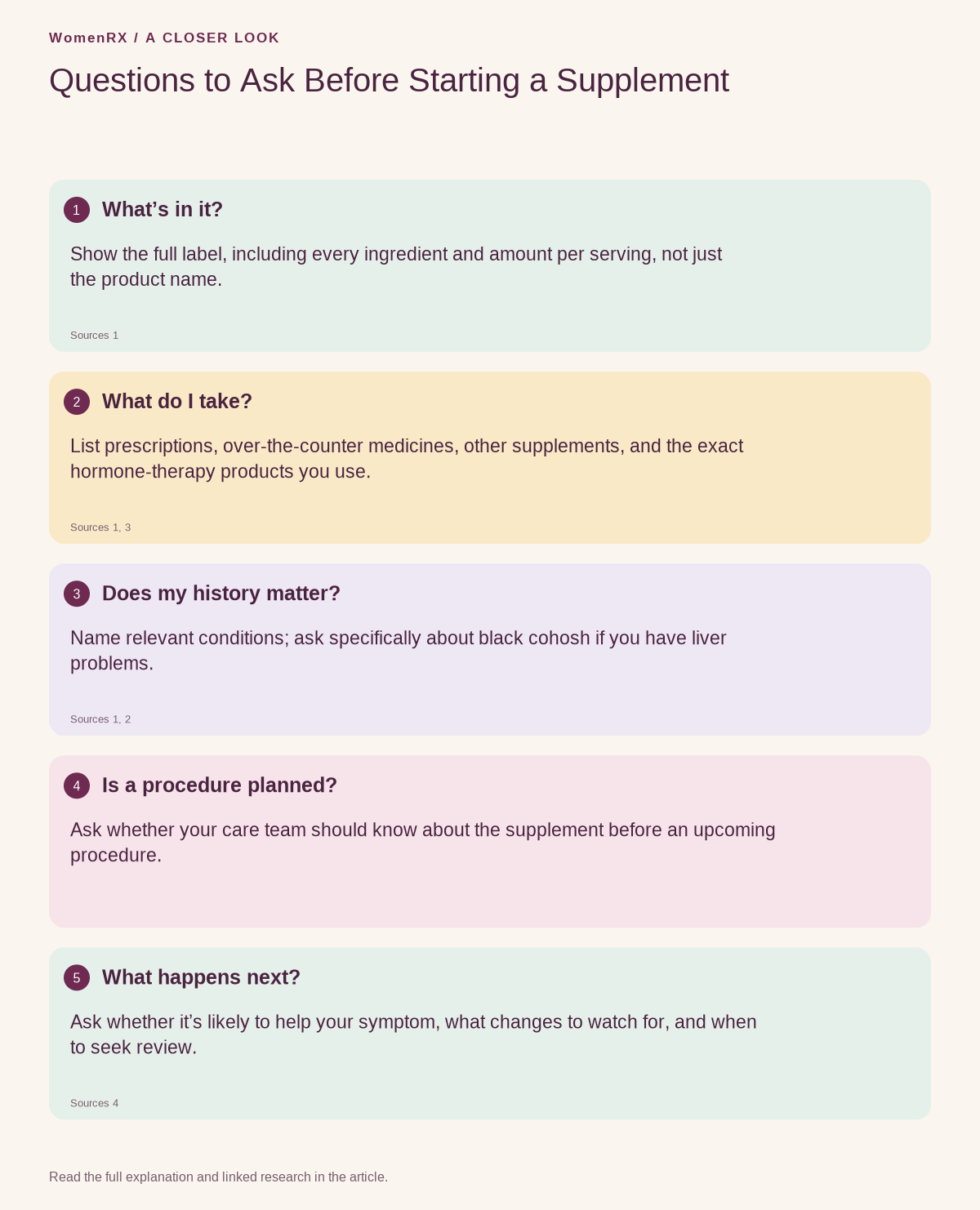
Questions to Ask Before Starting a Supplement
What’s in it?: Show the full label, including every ingredient and amount per serving, not just the product name.1
What do I take?: List prescriptions, over-the-counter medicines, other supplements, and the exact hormone-therapy products you use.13
Does my history matter?: Name relevant conditions; ask specifically about black cohosh if you have liver problems.12
Is a procedure planned?: Ask whether your care team should know about the supplement before an upcoming procedure.
What happens next?: Ask whether it’s likely to help your symptom, what changes to watch for, and when to seek review.4
Read the figure as text
Use the exact product and your own medicine list to make the review specific.- What’s in it?: Show the full label, including every ingredient and amount per serving, not just the product name.1
- What do I take?: List prescriptions, over-the-counter medicines, other supplements, and the exact hormone-therapy products you use.13
- Does my history matter?: Name relevant conditions; ask specifically about black cohosh if you have liver problems.12
- Is a procedure planned?: Ask whether your care team should know about the supplement before an upcoming procedure.
- What happens next?: Ask whether it’s likely to help your symptom, what changes to watch for, and when to seek review.4
More questions, answered
Does “natural” mean a supplement can’t interact with medicine?
No. Some herbs can affect drug-processing enzymes. Whether that leads to a meaningful interaction depends on the ingredients, the medicine, and the evidence for that combination. 1
Sources you can check
- Herbal Medicines and Drugs Interactions: Cytochrome P450 Responsibility.Shanaida M, Oleshchuk O, Shevchuk O, Posokhova K, Ivankiv Y, Mocherniuk K, Klantsa M, Korda M. · Current medicinal chemistry · 2026Return to first citation
- A cross-sectional clinical study in women to investigate possible genotoxicity and hematological abnormalities related to the use of black cohosh botanical dietary supplements.Smith-Roe SL, Garantziotis S, Church RL, Bemis JC, Torous DK, Shepard KG, Hobbs CA, Waidyanatha S, Mutlu E, Shockley KR, Kissling GE, McBride SJ, Xie G, Cristy T, Pierfelice J, Wit... · Environmental and molecular mutagenesis · 2022Return to first citation
- The 2022 hormone therapy position statement of The North American Menopause Society.“The 2022 Hormone Therapy Position Statement of The North American Menopause Society” Advisory Panel. · Menopause (New York, N.Y.) · 2022Return to first citation
- The 2023 nonhormone therapy position statement of The North American Menopause Society.Menopause (New York, N.Y.) · 2023Return to first citation