Menopause Hormone Therapy or Supplements: What Evidence Supports
For hot flashes, hormone therapy has the strongest evidence; supplements are not a proven equivalent, and the right choice depends on your symptoms and health history.
For bothersome hot flashes and night sweats, menopausal hormone therapy is the most effective treatment supported by current guidance. The Menopause Society does not recommend supplements or herbal remedies as treatment for these symptoms because evidence is limited or inconsistent. Hormone therapy can also help menopause-related vaginal and urinary symptoms, while supplement products vary and may interact with medicines. 2 3 4
Start with the symptom you want to treat
“Menopause symptoms” can mean hot flashes and night sweats, vaginal dryness or discomfort, or something else. Those symptoms don’t all have the same evidence-based options, so compare treatments for the problem you actually want relief from.
For hot flashes and night sweats, menopausal hormone therapy is the most effective treatment. The Menopause Society’s evidence review does not recommend supplements or herbal remedies for these symptoms; the evidence was limited or inconsistent. That doesn’t prove every product has no effect, but it does mean supplements shouldn’t be treated as an evidence-backed substitute for hormone therapy. 2 3
For vaginal and urinary symptoms linked to menopause, hormone therapy can also be an option. Guidance distinguishes local, low-dose vaginal treatments from systemic hormone therapy: vaginal treatment may be considered for bothersome symptoms that haven’t improved with over-the-counter care when systemic therapy isn’t indicated. A supplement marketed for hot flashes shouldn’t be assumed to treat these symptoms too. 2
Hormone therapy is a medicine, not a one-size-fits-all choice
Hormone therapy’s benefits and risks depend on factors including the type, dose, route, duration, timing, and whether a progestogen is used. For women younger than 60 or within 10 years of menopause onset who have no contraindications, the Menopause Society describes the benefit-risk balance as favorable for treating bothersome hot flashes and preventing bone loss. Starting later, after age 60 or more than 10 years after menopause begins, is associated with a less favorable balance because certain risks are higher. These are general patterns, not a personal verdict. 2
That makes the useful comparison a personal one: Which symptom is disrupting your life, how much relief do you want, and how does your health history affect the options? If hormone therapy isn’t a fit or isn’t your preference, there are evidence-supported nonhormonal treatments, including some prescription medicines and cognitive behavioral therapy. “Nonhormonal” does not have to mean “supplement.” 3
Supplements need product-level scrutiny
A supplement is not a single treatment category. Products can contain different ingredients and amounts, and the evidence review found enough uncertainty to advise against supplements and herbal remedies for hot flashes as a group. Another review describes mixed evidence and inconsistencies in product ingredients, dosage, and quality. Neither supports assuming that a product works because it is popular, plant-based, or labeled for menopause. 3 4
Supplements also don’t go through the same testing that drugs do. Some may interact with medicines or be a concern for people with conditions such as breast cancer. Before buying or combining products, check the exact ingredient list and labeled serving, and review the product with a clinician or pharmacist if you take medicines or have a relevant health condition. Tell your care team what supplements you use, don’t exceed the label’s serving, and ask about them before surgery. 1 4
A practical way to weigh the options
- Name the main symptom. Hot flashes, night sweats, and vaginal discomfort call for different comparisons.
- Compare evidence, not “natural” versus “hormonal.” For hot flashes, hormone therapy has the strongest evidence; supplements and herbal remedies are not recommended by the Menopause Society. 2 3
- Put your history into the decision. Age, time since menopause, personal health history, and the kind of hormone therapy being considered can change its benefit-risk balance. 2
- Check the actual supplement. Bring or share the product label and review ingredients and possible interactions, especially if you take medicines or have a history of breast cancer. 1 4
If you prefer not to use hormone therapy, you still have options. Ask about nonhormonal approaches with evidence for the symptom you’re treating rather than feeling pushed toward an unproven supplement. 3
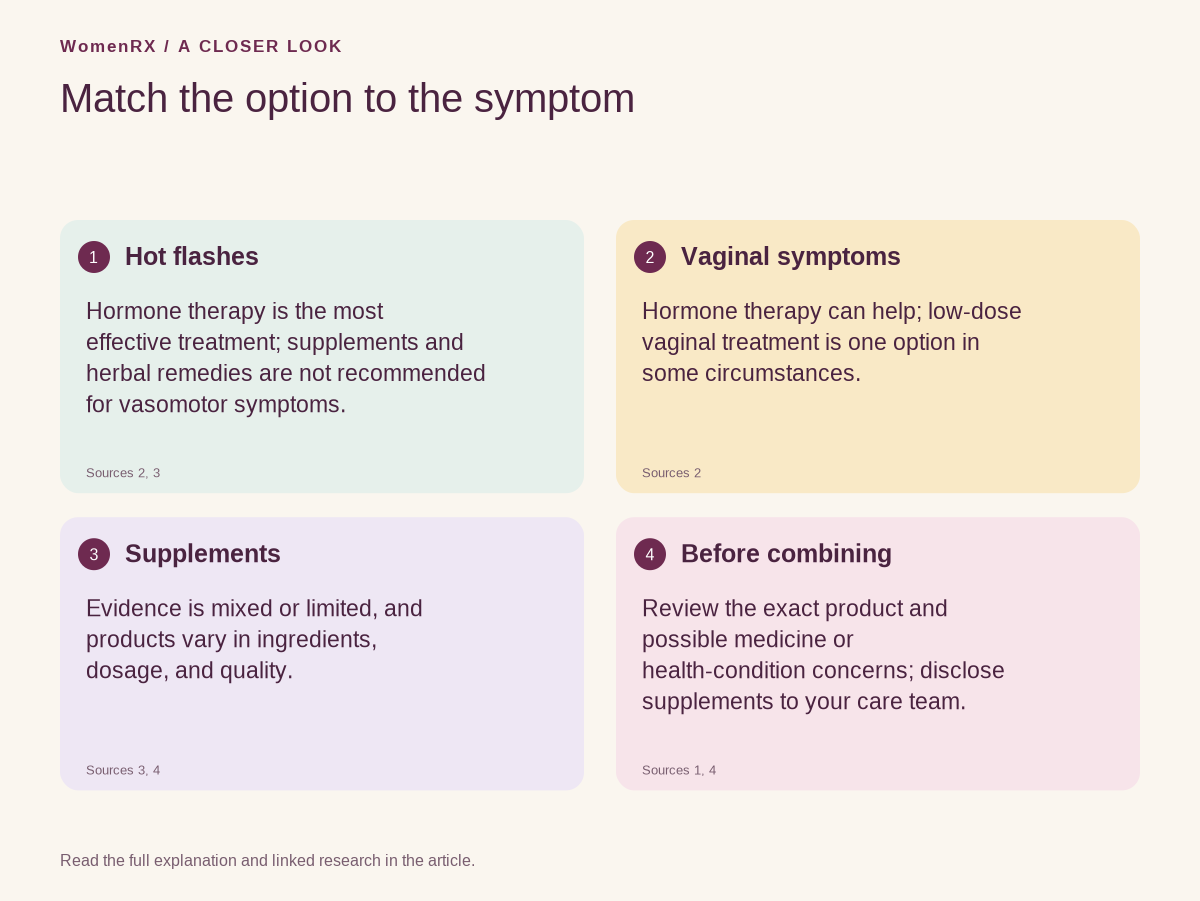
Match the option to the symptom
Hot flashes: Hormone therapy is the most effective treatment; supplements and herbal remedies are not recommended for vasomotor symptoms.23
Vaginal symptoms: Hormone therapy can help; low-dose vaginal treatment is one option in some circumstances.2
Supplements: Evidence is mixed or limited, and products vary in ingredients, dosage, and quality.34
Before combining: Review the exact product and possible medicine or health-condition concerns; disclose supplements to your care team.14
Read the figure as text
The strength of evidence differs by symptom. This comparison separates established hormone-therapy uses from the more limited evidence for supplements and flags a practical safety check.- Hot flashes: Hormone therapy is the most effective treatment; supplements and herbal remedies are not recommended for vasomotor symptoms.23
- Vaginal symptoms: Hormone therapy can help; low-dose vaginal treatment is one option in some circumstances.2
- Supplements: Evidence is mixed or limited, and products vary in ingredients, dosage, and quality.34
- Before combining: Review the exact product and possible medicine or health-condition concerns; disclose supplements to your care team.14
More questions, answered
Does “natural” mean a menopause supplement is safer?
No. Supplements do not go through the same testing as drugs, and some can interact with medicines or be a concern with certain health conditions. Check the specific product rather than relying on the word “natural.” 1 4
If I don’t want hormone therapy, are supplements my only option?
No. Evidence-supported nonhormonal options include cognitive behavioral therapy and certain prescription treatments. Which may fit depends on the symptom and your circumstances. 3
Sources you can check
- Dietary Supplements: MedlinePlusAccessed 2026-09-25Return to first citation
- The 2022 hormone therapy position statement of The North American Menopause Society.“The 2022 Hormone Therapy Position Statement of The North American Menopause Society” Advisory Panel. · Menopause (New York, N.Y.) · 2022Return to first citation
- The 2023 nonhormone therapy position statement of The North American Menopause Society.Menopause (New York, N.Y.) · 2023Return to first citation
- The value of over-the-counter products/services in the management of mild-to-moderate menopausal symptoms.Stute P, Currie H, Palacios S. · Climacteric : the journal of the International Menopause Society · 2025Return to first citation