What Can Menopause Telehealth Help With, and How Does a Visit Work?
A virtual visit can help you discuss menopause symptoms and treatment choices, but an exam or test may still be needed, and posted prices don’t always include medication.
Menopause telehealth can suit a conversation about hot flashes, other bothersome symptoms, or a treatment review. A clinician can discuss options, though vaginal or pelvic pain may need an examination, and some concerns need testing. 1 3 As of September 25, 2026, one service listed a $250 first visit; another listed a $49 consultation with medication priced separately. 8 9
When a virtual visit may be a good fit
A telehealth appointment may work well when your main need is to describe symptoms, talk through how they affect daily life, or review treatment choices. For example, you might want to discuss hot flashes, or revisit whether a menopause treatment is still meeting your needs. Menopausal hormone therapy is an individualized decision: its benefits and risks vary with factors such as age, time since menopause, treatment type, and personal health history. A virtual conversation can support that discussion, but it does not guarantee a prescription or settle suitability on its own. 4
If you’re considering nonhormone options for hot flashes, those can also be part of the conversation. A North American Menopause Society position statement identifies several evidence-supported options, including cognitive behavioral therapy, clinical hypnosis, and certain prescription treatments. Which options fit depends on your circumstances and preferences. 5
There’s some direct, though limited, evidence that menopause care can be delivered by video or telephone. In one prospective study of a specialist service for people affected by cancer-related menopause symptoms or inherited cancer risk, most surveyed patients were satisfied with video visits; clinicians were especially likely to use video again for patients who did not need an examination. A separate study of one Toronto menopause clinic during the first wave of the pandemic also found high satisfaction with telephone visits. These studies describe particular services and patient groups, not a guarantee that every menopause concern can be handled remotely. 6 7
What a visit might involve
There isn’t one established menopause telehealth script. Depending on your concern and the service, a visit may include describing your symptoms, discussing your health history and current treatments, and considering possible next steps. A clinician you haven’t seen before may not have your full medical history, so it can help to have a current medication list and relevant records available if you have them. 1
The discussion can be specific to the symptom. For example, if you’re having vaginal dryness or pain with sex, the clinician may ask where the pain occurs and whether you also have urinary or skin symptoms. Those details matter because menopause-related tissue changes are one possible cause, but pain can also involve the pelvic floor, skin, inflammation, or other pelvic issues. 2 3
When the conversation may need an in-person step
A video or phone call can’t provide a physical examination. If your symptoms need one to distinguish among possible causes, a clinician may say that an in-person assessment is the next useful step. That can matter for vaginal or pelvic pain: evaluation may involve looking at the vulva and vagina, assessing pelvic-floor tenderness, or, when deeper causes are suspected, further pelvic evaluation. The exact assessment depends on what you describe. 1 3
Testing may also be needed. Telehealth guidance notes that a clinician sometimes can’t make the right diagnosis without examining you or arranging a lab test. That doesn’t mean the virtual visit was wasted; it may clarify what needs checking. But don’t assume the test, examination, or any referral will be arranged automatically. Ask what the clinician recommends and how you should follow through. 1
What the posted price may cover
A low consultation price and a higher visit price aren’t necessarily prices for the same care. On September 25, 2026, Midi listed a 30-minute first visit at $250 self-pay and a 15-minute returning visit at $150 self-pay. These were visit prices; additional costs may apply, so they don’t establish what you’d pay for medication or labs. Insurance costs depend on your plan. 8
Alloy listed a one-time $49 doctor consultation fee and an estradiol pill starting at $39.99 per month on the same date. That medication starting price is separate from the consultation fee and isn’t a complete treatment cost: it doesn’t specify a pill quantity or dose, doesn’t include a stated progesterone price, and the prescribed treatment determines the final cost. Alloy says its subscriptions usually bill every three months, with some exceptions, so a monthly advertised price may not be the amount charged at checkout. These are examples of two services’ posted offers, not a comparison of equivalent treatment plans or a quote for you. 9 10
Before booking, check whether there’s a membership fee, how often you’ll be billed, and whether follow-up, medication, or testing costs extra. A posted offer tells you what a service advertises, not whether a particular treatment is right for you. 8 9 10
Before you book, check the practical fit
Think about what you want help with: a symptom discussion, a treatment review, or an assessment that may require someone to examine you. If your concern is mainly a conversation, telehealth may be a reasonable option. If you already expect an examination or a test, ask whether the service can provide that care or help you plan the next step. A virtual appointment may be less convenient if you’d have to coordinate separate care afterward. 1
If you’re seeing a clinician who doesn’t know you, have your relevant health history and current medicines handy. You can also ask at the end of the visit: “Do you have enough information to advise me, or do I need an exam or test?” That question keeps the focus on whether the remote assessment has answered your particular concern. 1
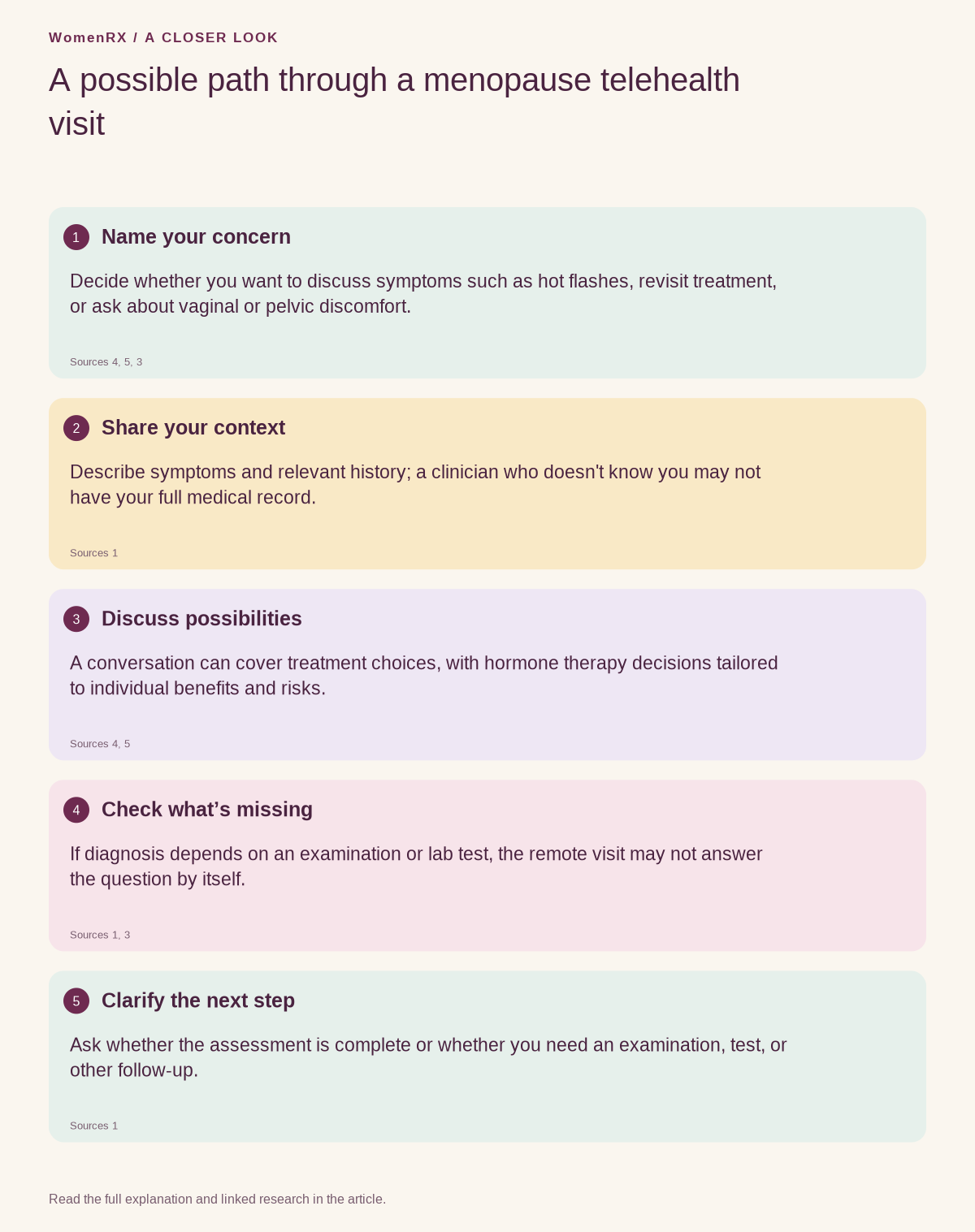
A possible path through a menopause telehealth visit
Name your concern: Decide whether you want to discuss symptoms such as hot flashes, revisit treatment, or ask about vaginal or pelvic discomfort.453
Share your context: Describe symptoms and relevant history; a clinician who doesn't know you may not have your full medical record.1
Discuss possibilities: A conversation can cover treatment choices, with hormone therapy decisions tailored to individual benefits and risks.45
Check what’s missing: If diagnosis depends on an examination or lab test, the remote visit may not answer the question by itself.13
Clarify the next step: Ask whether the assessment is complete or whether you need an examination, test, or other follow-up.1
Read the figure as text
A virtual visit may resolve a symptom or treatment question, or help identify what needs an in-person assessment. The route depends on your concern.- Name your concern: Decide whether you want to discuss symptoms such as hot flashes, revisit treatment, or ask about vaginal or pelvic discomfort.453
- Share your context: Describe symptoms and relevant history; a clinician who doesn't know you may not have your full medical record.1
- Discuss possibilities: A conversation can cover treatment choices, with hormone therapy decisions tailored to individual benefits and risks.45
- Check what’s missing: If diagnosis depends on an examination or lab test, the remote visit may not answer the question by itself.13
- Clarify the next step: Ask whether the assessment is complete or whether you need an examination, test, or other follow-up.1
More questions, answered
Can a telehealth visit tell me whether hormone therapy is right for me?
It can be a place to discuss your symptoms, health history, and treatment choices. Suitability is individualized, and the visit may identify questions that need more information or an in-person assessment; a virtual appointment doesn’t guarantee a prescription. 4 1
Sources you can check
- Telehealth: MedlinePlusAccessed 2026-09-25Return to first citation
- Case-Based Perspectives on the Management of Genitourinary Syndrome of Menopause.Cyriac J, Sood R. · Clinics and practice · 2026Return to first citation
- Assessment and management of dyspareunia in peri- and postmenopausal women: A phenotype-based gynecologic approach.Broul M, Vančo M, Banýrová J, Hujová A. · International journal of gynaecology and obstetrics: the official organ of the International Federation of Gynaecology and Obstetrics · 2026Return to first citation
- The 2022 hormone therapy position statement of The North American Menopause Society.“The 2022 Hormone Therapy Position Statement of The North American Menopause Society” Advisory Panel. · Menopause (New York, N.Y.) · 2022Return to first citation
- The 2023 nonhormone therapy position statement of The North American Menopause Society.Menopause (New York, N.Y.) · 2023Return to first citation
- Video telehealth to manage menopausal symptoms after cancer: a prospective study of clinicians and patient satisfaction.Rachagan N, Szabo RA, Rio I, Rees F, Hiscock HM, Hickey M. · Menopause (New York, N.Y.) · 2023Return to first citation
- Delivery of menopause care during a pandemic: an evaluation of patient satisfaction with telephone visits.Wright E, Shaltout O, Zokvic MA, Shirreff L. · Menopause (New York, N.Y.) · 2021Return to first citation
- Midi menopause telehealth visit pricesAccessed 2026-09-25Return to first citation
- Alloy menopause hormone consultation and medication pricesAccessed 2026-09-25Return to first citation
- Alloy menopause hormone subscription billing cadenceAccessed 2026-09-25Return to first citation