How a Telehealth Visit Works, Step by Step
A virtual visit can start the conversation and shape a care plan, but an exam or lab test may still be the next step.
A telehealth visit usually follows the same basic path as an in-person appointment: you book a service, explain your concern to a clinician by video or phone, and agree on what happens next. Telehealth can support some reproductive and general health needs, but the right format depends on your concern. If an exam or lab test is needed, the clinician may recommend in-person care. 1 2
1. Choose a service that fits your concern
Start with your regular clinic if you have one, or contact the service you’re considering and describe the reason for the visit. Ask whether it handles that kind of concern virtually and whether the appointment will be by video, phone, or another format. Telehealth visits can take place by video or phone, but the services offered vary. 1
Virtual care has applications in areas such as well-woman care, preventive care, preconception counseling, and family planning. Those are examples, not a promise that every provider offers them remotely or that every concern can be resolved that way. 2
Before you book, ask how the visit is arranged and whether your insurance covers it. Coverage can vary, and a virtual appointment with a clinician who doesn’t know your history may leave them without information your regular provider has. 1
2. Get ready to explain what’s going on
Before the appointment, think through what you want help with and what has changed. For a reproductive or sexual health concern, that might mean describing the question you want answered, the symptoms that prompted the visit, or the kind of care you’re seeking. For a general concern, focus on what you’ve noticed and what you need from the conversation. MedlinePlus recommends preparing for a telehealth visit and communicating clearly, as you would for an in-person visit. 1
Check the clinic’s instructions for joining. A lost connection or software problem can interrupt a virtual visit, so know how the service wants you to reconnect or reach the office if the technology fails. 1
3. Use the visit to make a plan
The clinician will hear your concern and decide what can be addressed remotely. Be direct about what you’re hoping to accomplish, and ask what the clinician can determine from the conversation and what remains uncertain. A virtual visit is a way to receive care at a distance, not a guarantee that a diagnosis can be made without an examination. 1
For example, a visit might focus on a preventive or family-planning question, while a concern that requires a physical examination may call for an in-person appointment. The range of gynecologic telemedicine uses includes counseling and preventive care, but the specific service and its suitability depend on the provider and the concern. 2
4. Confirm what happens after the call
Before ending the visit, make sure you understand the plan: whether anything else is needed, who will arrange it, and how you’ll hear about follow-up. A clinician may recommend an in-person examination or a lab test if the information available remotely isn’t enough. That doesn’t mean the virtual visit was pointless; it can help identify what kind of next step is needed. 1
If you saw a clinician outside your usual practice, find out whether they will share the visit information with your regular provider or whether you need to coordinate that yourself. After a virtual visit, coordinating care with your regular provider may be up to you. 1
The simplest way to think about telehealth is as one possible starting point in care. It may answer the question remotely, or it may help set up the examination, testing, or continued care that needs to happen in person.
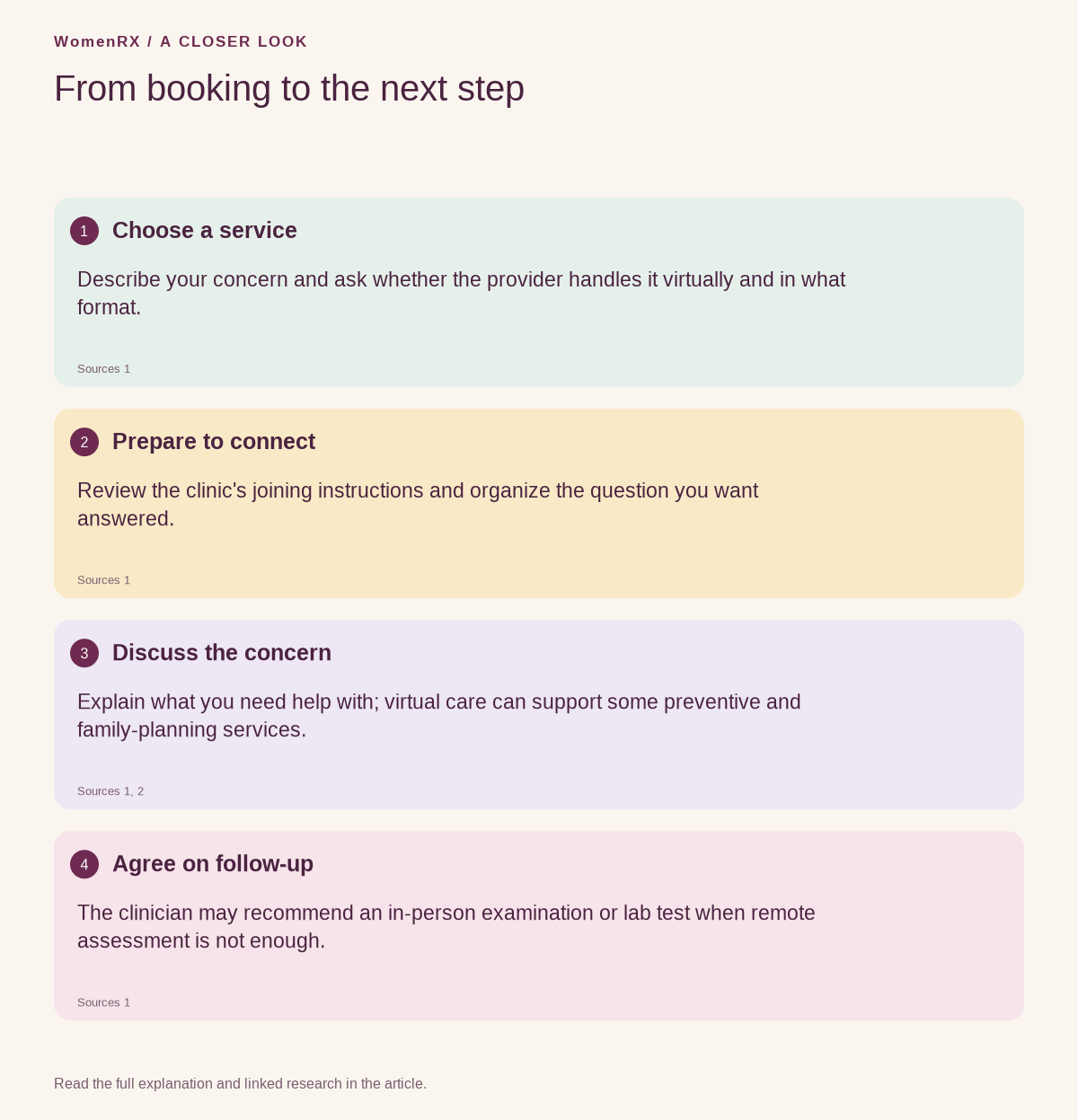
From booking to the next step
Choose a service: Describe your concern and ask whether the provider handles it virtually and in what format.1
Prepare to connect: Review the clinic's joining instructions and organize the question you want answered.1
Discuss the concern: Explain what you need help with; virtual care can support some preventive and family-planning services.12
Agree on follow-up: The clinician may recommend an in-person examination or lab test when remote assessment is not enough.1
Read the figure as text
A virtual appointment can resolve a concern remotely or identify what needs to happen in person.- Choose a service: Describe your concern and ask whether the provider handles it virtually and in what format.1
- Prepare to connect: Review the clinic's joining instructions and organize the question you want answered.1
- Discuss the concern: Explain what you need help with; virtual care can support some preventive and family-planning services.12
- Agree on follow-up: The clinician may recommend an in-person examination or lab test when remote assessment is not enough.1
More questions, answered
Can a telehealth visit be by phone instead of video?
Yes. Virtual visits may take place by phone or video, depending on the service and appointment. Ask the clinic which format it uses when you book. 1
Can a telehealth clinician order an in-person exam or lab test?
A clinician may decide that an in-person examination or lab test is needed because some concerns can’t be assessed fully from a distance. 1
Sources you can check
- Telehealth: MedlinePlusAccessed 2026-09-25Return to first citation
- Clinical Applications of Telemedicine in Gynecology and Women's Health.Lee S, Hitt WC. · Obstetrics and gynecology clinics of North America · 2020Return to first citation