Telehealth or In-Person Care: Choose by What the Visit Needs
Choose the visit format by whether your concern can be assessed through conversation or needs an examination, testing, or hands-on care.
A virtual visit can be a reasonable first step when the main need is to discuss symptoms, review ongoing care, or decide what should happen next. An in-person visit may be needed if the clinician has to examine you or arrange testing. The right format depends on the concern, your care history, and what the clinician learns; a virtual visit can lead to an in-person assessment. 1
Start with what the visit needs to accomplish
Instead of asking whether telehealth is as good as an office visit in general, ask what needs to happen to address your concern. If the main task is talking through symptoms, reviewing an established plan, or deciding whether a test is needed, a virtual appointment may be a practical first step. MedlinePlus lists some wellness care and concerns such as sinusitis, urinary tract infections, and common rashes among care that may be available by telehealth. That doesn’t mean every case can be assessed or resolved remotely. 1
An in-person visit becomes more useful when a clinician needs to examine you directly or arrange a test that can’t be done during the virtual appointment. A good virtual visit can still move care forward: the clinician may decide what assessment is needed and direct you to an in-person visit or lab testing. 1
A practical comparison
Consider starting virtually if your concern is mainly a conversation: for example, reviewing a known health issue, discussing symptoms, or checking in about an ongoing plan. It can also help when getting to a clinic is difficult. Whether it’s enough depends on the specific concern and the information the clinician needs. 12
Lean toward in-person assessment when the clinician may need to examine you or perform or arrange testing. A video image and description can provide useful information, but they don’t replace every kind of examination. If the clinician can’t make a sound assessment remotely, changing to an in-person visit is a sensible next step, not a failed appointment. 1
Think about continuity, too. A clinician who knows your history may have context that a new clinician doesn’t. MedlinePlus notes that a virtual visit with someone who isn’t your regular provider may not include all your medical history, and you may have to coordinate follow-up with your usual care team. 1
Factor in access and technology. A virtual visit may reduce travel barriers, but a poor connection or difficulty using the technology can get in the way. If either is likely to make it hard to explain your concern or follow the conversation, tell the clinic when scheduling and ask about other options. 13
Pelvic or pregnancy-related concerns need individual consideration
A pelvic symptom or a concern during pregnancy doesn’t automatically dictate one visit format. The useful question is what needs to be assessed in your particular situation. If the clinician needs an examination or testing, a virtual conversation alone may not be enough; if the first need is to explain what’s happening and work out the next step, a virtual visit may help. Call the clinic, describe the concern, and ask whether the appointment should be in person or whether a virtual visit can help determine that. This is an application of the general limits of remote assessment, not a rule specific to every pelvic or pregnancy-related concern. 1
What outcome studies can, and can’t, tell you
Research doesn’t establish one visit format as best for every concern. In an observational study of 464 people with diabetes who had requested telemedicine, hybrid care was associated with glycemic and lipid outcomes comparable to in-person care over 12 months. That finding applies to this particular group and care context, not to every new symptom or examination need. 2
A review of headache care likewise described generally comparable outcomes for telehealth and in-person visits among selected patients, particularly in non-acute care and structured follow-up. Those findings support considering virtual care in some situations, but they don’t answer whether a particular concern requires a physical examination. 4
Ask one useful question when booking
Try: “Can this concern be assessed virtually, and what might mean I need an in-person exam or test?” If you’re booking with someone new, ask how they’ll access your relevant history and who will coordinate any follow-up. That gives you a clearer expectation without requiring you to know in advance which format is right. 1
The visit format is a starting point, not a promise that all care will happen in one setting. Choose the option that makes it possible to begin the conversation, then let the assessment determine whether anything else is needed.
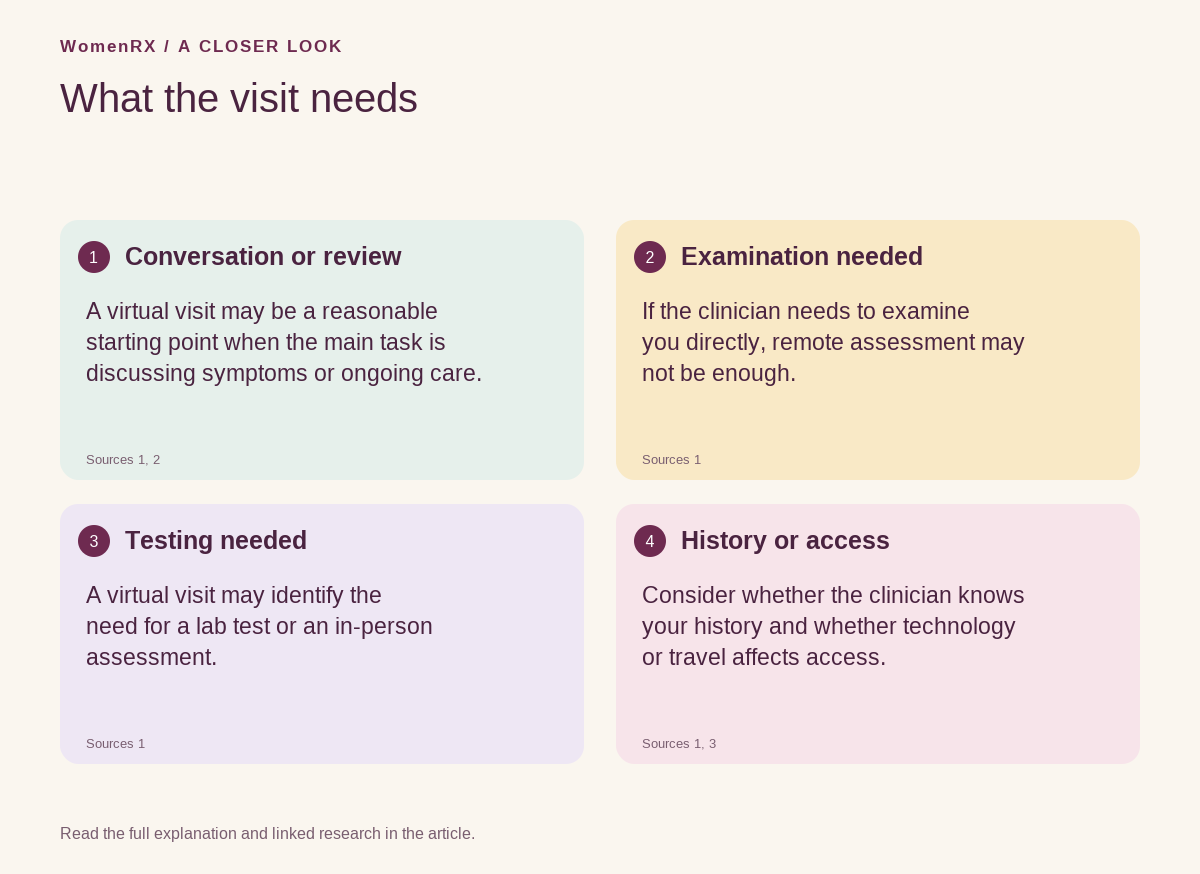
What the visit needs
Conversation or review: A virtual visit may be a reasonable starting point when the main task is discussing symptoms or ongoing care.12
Examination needed: If the clinician needs to examine you directly, remote assessment may not be enough.1
Testing needed: A virtual visit may identify the need for a lab test or an in-person assessment.1
History or access: Consider whether the clinician knows your history and whether technology or travel affects access.13
Read the figure as text
Compare the task of the appointment with what each format can provide; either format may lead to a change in plan.- Conversation or review: A virtual visit may be a reasonable starting point when the main task is discussing symptoms or ongoing care.12
- Examination needed: If the clinician needs to examine you directly, remote assessment may not be enough.1
- Testing needed: A virtual visit may identify the need for a lab test or an in-person assessment.1
- History or access: Consider whether the clinician knows your history and whether technology or travel affects access.13
More questions, answered
Can a virtual appointment lead to an in-person visit?
Yes. A clinician may recommend an in-person examination or lab testing if they can’t make the needed assessment remotely. 1
Does telehealth work for follow-up care?
It can be useful in some established care settings. For example, an observational study in people with diabetes found comparable glycemic and lipid outcomes for hybrid care and in-person care over 12 months. That result shouldn’t be assumed to apply to every condition or visit. 2
Sources you can check
- Telehealth: MedlinePlusAccessed 2026-09-25Return to first citation
- Hybrid vs in-person diabetes care: Outcomes and barriers to telemedicine utilization in a post-pandemic setting.Kongmalai T, Yodmalai C, Luerithiphong S, Sitasuwan T, Thongtang N. · Primary care diabetes · 2026Return to first citation
- It's Virtually Here: Telemedicine, Virtual Care, and Neuromuscular Disease.AANEM, Kassardjian CD, Desai U, Živković SA, Simmons Z, Narayanaswami P. · Muscle & nerve · 2026Return to first citation
- Telemedicine for headache disorders in real-world practice: from patient experience to health system impact.Grasso R, Carapelle E, Raunich G, Avolio C. · Neurological sciences : official journal of the Italian Neurological Society and of the Italian Society of Clinical Neurophysiology · 2026Return to first citation