How to Choose a Telehealth Provider for Your Needs
Before booking, check whether the service fits your concern, what you may pay, and how care continues if a remote visit isn’t enough.
Compare services using the same questions: Do they handle your specific concern, who will provide care, what could it cost, and how will follow-up or in-person care work? Ask about privacy, prescriptions, insurance, and whether you can use the service from your location. Telehealth can make care easier to reach, but some concerns need an exam or lab test. 1
A convenient booking page doesn’t tell you whether a service is right for your concern or what happens after the appointment. Before you book, ask each service the same questions and compare its answers, not just its specialty labels or advertised price.
Telehealth can make it easier to reach a provider, including when travel is difficult. But a remote visit may not be enough: a provider might need to examine you in person or arrange a lab test, and a clinician who doesn’t know your history may not have all the context they need. 1
Start with the care you need
Name the specific question you want answered. Then ask whether the service handles it and what can be done remotely. For example, if you’re looking for contraception, care for menopause symptoms, pregnancy-related care, or postpartum support, ask about that need directly. Don’t assume a service offers all of these just because it advertises women’s health.
Ask what might lead to an in-person visit, test, or referral. A clear answer helps you understand the limits of the appointment before you pay or share personal details. If you’re looking for ongoing care, ask whether the service can provide follow-up or whether you’ll need another provider.
Find out who is responsible for your care
Ask who you’ll see, what their role and credentials are, and whether you can find out who is providing care before the appointment. If the service involves a team, find out who is responsible for your care and who can answer questions afterward.
Continuity is worth asking about, especially if you already have a regular provider. A virtual visit with someone who isn’t your regular provider may not include your full medical history, and coordinating with your usual provider afterward may be left to you. 1 Ask whether the service will share a visit summary or information with another provider, and what you need to do to make that happen.
Get cost details before you book
Ask what you’ll owe for the visit and whether tests, follow-up, or prescriptions could involve separate charges. If you plan to use insurance, check with both the service and your insurer about coverage and your expected costs. Don’t rely on an advertised visit price to tell you the total.
If the service may prescribe or renew medication, ask whether that’s within its scope for your concern and whether there are additional costs. The goal isn’t to assume a prescription will be offered; it’s to know what the service can address and what you might pay before you book.
Ask how privacy works in practice
Find out how to contact the service privately and how appointment reminders, messages, and billing communications are handled. If you share a phone, email account, or insurance plan with someone else, ask what information might be visible to them.
Privacy can be one reason someone chooses remote care, but preferences vary. In a study of telemedicine abortion requests in Germany during the COVID-19 pandemic, respondents commonly cited privacy and secrecy. Those results describe a specific service and setting, not all women or all telehealth visits. 3
Check access and the plan for in-person care
Ask whether the service can see patients in your location, what technology you’ll need, and what happens if the video or phone connection fails. Access can depend on practical factors as well as distance. A Society for Maternal-Fetal Medicine statement identifies insurance coverage, internet access, digital literacy, and licensure policy as considerations for equitable telemedicine access in maternal-fetal medicine. These are policy considerations in that area of care, not a guarantee of coverage or availability for a particular service. 2
Then ask what happens if remote care isn’t enough. Will the service help identify an in-person option, send information to another provider with your permission, or leave you to arrange the next step? Some visits require an in-person examination or lab test, so ask how the service handles that possibility for your concern. 1
Compare the answers, not the promises
Make a short note for each service: what it can address, who provides care, likely costs, privacy practices, follow-up, location and technology requirements, and in-person next steps. If an answer is unclear, ask before booking. A service that explains both what it offers and where its limits are gives you a more useful basis for deciding than a broad specialty label alone.
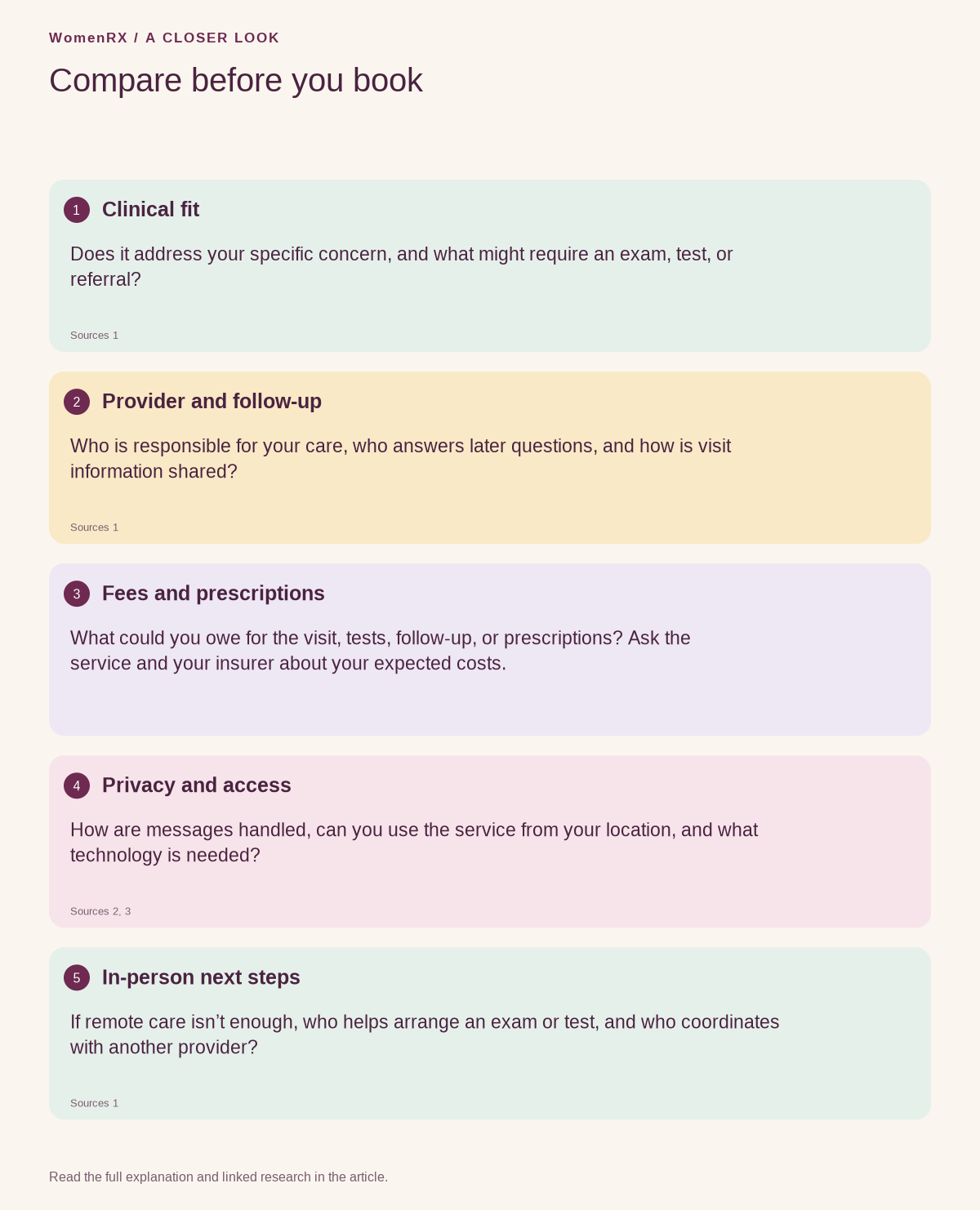
Compare before you book
Clinical fit: Does it address your specific concern, and what might require an exam, test, or referral?1
Provider and follow-up: Who is responsible for your care, who answers later questions, and how is visit information shared?1
Fees and prescriptions: What could you owe for the visit, tests, follow-up, or prescriptions? Ask the service and your insurer about your expected costs.
Privacy and access: How are messages handled, can you use the service from your location, and what technology is needed?23
In-person next steps: If remote care isn’t enough, who helps arrange an exam or test, and who coordinates with another provider?1
Read the figure as text
Ask each service the same questions to compare its scope, practical requirements, and plan for care beyond a remote visit.- Clinical fit: Does it address your specific concern, and what might require an exam, test, or referral?1
- Provider and follow-up: Who is responsible for your care, who answers later questions, and how is visit information shared?1
- Fees and prescriptions: What could you owe for the visit, tests, follow-up, or prescriptions? Ask the service and your insurer about your expected costs.
- Privacy and access: How are messages handled, can you use the service from your location, and what technology is needed?23
- In-person next steps: If remote care isn’t enough, who helps arrange an exam or test, and who coordinates with another provider?1
More questions, answered
Can telehealth replace an in-person visit?
Not always. Some concerns need an examination or lab test, so ask what would require in-person care and how the service handles that next step. 1
What should I ask about follow-up?
Ask who answers questions after the appointment, whether you’ll receive a visit summary, and whether the service can coordinate with your regular provider or expects you to do that yourself. 1
Sources you can check
- Telehealth: MedlinePlusAccessed 2026-09-25Return to first citation
- Society for Maternal-Fetal Medicine Special Statement: Utilizing telemedicine to address disparities in maternal-fetal medicine: a call to policy action.Society for Maternal-Fetal Medicine (SMFM), Kern-Goldberger AR, Malhotra T, Zera CA, SMFM Health Policy and Advocacy Committee. Electronic address: smfm@smfm.org. · American journal of obstetrics and gynecology · 2024Return to first citation
- "In some clinics, they said it's elective, and then they would refuse": A Mixed-Methods Study on the impact of the COVID-19 pandemic on access to abortion services in Germany.Rød H, Gomperts R, Atay H, Tersbøl BP. · Sexual & reproductive healthcare : official journal of the Swedish Association of Midwives · 2023Return to first citation