Where Your Telehealth Information Can Go
A virtual visit can involve more than a video call, so ask how the specific service handles each step before sharing sensitive details.
A reproductive or sexual health visit may involve sensitive information shared through intake forms, conversations, and messages. 2 What happens to that information depends on the specific provider and service. Before booking, ask what they collect, who can access it, whether appointments are recorded, and what might appear in billing or account records. These are questions to verify, not details to assume.
A private conversation at home can feel more discreet than an in-person visit. But privacy has two sides: who might overhear you, and what happens to the information you share through the service. Reproductive and sexual health visits may involve details about your health history, sexual history, family planning, or mental health. That information may be entered in a form, discussed during the visit, or sent in a message. 2
There isn’t one telehealth setup that applies everywhere. A visit might happen by phone or video, and the services and tools involved can differ. 12 Rather than relying on assumptions, ask how the specific service handles the information you’ll share.
Start with what you’ll enter
Before completing an intake form, look at what it asks and whether each field is required. You can ask why a sensitive detail is needed, who will see it, and whether you can discuss it with the clinician instead. That doesn’t mean leaving out information your clinician needs. It means understanding what’s being collected and sharing accurate information while raising any privacy concerns.
A US survey of 847 women who had not used telemedicine for reproductive health found that perceived privacy risks were associated with less willingness to disclose accurate personal health information. This was a survey about perceptions and intentions, not an assessment of how particular services handle data. 2 If privacy concerns make it harder to answer a question, ask how the information is used and whether there’s a way to discuss your concern directly.
Ask what happens during and after the appointment
Ask whether the visit is by video, phone, or another format. Then ask whether the service records or transcribes appointments. Don’t assume either way. You can also ask where visit notes are kept, who can view them, and who can access messages or uploaded files. If a separate company provides the video, messaging, or record system, ask where to find information about its role and privacy practices.
Ask how follow-up works, too. Will the service contact you through a portal, text, email, or phone call? Can you choose a method that feels safer? MedlinePlus notes that telehealth may include phone, email, or text reminders, but that doesn’t establish what any particular service will send or how it will appear on your devices. 1 Ask the provider what to expect before sharing contact details or using a shared account.
Billing is a separate question. Ask who bills for the visit and what, if anything, might appear in insurance or account records. The answer depends on the arrangement, so verify it with the provider or billing contact rather than assuming every service handles it the same way.
Think about the room and device you’ll use
A remote appointment can feel comfortable for some people, but your surroundings matter. In interviews about sexual and reproductive health care during early COVID-19 service changes, some participants described reduced privacy in remote or socially distanced care, while others appreciated aspects of remote appointments. The study included 20 people in Britain, so it doesn’t tell us how common these experiences are in current US care. 3
If you share a home or device, consider whether someone could overhear the appointment, see an open portal, or read a message preview. You might ask the service to use a contact method that works for your situation, sign out after using a shared device, or arrange a time and place where you can speak privately. If that isn’t possible, ask whether a phone visit, a different time, or an in-person option is available. Some telehealth visits may also require an in-person examination or lab test. 1
A practical privacy check before booking
You can ask these questions by phone or through the service’s contact form:
- What information do you collect before, during, and after the visit?
- Why do you need each sensitive detail, and who can see it?
- Do you record or transcribe appointments? If so, where can I learn how that information is handled?
- Who can access visit notes, messages, or files I upload?
- Which contact methods will you use, and can I choose one that works on a shared device?
- Who bills for the visit, and what could appear in insurance or account records?
- Where can I read the privacy information for the provider and any technology used for the appointment?
If you don’t get a clear answer, ask who can explain the service’s practices before you share sensitive details. You can also ask whether another way to receive care is available. The goal isn’t to avoid every digital service. It’s to understand the tradeoffs well enough to choose a setting and communication method that work for you.
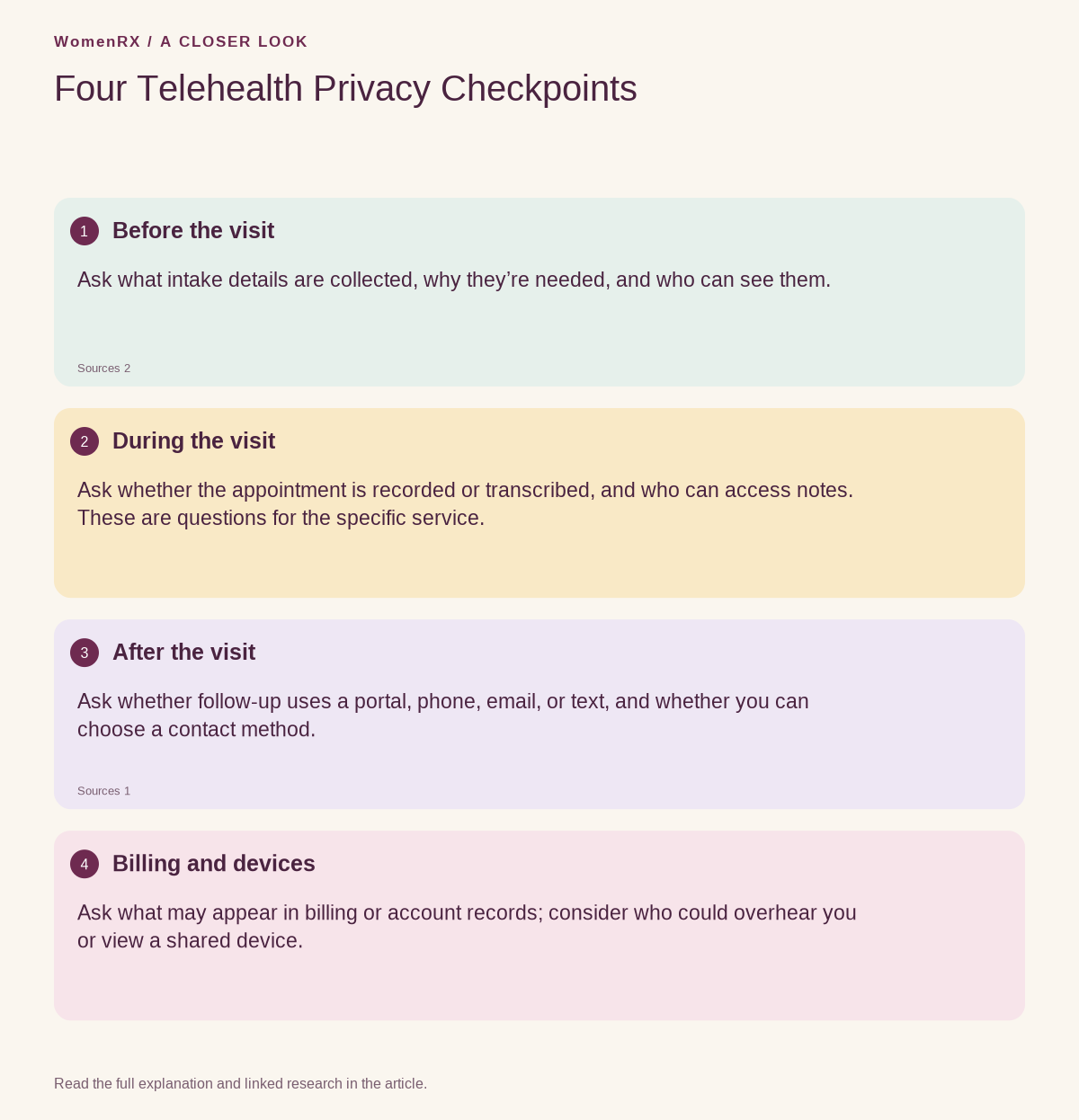
Four Telehealth Privacy Checkpoints
Before the visit: Ask what intake details are collected, why they’re needed, and who can see them.2
During the visit: Ask whether the appointment is recorded or transcribed, and who can access notes. These are questions for the specific service.
After the visit: Ask whether follow-up uses a portal, phone, email, or text, and whether you can choose a contact method.1
Billing and devices: Ask what may appear in billing or account records; consider who could overhear you or view a shared device.
Read the figure as text
Information and contact can come up at several stages of a virtual visit. Use these checkpoints to ask what applies to the specific service.- Before the visit: Ask what intake details are collected, why they’re needed, and who can see them.2
- During the visit: Ask whether the appointment is recorded or transcribed, and who can access notes. These are questions for the specific service.
- After the visit: Ask whether follow-up uses a portal, phone, email, or text, and whether you can choose a contact method.1
- Billing and devices: Ask what may appear in billing or account records; consider who could overhear you or view a shared device.
More questions, answered
Does a video visit mean my appointment is recorded?
Not necessarily. Ask the provider or platform directly whether it records or transcribes appointments, and how to find out what happens to any recording or transcript.
Is a telehealth visit always more private than going in person?
Not for everyone. A remote visit may feel comfortable, but someone nearby could overhear it; in-person care can raise privacy concerns, too. Consider which setting gives you the best chance to speak openly. 3
Sources you can check
- Telehealth: MedlinePlusAccessed 2026-09-25Return to first citation
- Does telemedicine hold the key for reproductive health care? A quantitative examination of women's intentions toward use and accurate information disclosure.Fox G, Lynn T, van der Werff L, Kennedy J. · Health services research · 2025Return to first citation
- Access to and quality of sexual and reproductive health services in Britain during the early stages of the COVID-19 pandemic: a qualitative interview study of patient experiences.Bosó Pérez R, Reid D, Maxwell KJ, Gibbs J, Dema E, Bonell C, Mercer CH, Sonnenberg P, Field N, Mitchell KR. · BMJ sexual & reproductive health · 2023Return to first citation