After Telehealth, Where Is Your Prescription?
A prescription can be decided on, sent, and still not be ready to pick up.
After a telehealth clinician decides to prescribe, the prescription may be sent electronically to the pharmacy, but sending it isn’t the same as the pharmacy receiving and processing it. If it hasn’t appeared, ask the pharmacy whether it received the prescription and what, if anything, is holding it up. Then contact the prescriber’s office if the pharmacy needs a correction or can’t find it. 1 3
Four steps, not one
It’s easy to hear “I sent it” and expect the medicine to be ready. But a prescribing decision, an electronic transmission, pharmacy processing, and actually receiving the medicine are separate things.
- The clinician decides whether to prescribe. A telehealth visit can lead to a prescription, but the clinician may need more information, an in-person exam, or a lab test before deciding what’s appropriate. 1
- The prescription is sent. Electronic prescribing allows a clinician to send a prescription digitally to a pharmacy. 3
- The pharmacy checks and processes it. The prescription may need attention before the pharmacy can dispense it. For example, pharmacy-reported issues in a study from Navarra included medicine shortages and prescriptions that needed renewal or updating. That study describes a specific regional system, not a standard process for every pharmacy. 2
- You receive the medicine. A prescribing decision doesn’t guarantee that the medicine has been dispensed or received. In one study of adults receiving primary care for depression, people prescribed an antidepressant during a telephone visit were less likely to receive it than people prescribed one during an in-person visit. That result concerns one treatment and setting, but it shows why “prescribed” and “received” aren’t interchangeable. 4
If it hasn’t shown up, find the point where it stalled
Start with the pharmacy you selected. Ask whether it has received a prescription under your name and confirm that you’re checking with the right location. If it has the prescription, ask what status it’s in and whether anything is needed before it can be dispensed.
Depending on the situation, you can ask whether the pharmacy needs a correction or more information from the prescriber, whether there’s a coverage question to resolve with your health plan, or whether the medicine is unavailable at that location. These are ways to clarify the next step, not promises that every pharmacy or plan handles the issue the same way.
If the pharmacy can’t find it, contact the telehealth service or prescriber’s office. Ask whether the prescription was sent, where it was sent, and whether it needs to be sent again. If the pharmacy identified a specific problem, pass along that detail. Pharmacy-prescriber communication can help resolve medication-related incidents, though the process described in a study from Navarra may not match systems where you live. 2
A clear message can save a round of back-and-forth: “The pharmacy at [location] says it hasn’t received my prescription for [medicine]. Can you confirm where it was sent and whether it needs to be sent again?” If the pharmacy did receive it, tell the prescriber’s office exactly what the pharmacy says it needs.
Share context that could affect the decision
If the medicine relates to pregnancy, breastfeeding, or reproductive care, tell the clinician that context and share relevant health information before the prescribing decision. Telehealth clinicians may not have your full medical history, and some situations require an exam or lab test before they can make a diagnosis or treatment decision. 1
Use the status to choose your next contact
“Prescribed,” “sent,” “received,” and “ready” each describe a different point in the process. If you don’t know which one applies, ask the pharmacy what it can see and what needs to happen next. If the prescription never arrived, follow up with the prescriber; if it arrived but is being held up, ask the pharmacy what information or action is needed.
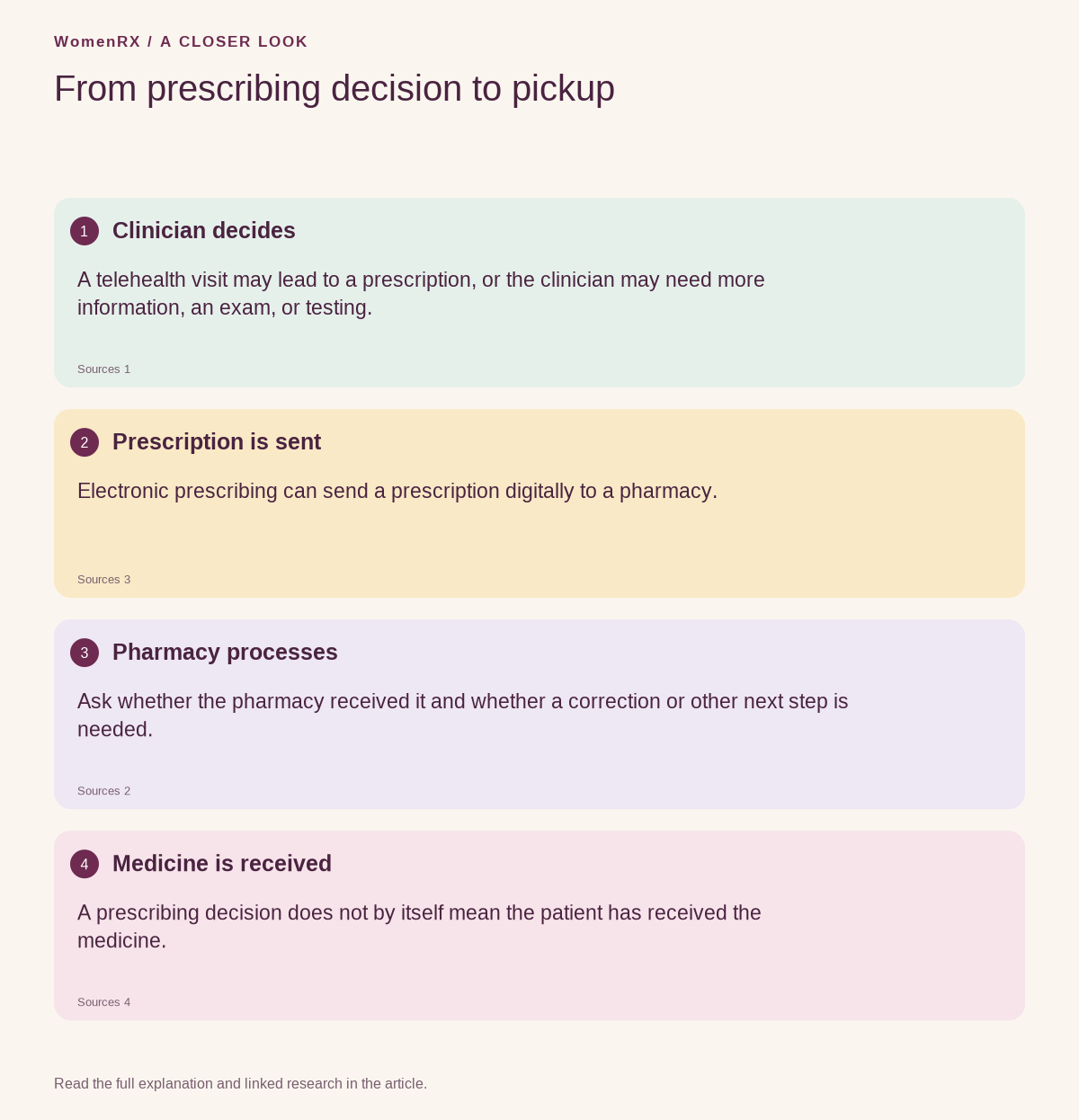
From prescribing decision to pickup
Clinician decides: A telehealth visit may lead to a prescription, or the clinician may need more information, an exam, or testing.1
Prescription is sent: Electronic prescribing can send a prescription digitally to a pharmacy.3
Pharmacy processes: Ask whether the pharmacy received it and whether a correction or other next step is needed.2
Medicine is received: A prescribing decision does not by itself mean the patient has received the medicine.4
Read the figure as text
Each stage has a different status. If the process stalls, find out which stage has the prescription and what action is needed next.- Clinician decides: A telehealth visit may lead to a prescription, or the clinician may need more information, an exam, or testing.1
- Prescription is sent: Electronic prescribing can send a prescription digitally to a pharmacy.3
- Pharmacy processes: Ask whether the pharmacy received it and whether a correction or other next step is needed.2
- Medicine is received: A prescribing decision does not by itself mean the patient has received the medicine.4
More questions, answered
Does a telehealth visit guarantee a prescription?
No. A clinician may need more information, an in-person exam, or a lab test before deciding whether to prescribe. 1
Who should I contact first if the pharmacy says nothing came through?
Ask the pharmacy to confirm whether it checked the right location and can find a prescription under your name. If it can’t, contact the telehealth service or prescriber’s office and ask where the prescription was sent and whether it needs to be sent again.
Sources you can check
- Telehealth: MedlinePlusAccessed 2026-09-25Return to first citation
- Improving patient care: communication channel between health centres and community pharmacies through the electronic prescribing application.Rodríguez Esquíroz A, García González P, Viamonte Ezcurdia A, Marín Marín M, Echeverría Gorriti A, Otamendi Murillo A, Galipienzo Jimenez M. · Farmaceuticos comunitarios · 2026Return to first citation
- Comprehensive usability evaluation of electronic prescription systems: integrating expert and user perspectives.Arabian S, Hajesmaeel-Gohari S, Zarei AH, Alizadeh Savareh B, Bashiri A. · BMC medical informatics and decision making · 2025Return to first citation
- Comparing In-Person, Telephonic, and Video-Based Treatment of Depression in Adult Primary Care During the COVID-19 Pandemic.Metrikin B, Hill RL, Liu J, Adams J, Duggan MC, Perlman S, Coleman KJ. · The Permanente journal · 2025Return to first citation